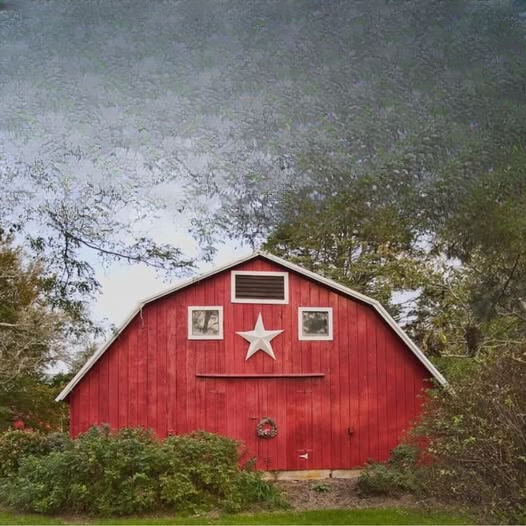
If you’ve ever taken a slow drive through the countryside—especially in parts of the northeastern or midwestern United States—you’ve probably seen them.
Mounted high on weathered barns.
Centered above farmhouse doors.
Displayed proudly on garages, sheds, or even garden walls.
Large five-pointed stars, often painted in deep reds, blues, greens, or muted earth tones, quietly watching over the landscape.
At first glance, they may look like simple rustic decorations. Just another charming detail of rural life. But those “barn stars,” as they’re commonly called, carry a much deeper story—one woven from craftsmanship, heritage, symbolism, and generations of tradition.
They are more than ornaments.
They are cultural markers.
They are storytellers in metal and paint.
Let’s take a long, thoughtful look at where barn stars came from, what they have meant historically, how their symbolism evolved, and why they continue to hold quiet significance today.
What Exactly Is a Barn Star?
A barn star is typically a large, flat, five-pointed star mounted on the exterior of a barn, farmhouse, or outbuilding. Most are made from metal, though historically some were crafted from wood. They are often painted in bold, solid colors and positioned prominently for visibility.
They are especially common in regions influenced by early German-American settlers, particularly in areas such as:
-
Pennsylvania
-
Ohio
-
Indiana
-
Maryland
-
Parts of the Midwest
While they are now widely used as decorative accents, their roots stretch back to earlier cultural traditions brought to North America by European immigrants.
Origins: The Influence of the Pennsylvania Dutch
The tradition of barn stars is often linked to the culture of the Pennsylvania Dutch—a name that can be misleading. The term “Dutch” in this case derives from “Deutsch,” meaning German. The Pennsylvania Dutch were German-speaking immigrants who began settling in Pennsylvania during the 17th and 18th centuries.
These communities brought with them artistic traditions, symbolic motifs, and decorative practices rooted in European folk culture.
Among these traditions were geometric symbols painted on buildings, furniture, and household objects. These symbols often carried layered meanings related to:
-
Protection
-
Good fortune
-
Harmony
-
Fertility
-
Faith
-
Community identity
Over time, some of these decorative symbols evolved into what we now recognize as barn stars.
Protective Symbolism in Early Use
In early rural communities, life revolved around the farm. A family’s survival depended on:
-
Livestock health
-
Crop success
-
Stable structures
-
Safe storage of food
It is not surprising that symbols of protection found their way onto barns, which were central to daily life.
Many settlers believed that placing meaningful symbols on their barns and homes could serve as a kind of visual blessing—inviting prosperity and discouraging misfortune.
The five-pointed star became one such symbol.
While interpretations varied, stars have long been associated across cultures with:
-
Guidance
-
Light in darkness
-
Divine oversight
-
Order and balance
Mounting a star on a barn may have symbolized hope for steady seasons, strong harvests, and protection over animals and land.
It is important to note that historical evidence suggests many of these beliefs were rooted in cultural symbolism rather than formal religious doctrine. The stars represented heritage and tradition more than any organized spiritual practice.
The Relationship Between Barn Stars and Hex Signs
Barn stars are often confused with hex signs. Though related in cultural origin, they are not identical.
Hex signs are more elaborate, circular folk art designs commonly associated with Pennsylvania Dutch decorative painting. These signs typically include intricate geometric patterns, stylized flowers, birds, or hearts arranged symmetrically around a central motif.
While hex signs sometimes feature stars as part of their design, they are generally more detailed and colorful than the simple five-pointed metal barn star.
Both barn stars and hex signs share common roots in German-American folk art traditions, but barn stars are typically simpler in shape and more architectural in placement.
The Meaning Behind the Colors
One of the most fascinating aspects of barn stars is the color symbolism historically associated with them. While interpretations vary by region and era, traditional color meanings have been passed down through generations.
Red: Strength and Good Fortune
Red is perhaps the most commonly seen color for barn stars.
Historically, red has symbolized:
-
Energy
-
Vitality
-
Protection
-
Prosperity
Red barns were common in rural America because red paint was once affordable and durable. A red star mounted on a red barn created visual contrast while symbolizing resilience and strength.
Blue: Calm and Peace
Blue barn stars are often associated with:
-
Tranquility
-
Stability
-
Emotional balance
-
Trust
Blue evokes sky and water—two essential elements in rural life. A blue star may have symbolized hope for steady weather and peaceful living.
Green: Growth and Fertility
Green connects directly to agriculture.
It traditionally represents:
-
Fertility
-
Abundance
-
Renewal
-
Healthy crops
A green star on a barn may have symbolized optimism for a successful growing season.
Black: Protection and Stability
Black is sometimes interpreted as a grounding color.
In folk traditions, black can symbolize:
-
Strength
-
Protection
-
Stability
-
Endurance
A black star could have represented steadfastness and resilience through hardship.
White: Purity and Spiritual Reflection
White is often associated with:
-
Cleanliness
-
Honesty
-
Faith
-
Simplicity
In rural communities, white could symbolize clarity of purpose and moral grounding.
It’s important to understand that these color meanings were not universally standardized. Interpretations differed among communities and families. Still, color symbolism added personal depth to what might otherwise seem like simple decoration.
Barn Stars as Family Identity Markers
Over time, barn stars evolved beyond symbolic protection.
They began to serve as markers of identity.
In tight-knit rural communities, barns were more than buildings. They were hubs of work, gathering, and family legacy. A distinctive barn star could:
-
Reflect a family’s craftsmanship
-
Indicate pride in property
-
Showcase artistic skill
-
Represent generational continuity
Some families developed recognizable styles or preferred color schemes. Displaying a star became a subtle declaration of presence and belonging.
It was a quiet way of saying: “This is our home. This land is part of our story.”
Craftsmanship and Construction
Originally, barn stars were often handmade.
Materials included:
-
Wood
-
Forged iron
-
Sheet metal
Early stars were sometimes cut and shaped by local blacksmiths or skilled farmers. The craftsmanship itself became part of the tradition.
Later, mass production made metal barn stars widely available. Yet even modern manufactured stars retain the same fundamental five-pointed shape—a testament to the enduring appeal of the design.
From Rural Symbol to Popular Decor
In recent decades, barn stars have moved beyond their agricultural origins.
They are now commonly seen on:
-
Suburban homes
-
Garden fences
-
Porches
-
Interior walls
-
Retail storefronts
The shift reflects a broader appreciation for rustic and farmhouse-inspired decor.
What once symbolized protection and prosperity on working farms now often represents:
-
Nostalgia
-
Simplicity
-
Connection to heritage
-
Appreciation for traditional craftsmanship
Even people with no farming background are drawn to the timeless aesthetic.
The Barn Star in Modern Culture
Today, barn stars are largely decorative. Most homeowners who hang one are not consciously invoking historical symbolism.
Yet something about the star continues to resonate.
It suggests:
-
Stability
-
Tradition
-
A slower pace of life
-
Respect for the past
In a fast-moving digital world, symbols that evoke endurance and craftsmanship feel grounding.
The barn star stands as a visual reminder of a time when communities were smaller, work was physical, and identity was closely tied to land and family.
A Symbol of Continuity
What makes barn stars remarkable is not just their history—but their persistence.
Few decorative symbols have survived so long with such consistency of form.
Despite changes in architecture, farming practices, and cultural norms, the five-pointed barn star remains recognizable and widely appreciated.
It has transitioned from:
-
Protective folk symbol
-
Cultural identifier
-
Artistic tradition
-
Decorative accent
Yet through every stage, it has maintained its core identity.
Why They Still Matter
Even if modern barn stars are primarily aesthetic, they carry echoes of their past.
They remind us of:
-
The importance of community
-
The pride of craftsmanship
-
The value of heritage
-
The endurance of simple design
When you pass a barn with a star mounted high against its weathered boards, you are seeing more than decor. You are seeing a piece of living history—quietly bridging centuries.
Reflecting on the Meaning
The next time you notice a barn star:
Pause for a moment.
Think about the generations who painted and mounted similar symbols with hope in their hearts. Think about the farmers who depended on good seasons. Think about the families who saw their barn not just as storage, but as livelihood.
The star may no longer serve as a protective emblem in a literal sense.
But symbolically, it still represents:
-
Resilience
-
Belonging
-
Continuity
-
Pride
It stands as a reminder that even simple shapes can carry layered meaning.
Final Thoughts
Barn stars are more than rustic ornaments.
They are artifacts of immigration history, folk art traditions, agricultural life, and community identity. They reflect how symbols evolve—how something once rooted in cultural belief can transform into decorative art while still preserving echoes of its origin.
From early German-American settlers to modern homeowners seeking farmhouse charm, the barn star continues its quiet journey across time.
So when you see one—faded by sun or freshly painted—remember that it carries stories older than it looks.
A five-pointed shape.
A splash of color.
A legacy mounted on wood and metal.
Simple at first glance.
Meaningful upon reflection.