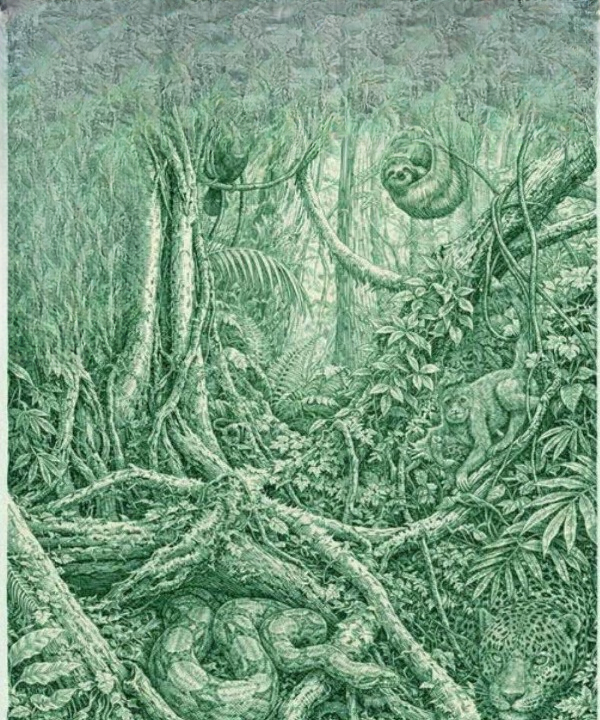
At first glance, the image appears to be nothing more than a dense jungle illustration. It is filled with overlapping layers of green foliage, twisting branches, vines, and textured shadows that create the impression of a complex natural environment.
However, upon closer inspection, viewers are told that several animals are hidden within the scene. This transforms the illustration from a simple drawing into a visual puzzle designed to test perception and attention to detail.
The accompanying headline often claims:
“The number of animals you see determines whether you are a narcissist.”
You are typically asked to choose from options such as:
- A: 3 animals
- B: 4 animals
- C: 5 animals
At first, this may sound like a psychological test. But in reality, it is not.
What Animals Are Hidden in the Illustration?
Most versions of this viral jungle illusion include a set of cleverly camouflaged animals. When carefully examined, the following creatures are commonly identified:
- A toucan perched on a branch
- A sloth hanging from a tree limb
- A snake blending into vines or roots
- A monkey hidden within the leaves
- A large cat such as a jaguar or leopard resting in the shadows
Depending on how closely someone studies the image, they may notice only a few animals at first glance, while others may gradually identify more after prolonged observation.
This difference in perception is completely normal and reflects how human visual processing works. Our brains prioritize patterns, contrast, and familiarity, which means we may initially miss details that are partially hidden or blended into complex backgrounds.
However, one important clarification must be made:
The number of animals a person identifies does not reveal anything scientifically valid about narcissism or personality traits.
Why This Type of Illusion Feels “Psychological”
This type of content often feels like a personality test because it combines visual perception with emotionally loaded labels such as “narcissism,” “intelligence,” or “personality type.”
There are a few reasons why these illusions become so popular:
1. Human Curiosity About Self-Identity
People naturally enjoy learning something about themselves. Even vague suggestions of personality insight can feel engaging, even if they are not scientifically grounded.
2. The Appeal of Quick Judgments
A simple image that claims to “reveal something about you instantly” is far more appealing than complex psychological explanations that require time and context.
3. Social Media Virality
These illusions are highly shareable. People often compare answers with friends, which increases engagement and spreads the content rapidly.
What Psychology Actually Says About Narcissism
Unlike what viral illusions suggest, narcissism is a well-studied psychological concept with a specific clinical meaning.
In psychology, narcissism refers to a personality trait characterized by patterns related to:
- Self-focus or self-importance
- Desire for admiration
- Sensitivity to criticism
- Interpersonal behavior patterns
However, it is important to understand that narcissism exists on a spectrum.
Low to Moderate Narcissistic Traits
Many people display mild narcissistic traits in healthy ways, such as:
- Confidence in abilities
- Pride in achievements
- Desire for recognition
These traits are not harmful and are often beneficial in everyday life.
Higher Levels of Narcissistic Traits
At more intense levels, narcissistic behavior may include:
- Excessive self-focus
- Difficulty recognizing others’ needs
- Strong need for validation
- Overestimation of personal importance
Narcissistic Personality Disorder (NPD)
At the clinical level, Narcissistic Personality Disorder is a diagnosable mental health condition. It involves persistent patterns that significantly affect relationships and functioning.
Diagnosis of NPD requires a professional evaluation and cannot be determined through casual observation, online quizzes, or visual puzzles.
Why the Illusion Is Not a Psychological Test
Despite the bold headline, there is no scientific relationship between:
- The number of animals a person sees
- Their personality traits
- Or whether they have narcissistic tendencies
This type of illusion is based on visual perception, not psychological assessment.
What you see first depends on factors such as:
- Eye movement patterns
- Attention focus
- Visual scanning speed
- Familiarity with shapes and animals
- Contrast sensitivity
- Lighting and screen quality
These are perceptual and cognitive processes—not indicators of personality disorders.
How Human Perception Really Works in Optical Illusions
Optical illusions like this one are designed to exploit the way the brain interprets complex images.
The brain does not process every detail equally. Instead, it:
- Focuses on dominant shapes first
- Ignores background noise
- Fills in missing information
- Prioritizes familiar objects
In a dense jungle scene, this means that:
- Large or high-contrast animals are seen first
- Camouflaged animals may take longer to notice
- Some viewers may never see all elements without guidance
This variation is normal and does not reflect intelligence or personality.
Why Different People See Different Things
Two people looking at the same image may report different numbers of animals because:
1. Attention Differences
Some people focus on the entire image, while others scan specific areas.
2. Experience and Familiarity
People familiar with wildlife or visual puzzles may identify hidden shapes faster.
3. Visual Strategy
Some viewers look for outlines, while others search for familiar textures or patterns.
4. Time Spent Observing
The longer someone looks at the image, the more details they tend to notice.
These differences are cognitive, not psychological diagnoses.
The Problem With “Personality Test” Headlines
Headlines that link visual puzzles to personality traits often oversimplify psychology. While they are entertaining, they can create misconceptions such as:
- Believing personality can be measured instantly
- Assuming traits like narcissism can be self-diagnosed through images
- Confusing entertainment with scientific assessment
In reality, personality psychology is based on:
- Structured questionnaires
- Long-term behavioral patterns
- Clinical interviews (in professional settings)
- Empirical research and validation
A jungle illustration cannot replicate any of these methods.
Why People Still Enjoy These Illusions
Even without scientific validity, these puzzles remain popular because they are:
- Fun and interactive
- Easy to share on social media
- Visually engaging
- Open to interpretation
- Light entertainment rather than serious evaluation
They encourage observation and discussion, which is why they spread widely online.
Final Thoughts
The jungle animal illusion is a fascinating example of how visual perception can vary between individuals. It demonstrates how the human brain interprets complex environments and how attention can shape what we notice first.
However, the claim that the number of animals someone sees determines whether they are a narcissist has no scientific basis. It is a catchy headline designed for engagement rather than psychological accuracy.
In reality, what the illusion truly measures is not personality, but perception.
And perception is influenced by attention, experience, and visual processing—not character judgments or mental health conditions.
So while it can be entertaining to compare answers with others, it should not be taken as a reflection of who someone is or how they think at a deeper psychological level.