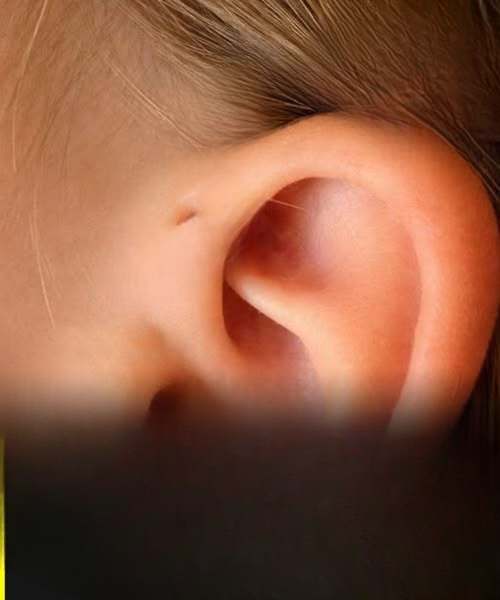
At first glance, a small dimple, hole, or indentation near the outer ear might seem like the result of an injury, piercing, or minor skin condition. Many people notice it only by chance—either on themselves or on someone else—and assume it has no particular significance.
However, this small feature is actually a naturally occurring anatomical variation known as a preauricular sinus. Far from being a scar or damage, it is a congenital trait present from birth. While uncommon, it is medically harmless in most cases and represents an interesting example of human developmental diversity.
Understanding what it is, how it forms, and why it exists reveals a fascinating connection between modern human biology and our evolutionary past.
What Is a Preauricular Sinus?
A preauricular sinus is a small opening or pit located near the front of the ear, typically where the ear meets the side of the head.
It forms during early fetal development, when the structures of the face and ears are being shaped. In some individuals, a tiny channel remains where tissue fusion did not completely close, resulting in a small visible indentation or opening.
This feature may appear:
- As a tiny hole or pit
- As a shallow dimple
- On one ear or both ears
- With or without a visible tract beneath the skin
Most people who have it are born with it and may not notice it unless it becomes visible during close inspection or medical examination.
Is It a Disease or a Medical Condition?
In the vast majority of cases, a preauricular sinus is completely harmless and does not affect hearing, health, or development.
It is not:
- An infection
- A deformity
- A result of injury
- A sign of illness
Instead, it is classified as a benign congenital variation—meaning it is present at birth and does not usually require any treatment.
However, in rare cases, the sinus opening can become infected if bacteria enter the small channel. This may lead to swelling, tenderness, or discharge, but such complications are uncommon and treatable.
How It Forms During Development
To understand this trait, it helps to look at early human embryonic development.
During fetal growth, the outer ear forms from several small tissue structures called “auricular hillocks.” These hillocks gradually merge and shape the final structure of the ear.
A preauricular sinus occurs when this fusion process is incomplete. As a result, a small tract remains beneath the skin near the ear.
This developmental process is random and not linked to any known health issue. It simply reflects natural variation in how human tissue develops before birth.
Evolutionary Theories and Human Origins
Some researchers have explored whether the preauricular sinus could be linked to human evolution.
In his book Your Inner Fish, evolutionary biologist Neil Shubin discusses how many human anatomical features can be traced back to ancient vertebrate ancestors. Humans share distant evolutionary relationships with fish, and many modern structures in the human body have deep biological origins.
The idea has been suggested that the preauricular sinus may represent a “vestigial” remnant of ancient structures found in early vertebrates, possibly related to gill development. However, this remains a theoretical interpretation rather than a confirmed scientific fact.
Most modern medical literature treats the preauricular sinus as a developmental variation rather than a direct evolutionary leftover.
Still, it highlights an important concept: human anatomy carries traces of a long and complex evolutionary history, even in subtle or seemingly insignificant features.
How Common Is It?
The preauricular sinus is relatively rare in global populations, but its frequency varies significantly depending on geographic and genetic factors.
Studies suggest:
- It is more common in parts of East Asia and Africa
- It is less common in European populations
- It can occur on one ear or both ears
- Most people are unaware they have it unless examined
These differences suggest a genetic component to its occurrence, although the exact inheritance pattern is not fully understood.
Does It Affect Health or Hearing?
For most individuals, a preauricular sinus has no impact on:
- Hearing ability
- Ear function
- Brain development
- General health
It is purely a structural variation of the skin and underlying tissue.
In rare cases, complications can occur if bacteria enter the sinus tract. This may lead to:
- Local infection
- Swelling near the ear
- Pain or discomfort
- Occasional discharge
When this happens, treatment typically involves antibiotics, and in recurring cases, minor surgical removal may be recommended.
However, such situations are not common.
Why People Often Mistake It for Something Else
Because the opening is small and located in a less visible area, many people mistake it for:
- A healed piercing
- A scar from childhood injury
- A skin defect
- An insect bite mark
- Or a minor infection
In reality, it is simply a natural variation present from birth.
Awareness of this trait helps reduce unnecessary concern when it is discovered.
Medical Perspective: A Normal Anatomical Variation
From a medical standpoint, the preauricular sinus is classified as a congenital anomaly, but the term “anomaly” does not imply danger or dysfunction.
In medicine, congenital variations are common and include features such as:
- Slight differences in ear shape
- Extra skin folds
- Minor bone structure variations
- Small pigmentation differences
The preauricular sinus fits into this category as a harmless variation that requires attention only if complications arise.
Cultural Curiosity and Misinterpretation
Because it is not widely discussed, the preauricular sinus has sometimes been surrounded by myths or symbolic interpretations in different cultures. Some people have associated it with personality traits or spiritual meanings, but there is no scientific basis for such claims.
Modern biology explains it clearly as a developmental trait, not a symbolic or meaningful marker.
Should It Be Treated or Removed?
In most cases, no treatment is necessary.
Removal is only considered if:
- The sinus becomes repeatedly infected
- There is chronic discomfort
- There is persistent drainage or swelling
In such cases, a minor surgical procedure can remove the sinus tract entirely.
For the majority of people, however, no action is needed at all.
Final Thoughts
The small mark near the ear, known as a preauricular sinus, is a fascinating example of how diverse human anatomy can be. Although it may look unusual at first glance, it is simply a harmless congenital feature present from birth.
It does not affect health, hearing, or development, and most people who have it live their entire lives without any issues.
From a broader perspective, it also reflects the complexity of human development and the subtle variations that occur in every individual. Whether viewed through the lens of biology or evolution, it serves as a reminder that the human body is full of small, interesting details shaped by millions of years of natural history.