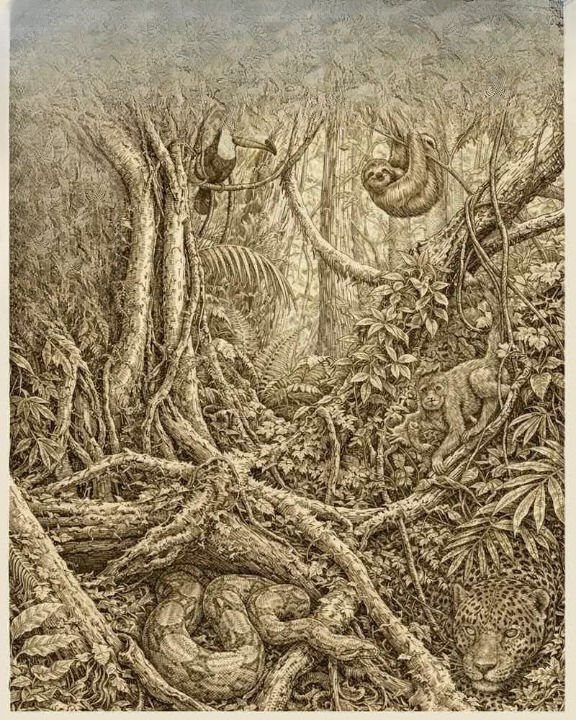
At first glance, a jungle-themed illustration filled with dense leaves, tangled vines, and layered shadows may seem like nothing more than an artistic depiction of a forest scene. The image might appear visually complex but ordinary—just another stylized drawing of nature.
However, upon closer inspection, hidden animals begin to emerge from the patterns. Carefully blended into the foliage are cleverly camouflaged figures such as a toucan perched among branches, a sloth hanging from a tree limb, a snake weaving through the undergrowth, a monkey partially hidden in the leaves, and a large feline such as a jaguar resting in the background.
What makes these images especially popular is not just the hidden artwork, but the accompanying claim often shared online: that the number of animals a person can identify reveals something about their personality—sometimes even suggesting traits like narcissism, intelligence, or emotional awareness.
This type of claim turns a simple visual puzzle into something that feels psychological or diagnostic. But how accurate is this idea really?
Why These Optical Illusions Feel So Personal
Optical illusion puzzles like this are designed to be engaging and interactive. They rely on the human brain’s natural tendency to recognize patterns while also filtering out visual clutter.
Different people may notice different things at first glance because perception is influenced by several factors, including:
- Attention span and focus
- Visual scanning strategy
- Familiarity with similar puzzles
- Time spent observing the image
- Individual differences in perception speed
As a result, one person might immediately see only two or three animals, while another might slowly uncover all five hidden figures after careful observation.
This difference in perception often creates the illusion that the image is revealing something personal about the viewer. In reality, it is simply highlighting how differently human brains process visual information.
The Psychology Behind “Personality Test” Claims
Many viral posts online attempt to connect optical illusions with personality traits. One common example involves claims that identifying a certain number of animals can indicate whether someone is narcissistic, empathetic, intelligent, or observant.
To understand why this is misleading, it is important to define what narcissism actually means in psychology.
In clinical and psychological terms, narcissism refers to a spectrum of personality traits ranging from:
- Healthy self-confidence and self-esteem at one end
- To more extreme patterns of behavior associated with Narcissistic Personality Disorder at the other
These traits involve long-term patterns of behavior, emotional regulation, empathy, and interpersonal relationships. They cannot be measured or diagnosed through a single visual puzzle or momentary observation.
Psychologists use structured assessments, interviews, and behavioral history to evaluate personality traits—not quick visual tests or internet challenges.
What Optical Illusions Actually Measure
Rather than revealing personality traits, optical illusions primarily test aspects of perception and cognition. These include:
1. Attention to detail
Some individuals naturally notice smaller or hidden elements more quickly, while others focus on broader shapes first.
2. Visual processing speed
The brain processes complex scenes at different speeds depending on familiarity and cognitive focus.
3. Pattern recognition
Humans are naturally skilled at identifying patterns, even in chaotic or abstract images.
4. Cognitive focus and scanning behavior
Some people analyze systematically, while others scan visually in a more random or intuitive way.
These differences are normal variations in perception and do not reflect personality flaws or psychological conditions.
Why People Are Drawn to These Puzzles
There is a reason why jungle illusions and “hidden animal” puzzles become viral so easily. They combine visual curiosity with the idea of self-discovery.
People are naturally interested in learning more about themselves, especially when information feels personalized. When a puzzle claims to reveal something about personality, it creates a sense of mystery and self-reflection.
This psychological appeal is strengthened by:
- The feeling of exclusivity (“what do I see that others don’t?”)
- The reward of finding hidden details
- The illusion of self-assessment
- Social sharing and comparison with others
However, the engagement factor does not make the underlying claims scientifically valid.
The Correct Interpretation of the Puzzle
In most versions of this jungle illusion, there is a fixed number of hidden animals—commonly five. These are intentionally embedded into the illustration by the artist.
The puzzle is designed to be solved through observation, not interpretation of personality. Whether someone finds all the animals quickly or slowly depends on visual attention rather than psychological traits.
In other words:
- It is a visual challenge, not a personality test
- It measures observation, not behavior or character
- It has a single intended solution created by the image designer
The variation in what people see first is part of the fun, not evidence of deeper meaning.
The Risk of Misinterpreting Online “Personality Tests”
While these puzzles are harmless entertainment, they can sometimes be misleading when presented as psychological evaluations. The main issue is that they simplify complex human behavior into overly general conclusions.
This can lead to:
- Misunderstanding personality traits
- Overinterpreting casual behaviors
- Creating false assumptions about others
- Reducing psychology to entertainment quizzes
Real psychological assessment requires context, consistency over time, and professional evaluation—not isolated visual tasks.
Healthy Ways to Engage With These Images
Optical illusions like jungle puzzles are best enjoyed as:
- Fun visual challenges
- Exercises in observation
- Light cognitive games
- Social entertainment activities
They can even be useful for relaxing the mind or improving focus in a casual way.
However, they should not be taken as diagnostic tools or meaningful indicators of personality.
A balanced approach is to enjoy the puzzle for what it is: a creative illustration designed to challenge perception and encourage curiosity.
Why the “Narcissism” Label Is Misleading
Claims that the number of animals seen reflects narcissistic tendencies are not supported by psychology. Narcissism involves long-term behavioral patterns such as:
- Need for admiration
- Difficulty with empathy
- Interpersonal relationship challenges
- Consistent self-centered behavior patterns
None of these traits can be measured by how quickly someone identifies hidden objects in an image.
Assigning personality labels based on such a simple task can create confusion and reinforce inaccurate ideas about mental health.
Final Thoughts
Jungle optical illusions with hidden animals are clever and entertaining visual puzzles, but they are not psychological tests. The idea that they can reveal personality traits such as narcissism is a misinterpretation of how perception works.
What these images truly demonstrate is the diversity of human attention and visual processing. People notice different details at different speeds, and that variation is normal and expected.
Ultimately, the value of these puzzles lies in their creativity and entertainment, not in their ability to define personality. They remind us that the human brain is highly adaptive and that perception is shaped by focus, not character judgment.
So instead of asking what the image says about who you are, the more accurate question is simply: what did you notice first, and how did your mind explore the scene?