I’ll admit something a little funny: I used safety pins for years without ever questioning their design.
I’ve used them to fix a broken zipper in a rush. I’ve used them to secure a loose hem before heading out the door. I’ve even used one as a temporary solution when a button popped off at the worst possible time. They’re one of those everyday tools you reach for automatically.
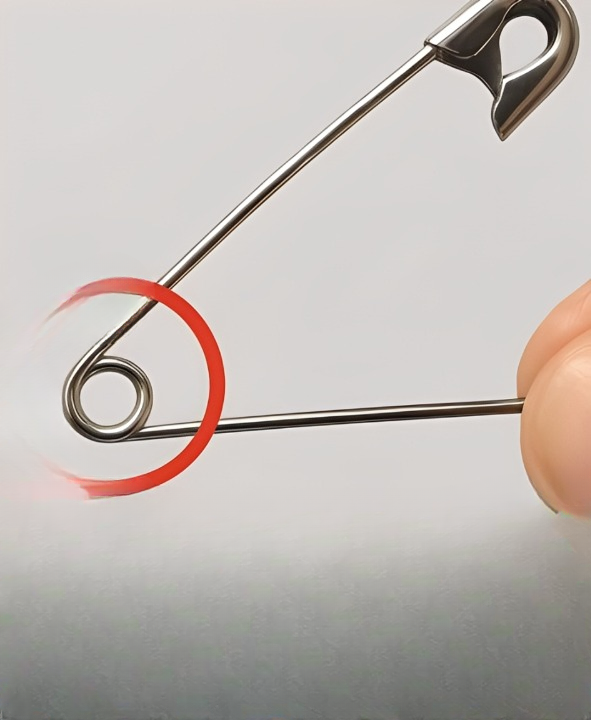
But one day, I noticed something I had somehow ignored my entire life: that tiny hole at the center of the coiled end.
You know the one. It’s right in the spiral part of the pin — small, round, easy to overlook.
For years, I assumed it was just… there. A leftover detail. Maybe decorative. Maybe meaningless.
It turns out that little hole is anything but random.
In fact, it plays a critical role in how a safety pin works. Once you understand why it’s there, you start to appreciate just how clever this simple piece of metal really is.
Let’s break it down properly.
A Quick Refresher: How a Safety Pin Works
At first glance, a safety pin looks extremely simple. It’s essentially a single piece of wire bent into a specific shape. But that shape is carefully engineered.
A standard safety pin has four key parts:
-
The sharp point – The piercing end used to fasten fabric.
-
The clasp (or guard) – The protective cover that locks the point in place.
-
The shaft – The straight section that passes through material.
-
The coil (spring) – The circular twist of metal at the opposite end.
It’s that coil — specifically the small hole in its center — that deserves attention.
The coil isn’t just there to look symmetrical. It functions as a spring. That spring is what keeps the pin closed securely. Without it, the pin wouldn’t snap back into position or stay tightly shut.
The entire usefulness of a safety pin depends on tension. And tension depends on that coil.
So What Is the Tiny Hole Actually For?
The hole in the center of the coil is part of the spring mechanism.
When manufacturers form a safety pin, they start with a straight piece of wire. That wire is then shaped, bent, and twisted into the familiar form we recognize. During this process, the wire is wrapped tightly into a spiral to create the spring.
The tiny hole marks the center of that coil. It’s the structural anchor point created when the wire is wound around itself.
But it’s more than just a leftover from manufacturing. That hole:
-
Helps maintain consistent spring tension
-
Stabilizes the coil structure
-
Ensures the pin snaps back into place after opening
-
Prevents the spring from loosening too easily
Without that precise coiled formation — including the center opening — the pin wouldn’t have the reliable “snap” that makes it safe and secure.
In short, the hole is a natural result of how the spring is formed, and it plays a role in maintaining the strength and flexibility of the mechanism.
Why the Coil Matters So Much
The spring coil is the heart of the safety pin.
Every time you open and close a safety pin, you’re flexing that coil. It absorbs pressure when you pull the pin open and then releases that stored energy to snap it back into its closed position.
This constant movement requires:
-
Elasticity
-
Strength
-
Structural stability
The central hole allows the coil to maintain its circular geometry. If it were compressed into a solid mass of metal, it wouldn’t flex properly.
Springs in many mechanical devices — from clothespins to industrial machinery — rely on similar open-coil designs. The empty center isn’t wasted space. It’s essential for controlled tension and movement.
The safety pin may look basic, but it uses the same mechanical principles found in far more complex tools.
A Manufacturing Perspective
Let’s take a closer look at how safety pins are made.
In automated production lines, thin metal wire is fed into machinery that:
-
Cuts the wire to length
-
Shapes one end into a sharp point
-
Forms the protective clasp
-
Winds the opposite end into a tight coil
During the coiling process, the wire wraps around a central guide rod. That wrapping motion creates the spiral and leaves the small hole in the middle.
The hole helps ensure:
-
Uniform coil size
-
Consistent tension across batches
-
Reliable performance
Without that guide-based coiling system, manufacturers would struggle to produce identical pins at scale.
So while the hole may appear insignificant, it’s actually evidence of precise engineering.
Why Most People Never Notice It
The safety pin is one of those objects we rarely think about.
It’s inexpensive.
It’s common.
It’s familiar.
We tend to reserve curiosity for complicated gadgets — smartphones, appliances, vehicles. Simple tools often escape scrutiny.
The design of the safety pin is so efficient and minimal that its complexity hides in plain sight.
There’s no label explaining the spring mechanics. No instruction manual detailing the coil geometry. It just works.
That’s good design.
A Brief History of the Safety Pin
The modern safety pin was invented in 1849 by Walter Hunt.
According to historical accounts, Hunt designed it quickly to settle a financial obligation. He patented the design but later sold the patent rights for a relatively modest sum.
What’s remarkable is how little the design has changed since then.
The core elements — including the coiled spring and its central hole — remain essentially the same more than 170 years later.
That longevity speaks volumes about the efficiency of the original concept.
Why the Hole Improves Durability
Metal fatigue is a real issue in spring-based tools. Every time a safety pin is opened, the coil bends slightly. Over time, repeated stress can weaken metal.
The open-coil structure distributes stress more evenly than a tightly packed, solid bend would.
The central hole:
-
Reduces internal stress buildup
-
Allows controlled flexing
-
Minimizes distortion
-
Improves lifespan
That’s why a quality safety pin can be opened and closed dozens — sometimes hundreds — of times before losing tension.
Without that balanced coil design, the pin might quickly become loose and unreliable.
Practical Bonus Uses for the Hole
While the hole wasn’t designed as an attachment point, creative users have found additional applications.
Some people thread:
-
Ribbon through the hole
-
Thin string for anchoring
-
Wire loops for craft projects
In sewing and embroidery, the hole can help:
-
Anchor thread
-
Secure placement
-
Add stability during fabric adjustments
Though these aren’t the original intended uses, they demonstrate how versatile the design can be.
Good engineering often allows for unexpected adaptability.
Comparing It to Other Everyday Design Details
Once you realize the safety pin’s hole serves a purpose, you may start noticing similar hidden features in other objects.
For example:
-
The hole in a saucepan handle can hold a spoon.
-
The ridges on bottle caps improve grip.
-
The small opening near measuring tape hooks compensates for thickness when measuring edges.
Many everyday items include subtle engineering solutions that go unnoticed.
The safety pin’s coil hole belongs in that category — a quiet but essential feature.
Why Understanding Small Details Matters
It’s easy to overlook minor design elements. But those small choices often determine whether a product succeeds or fails.
The safety pin has endured for generations because:
-
It’s reliable
-
It’s safe
-
It’s simple
-
It’s inexpensive
-
It performs consistently
And much of that reliability comes down to the precision of its spring.
Understanding the role of the hole gives you a new appreciation for how intentional the design really is.
The Beauty of Simple Engineering
There’s something elegant about tools that don’t require explanation.
The safety pin:
-
Protects its sharp end automatically
-
Stays closed under pressure
-
Opens smoothly
-
Requires no instructions
All of that functionality depends on mechanical balance.
The coil stores energy.
The hole allows controlled movement.
The clasp prevents accidental opening.
Remove any one of those components, and the design would suffer.
A Closer Look at Spring Mechanics
Springs work by storing potential energy when compressed or extended. When released, they return to their original shape.
In the case of a safety pin:
-
Opening the pin slightly unwinds the coil.
-
That motion stores tension.
-
Releasing the pin allows the coil to snap back.
The hollow center ensures the coil has room to flex inward and outward.
If the metal were tightly packed without space, the spring would resist movement differently and could crack under stress.
The hole is not an accident.
It’s physics.
Why the Safety Pin Remains Relevant
Despite modern fasteners like Velcro, adhesives, and zippers, safety pins are still widely used.
They are found in:
-
Sewing kits
-
First aid kits
-
Fashion accessories
-
Craft supplies
-
Household drawers
Their versatility keeps them relevant.
And their reliability stems from a thoughtful mechanical design that hasn’t required reinvention.
The Next Time You Use One
The next time you pick up a safety pin, take a moment to examine that tiny hole.
What once seemed like an insignificant detail is actually:
-
A structural anchor
-
A spring stabilizer
-
A manufacturing guide point
-
A durability enhancer
It’s a reminder that even the smallest design elements can serve meaningful purposes.
Final Thoughts
The hole in a safety pin isn’t decorative. It isn’t accidental. And it certainly isn’t useless.
It’s a critical part of the spring mechanism that allows the pin to function safely and effectively.
To summarize:
-
The hole forms naturally during the coiling process.
-
It helps maintain consistent spring tension.
-
It improves durability and flexibility.
-
It ensures reliable snap-back action.
-
It contributes to long-term performance.
What looks like a tiny opening in a piece of bent wire is actually a key component of a carefully engineered tool.
And once you understand that, you can’t help but appreciate how much thought goes into even the simplest objects we use every day.
Sometimes, genius hides in the smallest details.