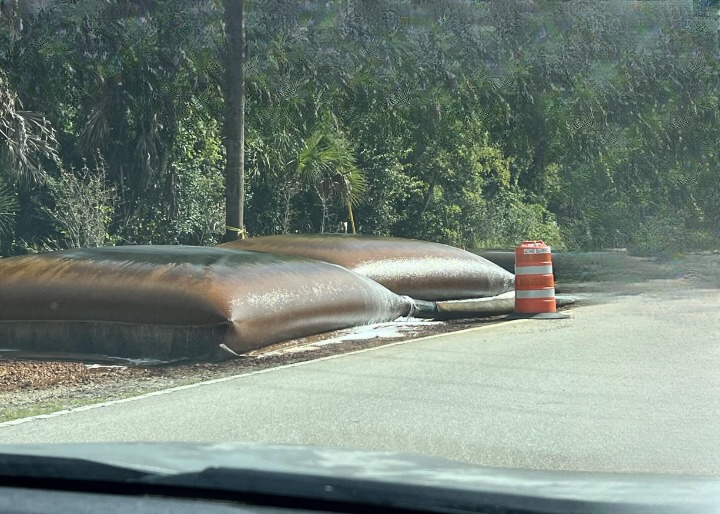
Most people never give them a second glance.
You’ve probably seen them sitting near construction sites, road projects, drainage ditches, or areas where crews are working around water. They look like enormous black pillows sprawled across the ground, partially inflated and oddly out of place.
Some resemble oversized beanbags.
Others look like giant trash bags filled with water.
At first glance, they don’t appear particularly important. In fact, many people assume they’re temporary storage containers, discarded materials, or equipment waiting to be hauled away.
But these strange-looking bags are actually performing one of the most important environmental jobs on a construction site.
They’re called dewatering bags, and despite their simple appearance, they help prevent tons of sediment and debris from entering rivers, lakes, streams, and stormwater systems every year.
The Hidden Problem Most People Never See
Construction projects generate far more than noise, dust, and heavy machinery.
Whenever crews dig foundations, grade land, excavate trenches, or move large amounts of soil, they disturb the ground. Rainwater and runoff then carry loose dirt, sand, clay, and sediment away from the work area.
At first, that may not sound like a major issue.
After all, it’s just dirt.
But once sediment enters natural waterways, the consequences can become surprisingly serious.
Murky water blocks sunlight that aquatic plants need to survive. Fish can struggle when fine particles clog their gills. Sediment can settle on riverbeds, disrupting habitats and affecting entire ecosystems.
Stormwater infrastructure can also suffer.
Excess sediment may clog drains, reduce water flow, and increase maintenance costs for municipalities and property owners.
That means construction sites can’t simply pump muddy water directly into nearby waterways.
The water must be treated first.
The Surprisingly Simple Solution
This is where dewatering bags come in.
Although they appear simple from the outside, they are carefully engineered using durable geotextile fabric designed to perform a specific task.
The material acts like a giant filter.
Construction crews pump sediment-filled water into the bag. As the water enters, the fabric allows liquid to pass through while trapping soil, sand, and other solid particles inside.
The process is remarkably straightforward:
- Muddy water is pumped into the bag.
- Sediment becomes trapped within the fabric.
- Cleaner water slowly filters out.
- Solids remain contained inside.
No motors.
No complicated machinery.
No elaborate filtration systems.
Just gravity, engineered fabric, and a practical design.
Why They Look So Strange
One reason people often misidentify dewatering bags is because they don’t resemble traditional equipment.
Unlike tanks or containers, these bags have no rigid structure.
As they fill, they bulge unevenly and spread across the ground. Their shape changes depending on how much water and sediment they contain.
Some appear partially inflated.
Others flatten into odd shapes that seem almost organic.
Because they sit motionless for days or even weeks, many passersby assume they’ve been abandoned or forgotten.
In reality, they are working continuously.
Every gallon of water flowing through them is being filtered before reentering the environment.
What’s Actually Inside?
Many people assume these bags contain clean water.
That’s usually not the case.
Most dewatering bags are filled with a thick mixture of water, soil, clay, and other suspended materials removed from construction runoff.
As water gradually drains through the fabric, the solids remain behind.
Over time, the contents settle and compact.
Eventually, what started as a slurry of mud and water becomes a dense mass of sediment.
In other words, that giant water-filled bag slowly transforms into a container full of dirt.
Once the bag reaches capacity and dries sufficiently, it can be removed and disposed of according to local environmental regulations.
Why Construction Crews Use Them
There are certainly more complex filtration methods available.
Mechanical filtration systems, settling tanks, and treatment facilities can all perform similar functions.
However, dewatering bags offer several significant advantages.
They are:
- Cost-effective
- Easy to transport
- Quick to install
- Suitable for temporary projects
- Low maintenance
- Effective for large volumes of runoff
For short-term construction projects, these benefits make them an attractive solution.
Instead of investing in expensive infrastructure that may only be needed for a few months, crews can deploy dewatering bags quickly and efficiently.
Protecting More Than Just Water
The benefits extend beyond cleaner streams and rivers.
By reducing sediment pollution, dewatering bags help protect:
- Fish habitats
- Wetlands
- Stormwater systems
- Local ecosystems
- Drinking water sources
They also help construction projects comply with environmental regulations designed to minimize runoff and preserve water quality.
Without proper sediment control measures, even small construction sites can contribute significant pollution during storms and heavy rainfall.
Dewatering bags help prevent that from happening.
The Beauty of a Simple Design
Perhaps the most impressive thing about dewatering bags is how little attention they demand.
In an age where many solutions rely on advanced technology, sensors, software, and automation, these bags solve a complex environmental problem using a remarkably simple principle.
Filter the water.
Keep the sediment.
Protect the environment.
That’s it.
Their effectiveness comes not from complexity but from thoughtful design.
Sometimes the best engineering solutions are the ones most people never notice.
The Next Time You See One
The next time you drive past a construction site and notice one of those giant black bags lying near a drainage ditch or excavation area, you’ll know you’re looking at more than an odd piece of equipment.
You’re seeing a quiet environmental safeguard at work.
It may not look impressive.
It may not move.
It may not even seem important.
But inside that strange, sagging bag, muddy runoff is being transformed into cleaner water before it returns to the surrounding environment.
And while most people never realize what those giant water-filled blobs are doing, their impact reaches far beyond the construction site itself.
Sometimes the most important tools are the ones working silently in the background—protecting rivers, streams, and ecosystems without anyone noticing at all.