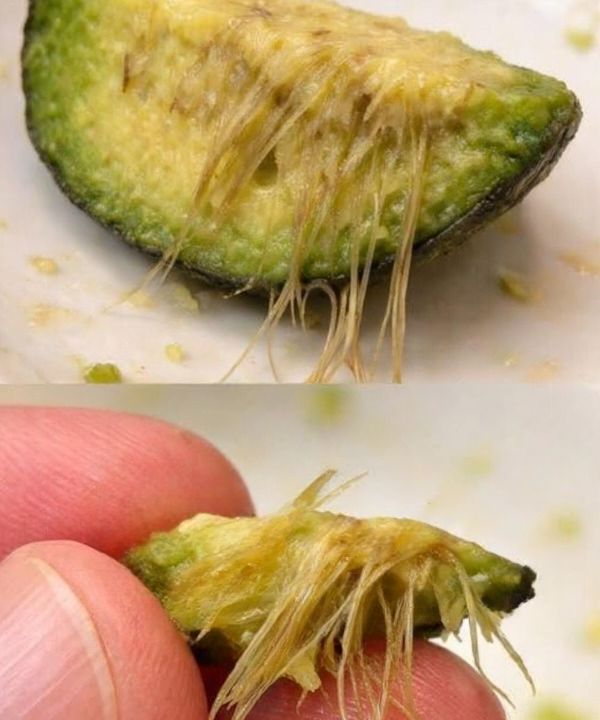
Few kitchen disappointments are as immediate as slicing into what looks like a perfectly ripe avocado, only to find thin, brownish strings running through the otherwise creamy green flesh. It can make the fruit seem spoiled or low quality at first glance, especially when you were expecting that smooth, buttery texture that avocados are known for.
But those fibers are not random defects—and they don’t automatically mean the fruit has gone bad.
They actually reveal something interesting about how avocados grow, mature, and respond to their environment long before they ever reach your kitchen.
What Those Stringy Fibers Actually Are
To understand the issue, it helps to know what an avocado really is.
Botanically speaking, the avocado (Persea americana) is a large single-seeded berry. Inside the fruit, there is a network of tiny vascular structures—essentially microscopic “transport lines” that carry water and nutrients while the fruit is developing on the tree.
In a healthy, properly matured avocado, these structures are so soft and evenly integrated into the flesh that you barely notice them. The fruit appears smooth, uniform, and creamy.
But when conditions change—during growth, ripening, or storage—those same structures can become more visible and firm, forming the stringy fibers people sometimes find unpleasant.
In other words, what you’re seeing isn’t foreign material. It’s part of the avocado itself.
The Most Common Cause: Ripening Imbalance
One of the biggest reasons avocados become stringy is uneven or advanced ripening.
As an avocado ripens, enzymes break down its internal cell walls, softening the flesh. Ideally, this process happens evenly, producing the smooth texture people expect.
However, when ripening is uneven, certain parts of the fruit break down faster than others. The softer flesh loses structure first, while the vascular fibers remain intact longer—making them stand out more clearly.
This creates the familiar stringy appearance.
In many cases, the avocado still tastes fine, even if the texture is slightly off.
Growing Conditions Also Play a Role
Not all avocados develop the same way on the tree. Their internal texture can be influenced by a variety of environmental factors, including:
- Inconsistent watering during growth
- Temperature fluctuations
- Soil quality and nutrient availability
- Natural variation between individual trees
When a tree experiences stress, the fruit it produces may develop stronger or more noticeable fiber structures.
Some avocado varieties are also naturally more prone to this texture. Even within the same grocery store, two avocados can have very different internal structures depending on their origin and growing conditions.
Storage and Transportation Matter More Than You Think
By the time most people buy avocados, they’ve already traveled a long way.
Commercial avocados are often harvested while still firm and then transported over long distances before ripening fully. During this journey, they may experience:
- Temperature changes
- Extended storage periods
- Controlled ripening processes
- Handling during shipping and distribution
All of these factors influence how the fruit develops internally.
If an avocado is stored too long or exposed to inconsistent conditions, its texture may become more fibrous as it continues to ripen.
This is one reason imported avocados sometimes show more variability than locally grown ones.
Does Stringiness Mean the Avocado Is Bad?
Not necessarily.
Stringy fibers alone are not a sign of spoilage. In most cases, the avocado is still safe to eat.
You can usually rely on a few simple indicators:
Still good to eat:
- Fresh, mild smell
- Mostly green or light yellow flesh
- Slightly firm or creamy texture despite fibers
Likely past its best:
- Strong sour or unpleasant odor
- Large dark or black patches inside
- Extremely mushy, watery, or uneven texture
If only the texture is affected, the avocado is typically fine—just less enjoyable to slice neatly.
How to Reduce the Chance of Stringy Avocados
While you can’t fully control how an avocado grows, you can improve your chances of getting a better one by paying attention to a few details:
1. Choose the right firmness
Pick avocados that are firm but give slightly when pressed. Extremely hard ones may take too long to ripen, while overly soft ones are already past their peak.
2. Let them ripen naturally
Room temperature ripening allows the fruit to develop more evenly. Once ripe, refrigerating it slows further breakdown.
3. Buy from consistent sources when possible
Different suppliers and regions may have different quality control standards and varieties.
4. Use them at the right stage
Timing matters. Even a high-quality avocado can become stringy if it is left too long after reaching peak ripeness.
When Texture Doesn’t Matter as Much
Even if an avocado develops some stringiness, it is rarely a complete loss.
In recipes where texture is less important, such as:
- Guacamole
- Smoothies
- Dressings
- Mashed spreads
…the fibers are usually unnoticeable once blended or mixed with other ingredients.
So while it may not be ideal for clean slices on toast, it still has plenty of culinary value.
The Bigger Picture: A Naturally Variable Fruit
The key takeaway is that avocados are not engineered products—they are natural, variable fruits shaped by countless environmental factors.
That means perfection is never guaranteed.
The stringy fibers that sometimes appear are simply a visible reminder of that natural complexity. They reflect how the fruit grew, how it ripened, and how it traveled before reaching you.
And while they may not always be visually appealing, they are part of what makes the avocado a living, changing food rather than a uniform product.
In most cases, they don’t signal failure—just variation.