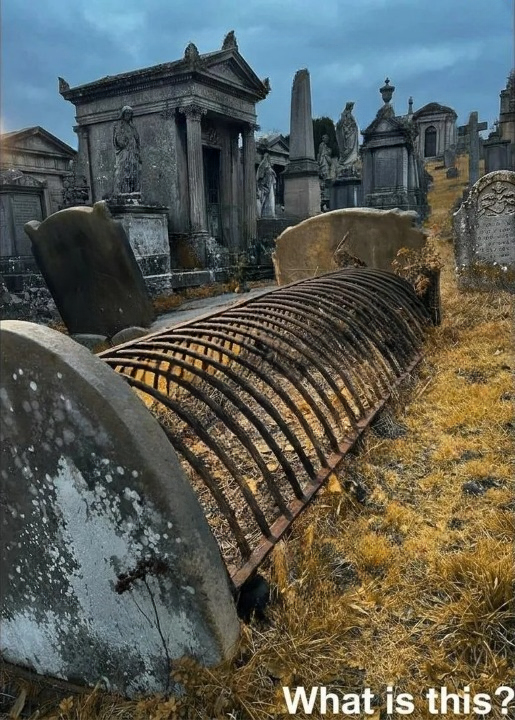
For centuries, cemeteries were considered quiet, sacred places where families could mourn and remember their loved ones in peace. But if you walk through certain historic burial grounds in the United Kingdom or Scotland today, you may come across something unsettling: heavy iron structures sitting over old graves, rusted with age and shaped like cages.
These eerie-looking structures were not decorative. They were called Mortsafe, and they existed for one very practical reason—grave robbing.
During the 18th and 19th centuries, medical science in Europe was advancing rapidly. Universities were expanding their anatomy programs, and doctors needed human bodies to study surgery and understand how the human system worked. But the law severely restricted where those bodies could come from. Only a small number of executed criminals were legally available for dissection.
This created a serious shortage.
Where medicine demanded more bodies, the law offered almost none. And into that gap stepped a dark underground trade.
Groups of body thieves—often called “resurrectionists”—began digging up recently buried corpses and selling them to medical schools. The work was carried out quickly, usually at night, and focused on fresh graves, where bodies were still intact enough for study.
For ordinary families, this was horrifying.
Graves were meant to represent final rest, dignity, and closure. The idea that a loved one could be dug up days after burial created widespread fear. Newspapers reported cases of stolen bodies, and communities began taking protective measures to defend their cemeteries.
One of the most effective solutions was the mortsafe.
A mortsafe was a heavy iron framework placed directly over a grave to prevent it from being opened. These structures were built from thick bars of iron and sometimes anchored into stone. Many were so heavy that they required several people to move, making grave robbing slow, noisy, and extremely risky.
Since body snatchers relied on speed and secrecy, the mortsafe worked by removing both.
Interestingly, most mortsafes were temporary. Once a body had decomposed enough to lose its value for medical study, it was no longer a target. Families would then remove the iron cage and reuse it for another fresh burial. In some communities, mortsafes were even shared or rented, like a protective tool passed from one grave to another.
But iron cages were only one part of the defense system.
Some towns organized cemetery watch groups, especially after recent burials. Guards would stay overnight to prevent disturbances. Others built watchhouses or hired local men to patrol burial grounds. Entire communities became involved in protecting the dead, reflecting just how deeply the fear of grave robbing had taken hold.
At the center of this problem was the growing demand for cadavers in medical education. As anatomy studies became more essential to improving surgery and treatment, pressure mounted to find a legal solution. Eventually, governments began to respond.
In Britain, reforms such as the Anatomy Act of 1832 changed the system by allowing unclaimed bodies and donated remains to be used for scientific research. This significantly reduced the demand for illegally obtained corpses and helped bring the era of body snatching to an end.
As legal supply improved and enforcement increased, grave robbing gradually disappeared. By the late 19th century, mortsafes were no longer widely needed. Many were removed, melted down, or left behind to rust quietly in forgotten cemeteries.
Today, the remaining mortsafes stand as striking historical relics. Visitors often mistake them for something symbolic, artistic, or even supernatural. Their rusted iron bars and cage-like shapes can easily feel mysterious without context. But their purpose was not symbolic at all—it was deeply practical.
They represent a time when science, law, and society were out of balance. Medicine was advancing faster than legal and ethical systems could adapt, creating fear and uncertainty among ordinary people. The mortsafe emerged as a direct response to that tension.
Historians now see these iron covers as more than just protective devices. They are physical reminders of a period when communities were forced to confront uncomfortable questions: How far should science go? Who controls the dead? And how do we balance progress with respect for human dignity?
At their core, mortsafes also reveal something deeply human. Beneath the fear of grave robbing was a universal desire—to protect loved ones, even after death. Families and communities invested time, money, and effort into preserving the dignity of the deceased because remembrance did not end at burial.
That is why these iron structures still capture attention today. They are not just remnants of old cemeteries. They are evidence of how people once lived with fear, adapted to uncertainty, and created practical solutions in the face of social and scientific change.
What remains in iron and rust is more than a cage over a grave. It is a reminder of a time when protecting the dead was as urgent as protecting the living—and when communities came together to ensure that even in death, dignity would not be stolen.