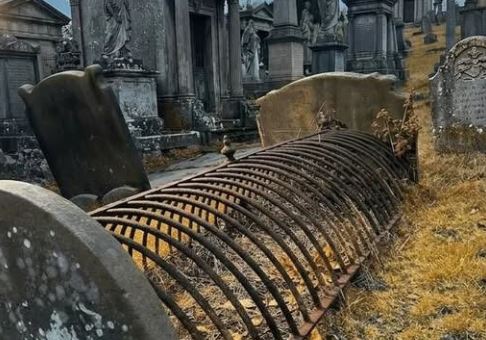
Walk through certain historic cemeteries in Scotland or parts of the United Kingdom, and you may encounter something both strange and unforgettable: heavy iron frameworks resting above old graves like weathered cages from another era.
To modern visitors, these structures often appear mysterious or even unsettling. Some assume they were decorative memorials. Others imagine connections to superstition, folklore, or fear of the supernatural.
But the real explanation is far more practical—and deeply tied to one of the most unusual periods in medical history.
These iron grave coverings were known as mortsafes, and they existed for one reason: to stop grave robbers from stealing bodies.
During the 18th and early 19th centuries, body snatching became a serious problem throughout Britain and parts of Europe. As medical schools expanded and anatomy research became increasingly important, the demand for human bodies rose dramatically. Yet strict laws severely limited which corpses could legally be used for scientific study.
This shortage created a dangerous underground trade.
Criminals known as “resurrectionists” began digging up freshly buried bodies and secretly selling them to medical institutions. Families feared that loved ones could be stolen only days after burial, and communities searched desperately for ways to protect graves from disturbance.
The mortsafe became one of the most creative—and effective—solutions.
Today, surviving mortsafes remain powerful reminders of a time when scientific progress, public fear, ethics, and grief collided in unexpected ways.
Why Medical Schools Needed Human Bodies
To understand why mortsafes appeared, it helps to understand how medicine was changing during that period.
The 18th and 19th centuries were times of major advancement in medical science. Doctors and surgeons increasingly recognized that studying real human anatomy was essential for improving surgery, diagnosis, and treatment methods.
Medical schools began expanding anatomy programs, and students needed access to actual human bodies for dissection and instruction.
At the time, however, legal access to cadavers was extremely limited.
In many places, only the bodies of executed criminals could legally be used for anatomical study. Unfortunately for medical institutions, the number of legally available bodies was far smaller than the rapidly growing educational demand.
That imbalance created opportunity for illegal activity.
The Rise of Grave Robbing
Because medical schools needed bodies and legal supply remained scarce, organized groups of thieves began targeting cemeteries.
These criminals became known as resurrectionists or body snatchers.
Their methods were often disturbingly efficient.
Rather than digging up entire coffins, body snatchers usually removed only the body itself while leaving clothing and valuables behind. This detail mattered because stealing personal property from graves carried harsher legal penalties than stealing a corpse, which occupied a strange legal gray area at the time.
Fresh burials were especially vulnerable.
Recently buried bodies were considered most useful for anatomical study, meaning grieving families often feared that loved ones could be stolen only days after funerals.
As stories spread through newspapers and communities, public anxiety intensified.
Fear Spread Across Communities
For families already experiencing grief, the possibility of grave robbery felt horrifying.
Burial was deeply connected to dignity, religious tradition, and respect for the dead. The idea that a loved one’s body might be disturbed after burial created enormous emotional distress.
Communities responded seriously to the threat.
People searched for practical ways to protect graves, especially during the first few weeks after burial when body snatchers were most active.
Several protective methods emerged, including:
- Cemetery patrols
- Watch towers
- Overnight guards
- Locked burial vaults
- Heavy stone slabs
- Iron cages placed over graves
Among these solutions, the mortsafe became one of the most recognizable.
What Exactly Was a Mortsafe?
A mortsafe was a heavy iron structure designed specifically to prevent grave robbers from accessing burial sites.
Most mortsafes consisted of thick iron bars arranged into cage-like frameworks positioned directly above or around a grave. Some were anchored into stone foundations, while others were simply so massive that moving them required several people.
Their purpose was straightforward:
Make grave robbery too difficult and time-consuming.
Because resurrectionists usually operated at night and relied on speed and secrecy, heavily protected graves became far less attractive targets.
If stealing a body required loud tools, additional labor, or too much time, robbers often moved on to easier opportunities.
Why Mortsafes Were Often Temporary
One fascinating detail about mortsafes is that they were frequently reused.
Body snatchers primarily targeted fresh graves because decomposition reduced the usefulness of remains for medical education.
That meant graves only needed protection temporarily.
After several weeks, once the body was no longer considered valuable to resurrectionists, the mortsafe could be removed and placed over another recent burial.
This made mortsafes practical investments for churches and communities.
In some towns, families even shared mortsafes collectively, rotating them between graves as needed.
Craftsmanship and Design
Despite their grim purpose, many surviving mortsafes display impressive craftsmanship.
Blacksmiths and metalworkers created these structures using thick iron bars built to resist tampering and harsh weather conditions. Some included:
- Hinged sections
- Locking mechanisms
- Reinforced corners
- Heavy grates
- Stone supports
Because they needed to survive outdoor exposure and potential interference, durability mattered enormously.
Today, surviving mortsafes often appear both imposing and strangely artistic, blending industrial design with historic cemetery architecture.
Cemetery Guards and Night Watches
Iron cages were not the only protective measure communities used.
In some regions, residents organized nighttime cemetery patrols to guard recent graves. Volunteers or hired watchmen remained near burial grounds overnight to discourage grave robbers.
Special watch houses were even constructed in certain cemeteries.
These small buildings allowed guards to monitor burial sites after funerals, especially during periods when body snatching activity increased.
The existence of these patrols demonstrates how seriously communities treated the threat.
Protecting the dead became a shared responsibility.
Why Medical Schools Purchased Stolen Bodies
Although grave robbing horrified the public, medical institutions still required anatomical specimens.
Human dissection played a critical role in helping doctors learn:
- Surgical techniques
- Organ structures
- Human physiology
- Disease effects
- Injury treatment
Without direct anatomical study, medical progress would have advanced far more slowly.
This created a difficult ethical conflict.
Society wanted better medicine, but many people strongly opposed the methods used to obtain bodies.
The mortsafe became a visible symbol of that tension between scientific advancement and public morality.
Legal Reforms Changed Everything
Eventually, governments recognized that the shortage of legal cadavers directly contributed to grave robbing.
Over time, laws changed to allow broader legal access to bodies for medical education.
In Britain, the Anatomy Act of 1832 became a major turning point. The law allowed unclaimed bodies and legally donated remains to be used for anatomical study, reducing reliance on stolen corpses.
These reforms helped:
- Reduce illegal body trafficking
- Improve oversight
- Establish ethical standards
- Protect burial sites
- Provide legal medical resources
As legal supply improved, grave robbing became less profitable and gradually declined.
The Decline of the Mortsafe
As body snatching decreased, mortsafes slowly disappeared from regular use.
By the late 19th century, most had become unnecessary.
Many were dismantled, recycled for metal, or abandoned. Others remained quietly in cemeteries, slowly weathering over time as reminders of a strange and uneasy chapter in history.
Today, surviving mortsafes are relatively rare, making them valuable historical artifacts.
Why Mortsafes Still Fascinate People
Modern visitors often find mortsafes captivating because they seem so unfamiliar and mysterious.
At first glance, they resemble:
- Iron cages
- Gothic enclosures
- Protective barriers
- Strange industrial structures
Without historical context, their purpose can appear eerie or supernatural.
Learning the true story behind them often surprises people because it reveals how deeply science, fear, ethics, and grief once intersected.
More Than Just Iron Cages
Beyond their practical function, mortsafes also represent something deeply emotional.
They reveal how strongly families wished to protect loved ones even after death.
Communities responded to fear not with mythology, but with practical innovation and cooperation.
In many ways, these iron structures symbolize:
- Respect
- Protection
- Grief
- Community effort
- Human dignity
They remind us that people have always sought ways to preserve dignity for those they loved.
Final Thoughts
The iron cages once placed over graves during the 18th and 19th centuries may look mysterious today, but their story is rooted in very real historical concerns.
Mortsafes were practical responses to the rise of grave robbing during a time when medical science desperately needed bodies for anatomical study while legal supply remained extremely limited.
Families and communities, fearing the theft of loved ones shortly after burial, created ingenious ways to protect graves. Heavy iron structures, cemetery patrols, and watch houses became symbols of both public fear and deep respect for the dead.
Today, surviving mortsafes stand as fascinating reminders of a unique period in history when science, ethics, law, and grief collided in unforgettable ways.
The next time you encounter one of these strange iron structures in an old cemetery, you’ll know it was never meant to frighten the living.
It existed to protect the dead—and to give grieving families peace of mind during one of history’s most unsettling eras.