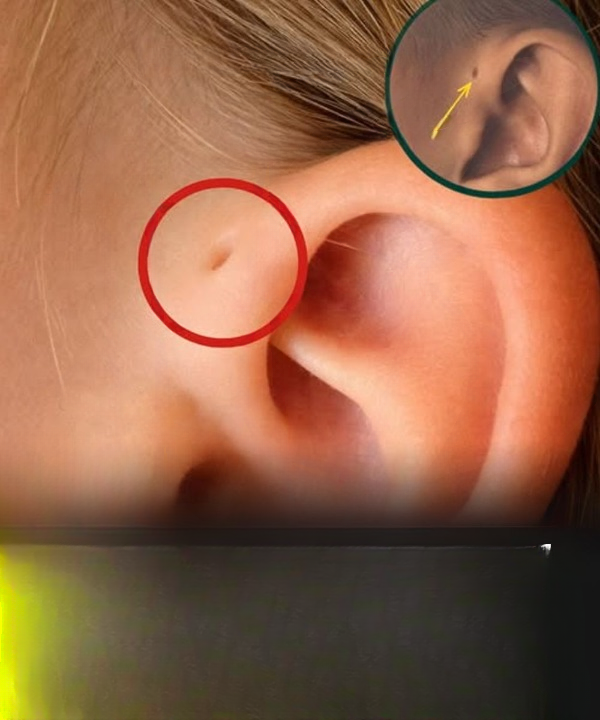
At first glance, it looks like nothing.
A tiny opening. A small dot. A barely noticeable indentation just in front of the ear, where it meets the side of the face. Many people who have it don’t even realize it’s there until someone points it out. Others assume it’s a scar, a piercing gone wrong, or some minor skin irregularity.
But this small feature—known medically as a Preauricular sinus—tells a much deeper story about human development, variation, and possibly even our distant evolutionary past.
A Feature You’re Born With
A preauricular sinus isn’t something that develops over time. It’s present from birth, formed during the earliest stages of fetal development.
As an embryo grows, the structures that will eventually become the outer ear develop from six small tissue swellings known as auricular hillocks. These must fuse together in a very precise way. Occasionally, that fusion isn’t perfectly seamless, leaving behind a tiny tract or opening near the ear.
That opening is the preauricular sinus.
It’s not an injury. It’s not damage. And in most cases, it isn’t even a medical concern. It’s simply a natural variation—one of many small differences that make human anatomy more diverse than we tend to expect.
Harmless… Most of the Time
For the vast majority of people, a preauricular sinus does absolutely nothing.
It doesn’t affect hearing.
It doesn’t interfere with daily life.
It often goes completely unnoticed.
However, in some cases, the tiny tract beneath the skin can become blocked or infected. When that happens, it may cause swelling, redness, or discharge, requiring simple medical treatment. In rare situations, repeated infections might lead doctors to recommend minor surgical removal.
But these cases are the exception—not the rule.
For most people, it remains just a quiet, harmless detail of their anatomy.
A Clue From Deep Evolutionary History?
Where things become especially interesting is in how scientists interpret features like this.
Some researchers have proposed that certain small, seemingly functionless traits in the human body may be evolutionary remnants—echoes of structures that once had a purpose in distant ancestors.
One of the most well-known voices exploring this idea is Neil Shubin, author of the book Your Inner Fish. In his work, he explains how parts of the human body can reflect patterns inherited from ancient life forms, particularly early fish.
This has led to a fascinating—though not definitively proven—idea:
That structures like the preauricular sinus may loosely resemble ancient developmental pathways similar to those involved in gill structures.
To be clear, humans do not have gills, and a preauricular sinus does not function like one. But during early embryonic development, humans form structures called pharyngeal arches, which are evolutionarily related to the gill-supporting structures found in fish.
In that sense, the tiny opening near the ear may be a subtle byproduct of how those ancient developmental blueprints still influence modern human biology.
It’s less about function—and more about history.
How Common Is It?
A preauricular sinus is considered relatively rare, but its frequency varies significantly depending on geographic and genetic factors.
- In parts of Africa, it appears more frequently
- In some Asian populations, it shows moderate occurrence
- In Europe, it is less common
- In the United States, it is relatively rare
Even in regions where it appears more often, it still represents a minority trait.
This variation highlights how human genetics express themselves differently across populations, shaped by ancestry, environment, and evolutionary history.
Not Everything Has a Purpose
One of the most compelling aspects of features like the preauricular sinus is what they reveal about the human body itself.
We tend to think of biology as efficient—every part serving a clear function. But evolution doesn’t always work that way.
Some traits persist not because they are useful, but because they are harmless enough to remain.
They are leftovers. Echoes. Structural footprints of earlier stages in development—both individual and evolutionary.
The preauricular sinus may be one of those footprints.
When Should You Pay Attention?
Although it’s usually harmless, there are a few situations where awareness matters:
- If the area becomes swollen, painful, or red
- If there is discharge or repeated irritation
- If infections occur frequently
In those cases, medical advice is recommended. Treatment is typically simple and effective.
Otherwise, there’s no reason to view it as a condition or problem.
It’s simply part of how the body formed.
A Small Detail, A Bigger Perspective
What makes this tiny feature so fascinating isn’t its appearance—but what it represents.
A nearly invisible mark can carry layers of meaning:
- A reminder of how intricate fetal development is
- Evidence of natural variation in human anatomy
- A possible link to evolutionary patterns stretching back millions of years
It’s easy to overlook something so small.
But sometimes, the smallest details reveal the biggest stories.
Final Thought
The human body is not just a machine—it’s a record.
Every structure, even the ones that seem insignificant, reflects a long and complex history of development, adaptation, and survival.
A tiny hole near the ear might not change your life.
But it quietly reminds us of something bigger:
We are shaped not only by who we are today—
but by everything that came before us.