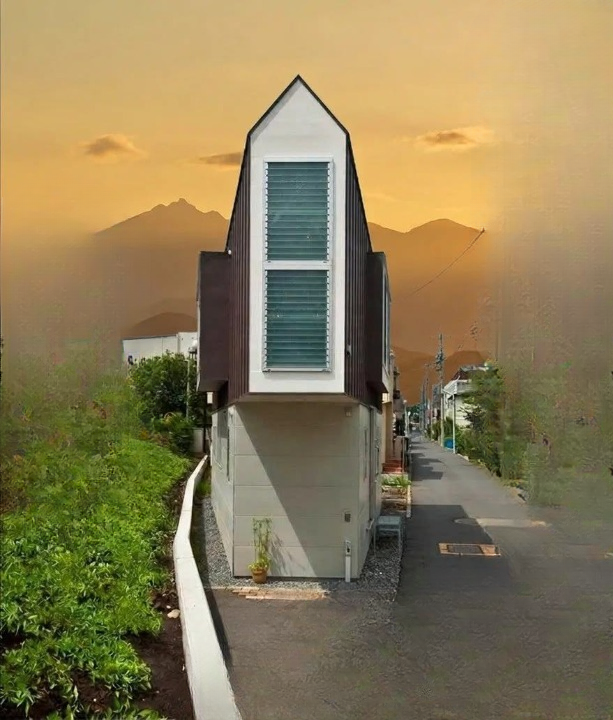
At first glance, it is easy to assume that a very narrow or unusually shaped piece of land would be a major limitation for building a home. Most people expect small or awkward plots to result in cramped interiors, limited natural light, and compromised comfort.
However, a remarkable home in Japan challenges that assumption completely. Built on a narrow triangular plot of land between a quiet river and a roadway, this compact residence demonstrates how thoughtful architectural design can transform even the most restrictive space into a functional, comfortable, and visually open living environment.
Designed by Mizuishi Architects Atelier, the house is a powerful example of how creativity and precision can turn spatial limitations into design opportunities.
Despite its modest size of approximately 594 square feet (around 55 square meters), the home feels far more spacious than its actual dimensions suggest. This is not because the structure is large, but because every element of its design has been carefully planned to maximize openness, light, and usability.
Making the Most of an Unusual Plot of Land
The defining feature of this project is the land itself. Instead of a standard rectangular lot, the house is built on a narrow triangular strip of land.
For many architects, such a shape would be considered highly challenging. Traditional building designs often rely on symmetry and straight lines, which are difficult to apply to irregular plots.
However, rather than resisting the shape of the land, the design embraces it fully. The building follows the natural angles of the plot, allowing the structure to “fit” into the environment rather than forcing the environment to adapt to the structure.
This approach results in a home that feels integrated with its surroundings rather than imposed upon them. The river on one side and the roadway on the other create a unique setting that further emphasizes the importance of efficient spatial planning.
A Compact Home With a Surprisingly Open Feel
From the outside, the house appears modest and tightly fitted into its surroundings. Its exterior does not immediately suggest the sense of space that exists within.
However, stepping inside reveals a completely different experience.
The interior has been designed with an emphasis on openness, light flow, and efficient use of vertical space. Instead of dividing the home into many small rooms, the layout is intentionally streamlined to create a sense of continuity between different areas.
This design philosophy helps reduce the feeling of confinement often associated with small homes.
A Two-Level Layout Designed for Function and Comfort
One of the most effective strategies used in this home is the division of space across two levels, each serving a distinct purpose.
Ground Floor: A Private and Restful Zone
The ground floor is primarily dedicated to rest and privacy. It contains a bedroom that serves as a quiet retreat from the more active areas of the home.
Key features of this level include:
- A compact but comfortable sleeping area
- A calm atmosphere designed for relaxation
- Large windows that allow natural light to enter
- A visual connection to the outdoors
The presence of natural light plays a critical role in making the space feel less enclosed. Even though the floor area is limited, the brightness created by the windows helps reduce any sense of confinement.
Upper Floor: The Social and Living Space
The upper level serves as the main living area of the home. This is where daily activities such as cooking, dining, and relaxation take place.
Instead of separating these functions into different rooms, they are combined into a single open-plan space.
This upper floor includes:
- A kitchen integrated into the living area
- An open layout that encourages movement and interaction
- A sloped ceiling that enhances vertical space
- A bright and airy atmosphere created by white interior surfaces
The sloped ceiling is especially important, as it adds both architectural character and a sense of height. Even in a narrow structure, vertical expansion helps create the impression of openness.
A Small Mezzanine With a Unique Purpose
One of the most distinctive features of the home is a small mezzanine level positioned above the main living area.
Accessed by a simple ladder, this elevated space serves as a flexible and cozy corner within the home. It can be used for:
- Reading and quiet relaxation
- A small workspace
- A resting nook
- Occasional storage or play space
Although compact, this mezzanine adds an extra layer of functionality without significantly increasing the building’s footprint. It also introduces a sense of vertical layering, which helps make the interior feel more dynamic and less flat.
The Role of Light and Materials in Expanding Space
One of the most important aspects of the design is the use of light-colored materials, particularly white walls and ceilings.
These surfaces play a key role in reflecting natural light throughout the interior, which helps create the illusion of a larger space. Instead of absorbing light and making rooms feel darker or smaller, the reflective surfaces distribute brightness evenly.
Combined with carefully placed windows, this design strategy ensures that the home remains bright throughout the day.
Natural light becomes an architectural tool rather than just a functional necessity.
Smart Design Principles Behind the Home
This narrow house demonstrates several important principles of modern small-space architecture:
1. Embracing Constraints
Instead of fighting the unusual shape of the land, the design adapts to it.
2. Vertical Thinking
When horizontal space is limited, vertical space becomes essential. The mezzanine and sloped ceilings reflect this approach.
3. Open-Plan Living
Reducing unnecessary internal walls helps create a sense of continuity.
4. Light Optimization
Maximizing natural light is essential in small homes to avoid a closed-in feeling.
5. Minimal but Functional Design
Every element of the home has a clear purpose, avoiding wasted space.
Redefining What “Small” Really Means
This home challenges a common assumption in architecture: that small spaces must feel restrictive.
Instead, it shows that size alone does not determine comfort. A well-designed small home can feel more open, functional, and livable than a poorly designed larger one.
The experience of space is shaped not just by square footage, but by:
- Layout
- Light
- Flow
- Materials
- Proportions
When these elements are carefully balanced, even a 594-square-foot structure can feel surprisingly spacious.
Final Thoughts
The narrow house designed by Mizuishi Architects Atelier is a strong example of how architectural creativity can transform limitations into strengths.
What appears externally as a small and constrained structure reveals itself internally as a thoughtful, bright, and highly functional living space. Every design choice—from the triangular footprint to the mezzanine level—contributes to a sense of openness that defies expectations.
Ultimately, this home demonstrates that innovative design is not about the size of a space, but about how intelligently that space is used.