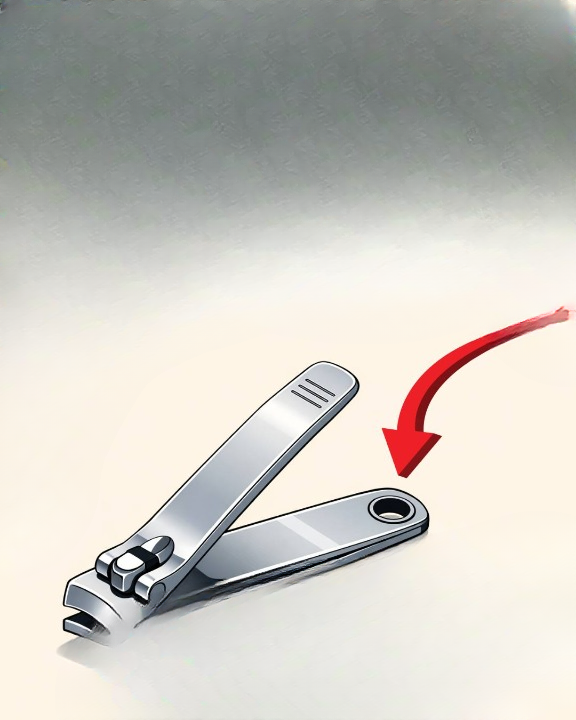
When we think about brilliant design, we often picture cutting-edge technology, sleek smartphones, or revolutionary medical devices. Rarely do we stop to consider the humble nail clipper—a small, inexpensive tool found in nearly every home around the world. Yet this everyday grooming essential is a remarkable example of thoughtful engineering, subtle innovation, and user-centered design.
Most of us pick up a nail clipper, trim our nails, and put it away without a second thought. We hardly ever question why it looks the way it does, how it works so efficiently, or why it includes that small round hole at the end of its handle. But behind this simple object lies a fascinating story of invention, refinement, and clever problem-solving that spans more than a century.
In this in-depth exploration, we’ll uncover the history of the nail clipper, the evolution of its design, the purpose of its smallest features, and why such a compact tool represents one of the most successful examples of practical industrial design in everyday life.
A Brief History of the Nail Clipper
Long before modern nail clippers existed, people maintained their nails using knives, small scissors, or specialized grooming blades. In ancient civilizations, personal grooming was often associated with status and hygiene. However, trimming nails was a more delicate and time-consuming task than it is today.
The development of the modern lever-style nail clipper began in the 19th century. One of the earliest recognized patents for a nail-cutting device is attributed to Henry P. Johnson, who patented an early version of the nail clipper in 1875. His invention laid the foundation for the compact, folding-lever design we recognize today.
While Johnson’s version was not identical to the clippers we use now, it introduced the essential principle of opposing cutting blades controlled by leverage. Over time, manufacturers refined the concept, simplifying the mechanism and improving durability.
By the early 20th century, nail clippers had become more standardized. Improvements in metal stamping and mass production made them affordable and widely available. What began as a specialty item gradually became a household necessity.
The Engineering Genius Behind a Simple Tool
At first glance, a nail clipper appears almost too simple to analyze. It consists of:
-
Two curved cutting blades
-
A pivot pin
-
A lever arm
-
Often, a built-in nail file
-
And that small round hole in the handle
But simplicity is deceptive. The nail clipper is a carefully engineered device built on the principle of mechanical leverage.
When you press down on the lever, force is transferred through the pivot, multiplying pressure at the cutting edges. This allows the blades to slice cleanly through keratin (the protein that makes up nails) with minimal effort. The curved blades are shaped to match the natural contour of fingernails and toenails, improving precision and comfort.
The folding lever design also locks the blades closed when not in use, making the tool safe and compact. This compactness is one of the key reasons nail clippers became so popular—they are portable, durable, and require no maintenance beyond occasional cleaning.
The Small Round Hole: A Tiny Feature with Big Purpose
One of the most overlooked features of the nail clipper is the small round hole at the end of the handle. At first glance, it might seem decorative or incidental. In reality, it serves several practical functions.
1. Portability and Attachment
The most common purpose of the hole is to allow the clipper to be attached to:
-
A keychain
-
A lanyard
-
A travel pouch
-
A wall hook
-
A grooming kit ring
This small addition transforms the nail clipper from a loose drawer item into a portable accessory. For travelers, commuters, and minimalists, this feature ensures the clipper is always within reach.
In earlier times, grooming tools were stored in cabinets or boxes. But as mobility increased—particularly in the 20th century—people needed compact personal care tools that could travel easily. The hole made attachment simple without altering the clipper’s primary function.
2. Organized Storage
Many households struggle with small items disappearing into drawers. Nail clippers are notorious for vanishing when needed most.
By hanging the clipper on a hook near a bathroom sink or attaching it to a toiletry bag, users can prevent clutter and reduce frustration. This tiny hole helps solve a surprisingly common problem: accessibility.
3. Grouping Multiple Clippers
Some people keep separate clippers for:
-
Fingernails
-
Toenails
-
Travel kits
-
Emergency grooming kits
Using a small metal ring, multiple clippers can be grouped together without becoming disorganized. This is especially useful in professional grooming settings or shared households.
4. Additional Grip and Stability
While not necessarily the original intention, some users find that placing a finger through the hole provides additional leverage or stability. For individuals with reduced grip strength, this small feature can subtly enhance control during use.
Why Portability Became Essential
In the modern world, portability is not just a convenience—it’s an expectation.
We carry smartphones, portable chargers, pocket tools, and compact grooming kits. The nail clipper fits seamlessly into this ecosystem of portable essentials.
Imagine traveling for business or vacation and discovering a broken nail with no tool to fix it. It’s a small inconvenience, but an irritating one. Thanks to the hole in the handle, many people attach clippers to keychains or travel kits, ensuring they’re always available.
This speaks to a broader design principle: tools that anticipate user movement remain relevant longer.
The nail clipper’s design quietly acknowledges that people move between home, work, travel, and social environments. Its portability ensures it remains useful in every context.
Evolution Through the 20th Century
After the foundational patent by Henry P. Johnson, nail clipper designs diversified.
Manufacturers experimented with:
-
Improved blade curvature
-
Stainless steel construction
-
Integrated nail files
-
Swivel lever mechanisms
-
Ergonomic grips
-
Anti-slip textures
Despite these improvements, the core lever-and-pivot mechanism remained unchanged. This consistency is a testament to the strength of the original design.
Some modern clippers even include magnifiers, splash guards, or precision trimming edges. Yet, at their core, they operate on the same mechanical principle introduced more than a century ago.
The Role of Materials in Longevity
Early nail clippers were often made from basic steel, which could rust easily in humid bathroom environments. Today, most are manufactured from stainless steel or chrome-plated metal, increasing durability and corrosion resistance.
Proper storage significantly affects longevity. Hanging the clipper using its small hole can prevent:
-
Moisture buildup
-
Accidental bending
-
Contact with damaging objects
-
Blade dulling from friction
By keeping the clipper dry and separate, users extend its functional lifespan.
A well-maintained nail clipper can last many years—sometimes even decades—without losing effectiveness.
Ergonomics: Designed for Human Hands
One of the most impressive aspects of the nail clipper is its ergonomic efficiency.
The lever length is carefully proportioned to maximize mechanical advantage while maintaining compact size. The pivot placement ensures smooth movement without blade misalignment. The slight curvature of the blades matches natural nail shape, reducing the risk of splitting or uneven cuts.
These design elements weren’t accidental. Over decades of refinement, manufacturers adjusted proportions based on real-world usage.
The result? A tool that feels intuitive from the first use.
Why the Design Has Barely Changed
In the world of product design, most tools evolve dramatically over time. Consider telephones, watches, or even toothbrushes.
The nail clipper, however, remains fundamentally unchanged.
Why?
Because it reached design maturity early.
When a product:
-
Performs its task efficiently
-
Is affordable to produce
-
Is durable
-
Requires minimal maintenance
-
Is easy to use
There is little need for reinvention.
The nail clipper represents design optimization. Its simplicity is not a lack of innovation—it is the end result of it.
Everyday Design Philosophy: Small Details Matter
The small round hole on a nail clipper is an example of micro-design thinking—small features that deliver outsized value.
In product design, details often determine user satisfaction. A slight curve, a balanced pivot, a small opening for storage—these subtle elements separate good design from great design.
We rarely notice these features unless they’re missing.
If nail clippers lacked that hole, portability would decrease. Storage would be less convenient. Organization would be slightly more frustrating.
The hole costs almost nothing to include during manufacturing, yet it increases the product’s functionality significantly. That’s efficient design.
Specialized Variations of Nail Clippers
Over time, several variations have emerged:
Standard Lever Clippers
The most common household type.
Toenail Clippers
Wider blades and stronger leverage for thicker nails.
Baby Nail Clippers
Smaller blades designed for delicate trimming.
Professional Grooming Clippers
Used in salons and medical settings for precision trimming.
Despite their differences, most versions still incorporate the small hole—proof that the feature remains relevant across applications.
Hygiene and Maintenance Considerations
Because nail clippers come into direct contact with nails, hygiene matters.
Experts recommend:
-
Cleaning clippers after use
-
Drying them thoroughly
-
Avoiding sharing without proper sanitation
-
Replacing them if blades become dull or misaligned
Proper storage—such as hanging via the small hole—reduces contamination risk and improves air circulation, helping prevent rust and bacterial buildup.
The Psychology of Everyday Objects
Why don’t we think about tools like nail clippers more often?
Because the best designs fade into the background.
When something works flawlessly, it becomes invisible. We only notice tools when they fail.
The nail clipper has achieved a rare design status: silent reliability.
Its mechanism is satisfying. Its function is immediate. Its storage is simple. And its portability is built in.
A Symbol of Thoughtful Simplicity
In an era dominated by complex technology, the nail clipper reminds us that innovation doesn’t always mean adding features. Sometimes it means refining function.
The small round hole in the handle represents:
-
Forethought
-
Adaptability
-
User-centered design
-
Cost-effective engineering
-
Everyday practicality
It’s a reminder that thoughtful details can dramatically improve usability without complicating the product.
The Unsung Hero of Personal Grooming
Personal grooming tools rarely receive design awards or media attention. Yet they are among the most frequently used objects in our lives.
The nail clipper sits quietly in bathroom drawers, travel kits, desk organizers, and keychains around the world. It performs its task without batteries, software updates, or user manuals.
Its reliability is its brilliance.
Final Thoughts: Appreciating the Little Things
The next time you pick up a nail clipper, pause for a moment.
Notice:
-
The smooth lever motion
-
The precise blade alignment
-
The satisfying click
-
The compact folding design
-
And yes—the tiny round hole
That small hole is not decorative. It is a practical solution to storage, portability, and convenience. It reflects more than a century of refinement since the early patent by Henry P. Johnson.
In a world fascinated by the newest and most complex inventions, the nail clipper stands as proof that timeless design often comes in small, unassuming packages.
Sometimes, the most impressive engineering isn’t flashy or digital.
Sometimes, it fits in the palm of your hand.