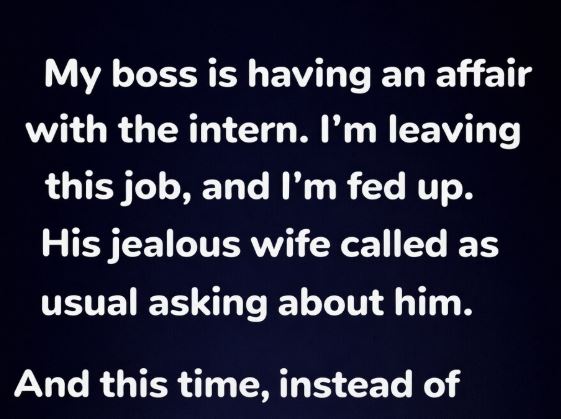
When I first started that job, I expected structure, routine, maybe even a little boredom. What I didn’t expect was to walk into an environment that felt more like a slow-burning drama than a workplace. At the center of it all was my boss—a man who knew exactly how to carry himself. He was confident in a way that drew people in, polished enough to be trusted, and just distant enough to avoid real scrutiny.
At first, I didn’t question him.
Most people didn’t.
But offices have their own ecosystem, and rumors are part of it. They don’t arrive loudly—they build. A glance held too long. A door closed just a second too quickly. Conversations that stop when someone else enters the room. Over time, those fragments start forming patterns, and once a pattern takes hold, people stop asking if it’s true.
They just start believing it.
That’s how the story about him and the new intern began.
She was young, ambitious, and clearly trying to prove herself. He, on the other hand, seemed unusually attentive. Not inappropriate—at least not in a way anyone could clearly point to—but enough to make people notice. And in a workplace already prone to speculation, “noticeable” quickly became “obvious.”
I tried to stay out of it.
I really did.
But when you’re surrounded by whispers long enough, they stop sounding like speculation and start feeling like facts. Conversations at lunch circled back to them. People exchanged looks instead of words. The atmosphere shifted from professional to quietly judgmental.
And somewhere along the way, I absorbed it too.
Not because I wanted to—but because it was easier than questioning everything.
Eventually, the tension started to wear on me. I found myself focusing less on my work and more on the undercurrent running through the office. It wasn’t just uncomfortable—it was draining. I didn’t like who I was becoming in that environment. Observant turned into suspicious. Neutral turned into quietly critical.
So I made a decision.
I would leave.
Not dramatically. Not angrily. Just… intentionally. For my own peace.
But before I did, something happened that completely shifted the way I see people.
It was a normal afternoon when the phone rang. I recognized the voice immediately—it was his wife. She had called before. Not often, but enough that I knew her tone. There was always something beneath it. Not outright distrust, but a kind of careful checking. Like someone trying to confirm something without asking directly.
That day, though, I was tired.
Tired of the tension. Tired of the rumors. Tired of pretending everything was normal when it clearly wasn’t—at least from where I stood.
So instead of giving the usual polite, vague answer, I did something I hadn’t done before.
I told the truth—or at least, what I believed to be the truth.
“Why don’t you come and see for yourself?” I said calmly. “He’s here. With the new intern.”
There was silence.
Not the kind filled with shock or anger—but something else. Something I couldn’t immediately place.
I braced myself.
I expected confrontation. Maybe outrage. Maybe even the sound of someone’s world cracking open on the other end of the line.
Instead—
She laughed.
Not loudly. Not bitterly.
Just… softly.
Knowingly.
“Oh, darling,” she said, her voice steady in a way I hadn’t anticipated, “I know. She’s my cousin. He’s helping her get experience for her studies.”
For a second, I didn’t process the words.
Then they landed.
And everything I thought I understood collapsed in on itself.
All the looks. All the whispers. All the conclusions we had drawn so confidently—none of them had been grounded in truth. We had built an entire narrative out of fragments, assumptions, and the quiet agreement of a room full of people who never stopped to question it.
And I had participated in that.
Not actively. Not maliciously.
But I hadn’t stopped it either.
That moment stayed with me long after the call ended.
Because it wasn’t just about being wrong—it was about how easy it had been to be wrong. How natural it felt to accept a version of reality that fit the story we were already telling ourselves.
We hadn’t been observing.
We had been interpreting.
And once interpretation takes over, truth becomes secondary.
I left that job not long after, but not for the reasons I originally thought. I wasn’t leaving because of the rumors anymore.
I was leaving because I had seen something in myself I didn’t want to ignore.
The tendency to assume.
The willingness to believe incomplete stories.
The quiet comfort of thinking I understood something I had never actually questioned.
That single phone call didn’t just correct a misunderstanding—it exposed how quickly perception can drift from reality when it’s built on fragments instead of facts.
Since then, I’ve carried that lesson with me.
Not everything is what it looks like.
Not every silence hides something wrong.
Not every story we hear—or help build—is true.
Sometimes, the truth is simpler than the narrative.
And sometimes, it’s just… different.
But either way, it deserves more than assumption.
It deserves patience.
It deserves humility.
And most of all, it deserves the willingness to admit when we might not understand it at all.