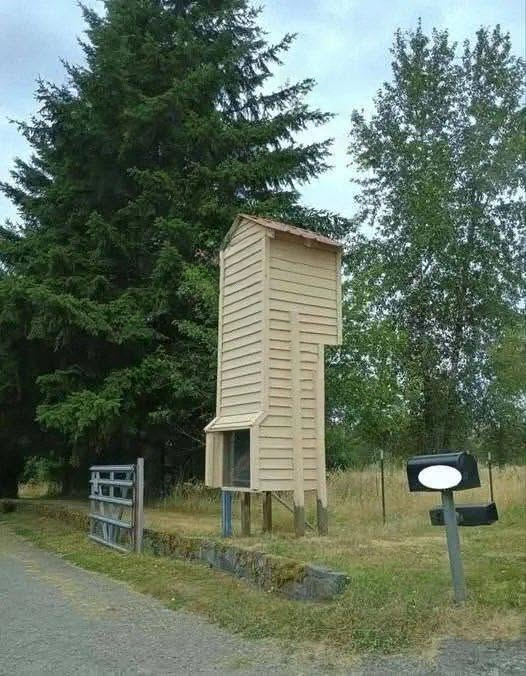
Drivers often notice it for the first time without understanding what they are looking at. Standing quietly beside a rural driveway, a tall, narrow beige structure rises nearly fifteen feet into the air. It has no signage, no branding, no visible wiring, and no electronic components. From a distance, it almost looks like a surveillance tower or an unfinished utility installation placed for reasons unknown.
That sense of mystery is exactly why so many people slow down as they pass it.
But despite its unusual appearance, the structure is not technological or commercial in nature. It is, in fact, a simple and highly practical homemade safety device: a driveway periscope designed to solve a very specific visibility problem.
The need for such a structure becomes clear when you understand the conditions where it is typically installed. In rural or semi-rural areas, some driveways connect to roads that curve sharply or slope in ways that block the view of oncoming traffic. From the perspective of a driver waiting at the edge of the driveway, the road can be partially or completely hidden behind a bend, hill, or obstruction.
This creates a dangerous situation. When a driver attempts to pull out, they may not be able to see approaching vehicles until it is too late to react safely. Even a brief moment of limited visibility can lead to serious accidents, especially on roads where cars travel at higher speeds and have little warning of vehicles entering from side driveways.
The driveway periscope addresses this problem using a concept that is both simple and effective: reflected line of sight.
At its core, the structure functions like a large vertical periscope, similar in principle to those used in submarines, but designed for roadside use. Inside the tall wooden frame are two mirrors carefully positioned at angles that allow light from the roadway to be redirected downward toward the driver’s viewpoint at ground level.
This means that instead of physically inching forward into a potentially dangerous lane to check for traffic, a driver can stand safely at the base of the structure and look into a viewing window that shows them the road above and around the blind curve.
The system requires no power source, no cameras, and no digital processing. It does not rely on sensors, Wi-Fi, or automated alerts. Instead, it operates entirely through basic optical physics—specifically, the predictable way light reflects off mirrored surfaces.
Light from vehicles traveling along the hidden portion of the road enters the top section of the tower. That light is then redirected by the first mirror downward, where a second mirror adjusts the angle again so that the image becomes visible to the driver standing below. The result is a live, real-time visual feed of approaching traffic, created entirely through reflection.
The materials used in its construction are equally straightforward. Typically, the tower is built from a tall wooden or metal frame designed to elevate the viewing system above surrounding obstacles like fences, hedges, or elevation changes. Inside, standard glass and two reflective mirrors form the core mechanism. These are not specialized components, but readily available materials that can be installed, adjusted, or replaced without advanced tools or technical expertise.
What makes this design particularly interesting is not its complexity, but its intentional simplicity. In a world increasingly dominated by digital monitoring systems, sensors, and automated infrastructure, the driveway periscope represents a return to mechanical problem-solving. It demonstrates that not every safety issue requires electronic intervention—sometimes the most reliable solution is one that depends only on physics and careful placement.
The structure also highlights an often-overlooked aspect of rural road safety: visibility is not always guaranteed by road design alone. While major highways and urban intersections are engineered with signage, mirrors, and traffic controls, smaller private driveways often rely on the surrounding landscape and individual property solutions. In cases where terrain makes visibility difficult, homeowners may take it upon themselves to create practical fixes.
This particular type of periscope system is especially useful in areas where modifying the road itself is not possible or too expensive. Instead of cutting back hillsides, removing trees, or reconstructing road curves, a vertical viewing system can be installed on private property to give drivers a safer way to assess oncoming traffic.
Over time, these structures have drawn curiosity from passersby. To someone unfamiliar with its purpose, the tall beige tower can easily be mistaken for something experimental or even official infrastructure. Its lack of labels or visible technology only adds to the confusion. Yet for those who understand its function, it is a quiet example of practical engineering solving a real-world problem in a simple way.
There is also an element of ingenuity in how the system adapts an old scientific principle for everyday use. Periscopes have been used for centuries in different forms, from naval applications to observational tools. Applying the same idea to a driveway may seem unusual at first, but it is a natural extension of the concept: extending a line of sight beyond physical obstacles using reflection.
Perhaps the most important takeaway from the driveway periscope is that effective solutions do not always need to be high-tech or expensive. In many cases, careful observation of a problem leads to straightforward answers that rely on basic principles rather than complex systems. By understanding how light behaves and how human visibility is limited by terrain, a simple structure can significantly improve safety.
In the end, the mystery tower beside the road is not mysterious at all once its purpose is understood. It is a reminder that innovation does not always come in the form of advanced technology. Sometimes it appears as a quiet wooden frame on the side of a rural driveway, using nothing more than mirrors and angles to make everyday travel a little safer.