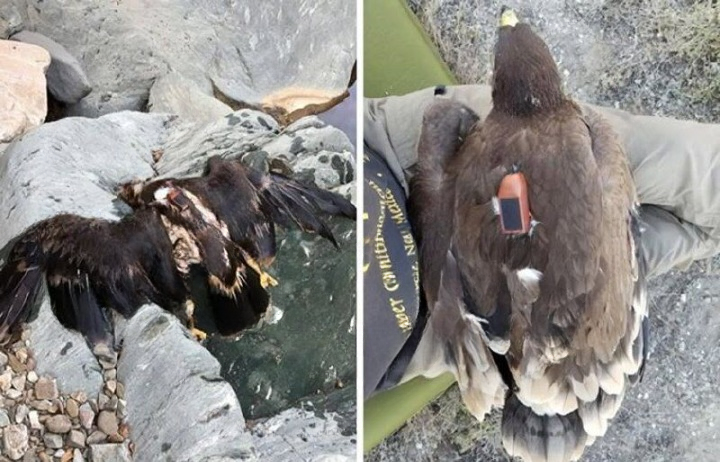
Every year, something extraordinary happens above our heads.
Without fanfare or announcement, millions of birds take flight, leaving behind familiar landscapes and heading toward distant regions they have never seen in their current lifetime. They cross oceans, deserts, mountain ranges, and borders—following routes that stretch across entire continents.
To an observer on the ground, it may look like a simple seasonal movement.
A flock rising into the sky. A shifting line across the horizon. A momentary glimpse of wings disappearing into the distance.
But in reality, migration is one of the most complex and remarkable survival strategies in the natural world. It is a story of endurance, instinct, precision, and adaptation—written not in words, but in motion.
And thanks to modern science, we are now able to follow that story in ways that were never possible before.
A Journey Written Across Continents
Imagine a map where a single path stretches from one side of the world to another.
It begins in a quiet breeding ground, perhaps in northern Europe or central Asia, where birds spend the warmer months raising their young. Then, as seasons change and temperatures drop, that same path extends southward—crossing deserts, forests, coastlines, and entire countries.
Each segment of the route represents survival.
Each stop along the way is not random, but necessary.
These migration routes, often called flyways, have existed for thousands of years. They are shaped by geography, climate, and generations of inherited knowledge passed down biologically from bird to bird.
What makes this journey even more remarkable is its precision. Many migratory species return to the exact same nesting and feeding sites year after year, as if following an invisible roadmap etched into memory.
But it isn’t memory alone guiding them.
The Invisible Navigation System
One of the greatest mysteries of migration has always been navigation.
How does a bird know where to go when crossing thousands of kilometers of unfamiliar terrain?
The answer lies in a combination of extraordinary natural abilities.
Birds are believed to use:
- The position of the sun during the day
- The position of stars at night
- Subtle cues from Earth’s magnetic field
- Visual landmarks such as rivers, coastlines, and mountain ranges
- Instincts shaped by evolution over countless generations
Some species are even capable of adjusting their routes in response to changing environmental conditions, detouring around storms or searching for alternative feeding grounds when resources are scarce.
This internal navigation system is so precise that it rivals modern GPS in accuracy—despite being entirely biological.
And yet, for centuries, humans could only wonder how it worked.
From Mystery to Science: How We Now Follow Migration
For most of human history, bird migration was observed but not understood.
People saw birds disappear in one season and return in another, but their exact routes remained unknown. Entire continents were crossed in silence, leaving only speculation behind.
That changed with advances in modern technology.
Today, lightweight GPS tracking devices can be safely attached to birds without interfering with their natural behavior. These devices record movement data and send it back to researchers in real time.
Scientists can now see:
- Exact flight paths across continents
- Resting and feeding locations
- Migration timing and delays
- Stopover points used for recovery
- Changes in routes over time
Each data point adds another layer to the story.
What once was invisible is now mapped in detail, revealing journeys that span thousands—even tens of thousands—of kilometers.
And with every tracked bird, we gain a deeper understanding of how life moves across the planet.
The Challenges Hidden in the Sky
Migration is not a peaceful journey.
It is a test of endurance, timing, and survival under constant pressure.
Along the way, birds face obstacles that can determine whether they complete their journey or not.
Some of these challenges include long stretches without food or water, particularly when crossing deserts or open oceans. Others involve sudden weather changes—storms, strong winds, or temperature drops that force birds off course.
Predators also play a role, especially during rest stops when birds are vulnerable and exhausted.
Even finding safe places to land can be difficult. A suitable stopover site is not just a resting point—it is a lifeline where birds replenish energy before continuing.
A single disruption in this chain can have serious consequences for survival.
Modern Threats Changing Ancient Routes
While migration has always been challenging, the modern world has introduced new risks that birds have never encountered before.
Human development has significantly altered the landscapes birds depend on.
Habitat loss is one of the most significant threats. Wetlands, forests, and grasslands—once abundant resting and feeding sites—are being reduced due to urban expansion, agriculture, and infrastructure development.
Climate change has also disrupted long-standing patterns. Shifts in temperature and rainfall affect food availability, meaning birds may arrive at a location only to find that the resources they depend on are no longer there.
Urban structures introduce additional hazards. Tall buildings, communication towers, and wind turbines can interfere with flight paths or cause collisions, especially during nighttime migration.
Pollution adds another layer of risk, affecting both air quality and the health of ecosystems that birds rely on.
Each of these challenges alone is significant. Together, they reshape migration in ways that scientists are still working to fully understand.
The Fragility Behind the Journey
One of the most difficult truths about migration is its unpredictability.
Even when a bird follows its instinct perfectly, success is not guaranteed.
A sudden storm can alter direction. A shortage of food can weaken strength. A disrupted habitat can eliminate a critical stopover point.
And sometimes, despite every adaptation nature has provided, the journey ends unexpectedly.
A bird that once crossed continents may fall silent far from its destination.
This is not unusual in nature—but it is always meaningful.
Because behind every recorded path is a living creature navigating a world full of uncertainty.
Why These Journeys Matter More Than They Seem
At first glance, a single bird’s migration might feel like a small story in a vast world.
But in reality, these journeys are deeply connected to the health of entire ecosystems.
Migratory birds play essential roles in nature. They help control insect populations, support plant growth through seed dispersal, and maintain ecological balance across regions.
Their movements also connect ecosystems across continents. A bird feeding in one region may contribute to biodiversity thousands of kilometers away.
Because of this, migration is often seen as an indicator of environmental health. When patterns change, it can signal larger shifts in climate, habitat stability, or ecosystem balance.
The Role of Conservation in Protecting Migration
Understanding migration is only the first step.
The next is protection.
Scientists and conservationists use tracking data to identify critical habitats and migration corridors. These areas become priorities for preservation efforts.
Conservation work often focuses on:
- Protecting wetlands and stopover sites
- Restoring natural habitats
- Reducing harmful environmental impacts
- Designing bird-safe buildings and infrastructure
- Monitoring population changes over time
These efforts benefit more than just birds. Healthy ecosystems support biodiversity, agriculture, and even human well-being.
Protecting migration routes is, in many ways, protecting the balance of nature itself.
A Story That Connects Science and Emotion
While migration is studied through data and observation, it also carries emotional weight.
Watching a bird’s journey unfold across a map creates a sense of connection. It transforms abstract movement into something personal and meaningful.
We begin to imagine the flight—the long hours of travel, the moments of rest, the challenges faced along the way.
And in that imagination, something shifts.
The bird is no longer just part of a dataset.
It becomes a symbol of endurance, vulnerability, and resilience.
Lessons Written in Flight
The story of migration carries several powerful lessons.
Resilience: Even in the face of extreme conditions, birds continue their journeys year after year.
Interconnection: Ecosystems across the world are linked through these movements.
Fragility: Even the most ancient natural patterns can be disrupted by small environmental changes.
Responsibility: Human activity has a direct influence on the survival of migratory species.
These lessons extend beyond biology. They reflect broader truths about balance, change, and coexistence.
Looking Toward the Future
As technology continues to improve, our understanding of migration will deepen even further.
New tracking systems, satellite data, and global research collaborations are revealing patterns that were once impossible to see.
But knowledge alone is not enough.
What matters most is how that knowledge is used.
Whether it leads to stronger conservation efforts, better environmental planning, or greater awareness of our impact on the natural world.
Final Reflection: A Journey That Continues Beyond the Sky
Every migration tells a story.
Not just of movement, but of survival.
Not just of distance, but of connection.
And not just of endings, but of cycles that continue year after year.
A bird’s journey across continents is a reminder that life is both fragile and resilient at the same time. It shows us a world that is constantly in motion, shaped by forces both natural and human.
And even when a single journey ends, the larger story continues—written again and again in the skies above us.
Because migration is not just something birds do.
It is something the Earth itself remembers.