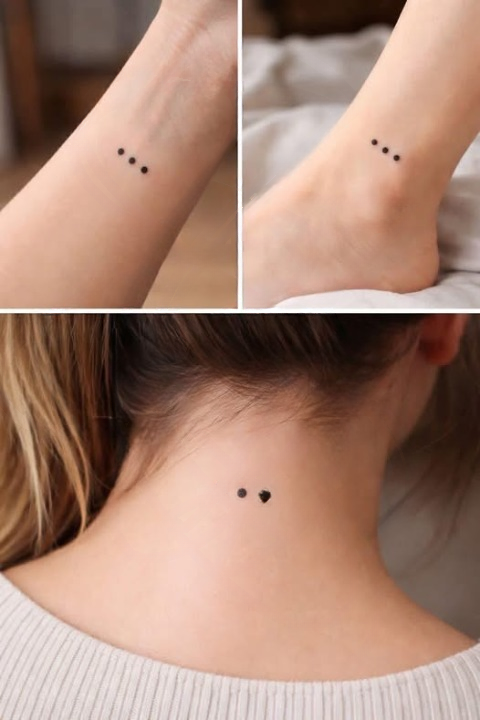
A cluster of three small dots placed between the thumb and forefinger might appear, at first glance, like a minimalist aesthetic choice—something subtle, almost decorative, easily overlooked in passing. But in certain social and cultural contexts, the three-dot tattoo carries a weight far greater than its size suggests. It functions less as ornamentation and more as shorthand: a compressed biography, a signal understood instantly by those familiar with its language, and often misinterpreted by those who are not.
The symbol is most commonly associated with the phrase “mi vida loca,” Spanish for “my crazy life.” Within that framing, the three dots are not tied to a single organization or rigid doctrine, but rather to a broader identity rooted in hardship, street survival, and lived experience on the margins of formal society. In many cases, it reflects an environment where stability was inconsistent, rules were informal, and resilience became a daily requirement rather than a choice. It is not necessarily an indication of current behavior, but it is often read as a marker of a past shaped by risk, defiance, or incarceration.
Another interpretation of the three dots connects them to the “Three Wise Monkeys” philosophy—see no evil, hear no evil, speak no evil. In prison environments, this concept can take on a more coded meaning. It becomes associated with silence, non-cooperation, and loyalty to one’s immediate circle over external authority. In this reading, the tattoo symbolizes a commitment to discretion, a refusal to disclose information, and adherence to an unwritten code of conduct that values silence as a form of protection. This is where the symbol begins to shift from cultural expression into something more consequential, as it becomes linked—fairly or not—to environments where silence is not just a preference but a survival strategy.
In some interpretations, particularly in parts of the United States and Latin America, the three dots can also function as a life marker. Each dot may represent a stage of time served, a personal loss, or a significant chapter endured. In this sense, the tattoo becomes autobiographical, etched into the skin as a permanent record of passage through hardship. Unlike written history, which can be edited or forgotten, this form of documentation is fixed and visible, turning the body into an archive. It tells a story not through explanation, but through implication.
Yet the meaning of the tattoo is not universal, and that ambiguity is part of what makes it powerful—and sometimes problematic. Unlike standardized symbols, its interpretation depends heavily on context: geography, community, and personal history. In one setting it may be read as a sign of affiliation; in another, as a stylistic choice devoid of deeper significance. This variability means that assumptions based solely on appearance can easily lead to misunderstanding. What is intended as a personal reminder of survival in one individual may be perceived as a warning sign by another.
The social consequences of this misunderstanding can be significant. Because tattoos are visible and permanent, they often shape first impressions long before a person has the opportunity to speak for themselves. For individuals who have moved beyond difficult chapters in their lives, the three-dot tattoo can become a lingering label attached to a past they no longer inhabit. It may influence how they are treated in workplaces, public spaces, or formal interactions, regardless of their present circumstances or personal growth.
This tension highlights a broader issue: the way society reads symbols on the body as fixed truths about identity. Tattoos, especially those associated with subcultures or marginalized environments, are frequently interpreted as definitive statements rather than layered expressions. Yet in reality, they often carry multiple meanings at once—personal, cultural, historical, and emotional. The three-dot tattoo is no exception. It can signify loyalty, endurance, regret, identity, or transformation depending on who wears it and why.
It is also important to recognize that the symbolism of such markings evolves over time. What may begin as a marker of a specific experience can gradually shift into something more abstract, especially as individuals grow distant from the circumstances that led to its creation. A tattoo made in youth may later represent a chapter closed rather than a life ongoing. In this way, the meaning of the three dots is not static; it is rewritten continuously by the life of the person carrying it.
Ultimately, the three-dot tattoo exists at the intersection of visibility and interpretation. It is small enough to go unnoticed, yet meaningful enough to provoke immediate assumptions from those who recognize it. Its power lies not in the ink itself, but in the stories projected onto it—stories of silence, survival, identity, and change.
And perhaps the most important truth about it is also the simplest: while symbols can suggest where someone has been, they cannot fully explain where they are now.