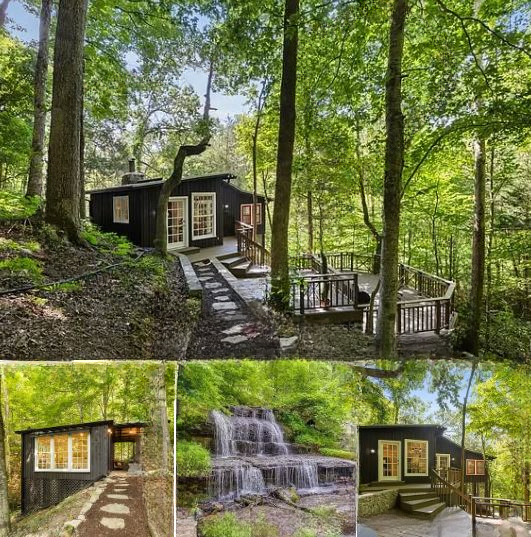
At first, the Fernvale Fishing Club felt like the kind of place people bragged about quietly.
Not a resort. Not a neighborhood. Something in between—105 acres of gated woodland outside Nashville, with a spring-fed lake at its center and only eight cabins scattered like secrets along the shore. My husband, Caleb, called it “a rare find.” I called it “our escape plan.”
We bought into Site #7—the Idlehour Cabin Compound—because it promised simplicity. Two cabins, a private dock, and enough distance from the world to forget how loud life had become.
The first year was exactly what the listing promised: screened porches, slow mornings, fishing lines drifting across glassy water. Even the restrictions felt reasonable—no full-time residency, eleven-month occupancy, shared maintenance through a small HOA. It all sounded like structure, not control.
Until the second summer.
That was when I noticed the rule that didn’t appear in the brochure.
It wasn’t written anywhere official. Not in the paperwork. Not in the welcome packet. We only learned it from a neighbor across the lake, an older man who rarely spoke unless spoken to.
“You’ll notice,” he said one evening, “they don’t like people staying into the twelfth month.”
Caleb laughed it off. “There isn’t a twelfth month.”
The man didn’t smile back.
That winter, we stayed later than usual.
Not by much—just a few extra days in late November, enjoying the quiet before closing up the cabin. The lake was nearly still, the woods stripped down to bare branches. It should have felt empty.
Instead, it felt watched.
On the third night, I saw headlights across the water.
There shouldn’t have been anyone else there. The HOA had closed access for the season.
The lights didn’t move. They stayed fixed on our cabin.
I told Caleb in the morning. He shrugged. “Probably maintenance.”
But maintenance doesn’t sit still at 3 a.m. looking directly at your windows.
The following year, we started noticing patterns.
Boats that appeared only during certain weeks.
Cabins that stayed dark until specific dates, then lit up like synchronized clocks.
And most unsettling of all—the rotation schedule.
It wasn’t just about fairness.
It was about timing.
Every owner’s visits overlapped in precise, repeating intervals. Not random. Not organic.
Designed.
One afternoon, I went down to the dock alone and found a laminated chart tucked under a bench.
It listed every cabin.
Every owner.
Every week of the year.
But one column was labeled differently.
“Observation Cycle.”
I didn’t understand it at first. Until I saw our names highlighted under it.
When I showed Caleb, he went quiet in a way I had never seen before.
“This is just HOA planning,” he said, too quickly.
But he stopped sleeping well after that.
The turning point came during our fourth visit.
We arrived early for spring, expecting the usual quiet reset. Instead, the gate was already open.
Not unlocked.
Open.
And someone had left a note on our porch table.
“Welcome back. Please remain within assigned usage windows.”
No signature.
No explanation.
That night, I walked the property alone.
The woods were silent in a way that didn’t feel natural. Even the lake seemed to hold its breath.
And that’s when I found the cabin behind the tree line.
It wasn’t on any map of the property.
It looked like part of the original 1930s fishing club—older wood, faded paint, almost swallowed by time.
Inside, I found records.
Not maintenance logs.
Behavior reports.
Pages of notes describing owner routines: arrival times, preferred rooms, how often they used the dock, how long they stayed outside in the evenings.
At the bottom of each report was a single line:
“Retention likelihood: high / medium / low.”
My stomach turned cold.
This wasn’t a retreat.
It was a study.
A long-term pattern analysis disguised as lakefront ownership.
And we weren’t participants.
We were subjects.
When I confronted Caleb, he finally admitted what he had been avoiding.
He hadn’t chosen the property randomly. His company had been “offered entry” through a private channel—exclusive access, discounted buy-in, guaranteed resale value.
“They said it was just elite access,” he said quietly. “A networking retreat model.”
But that didn’t explain the observation logs.
Or the locked cabin.
Or why every owner eventually stopped talking about what they saw.
The final piece came the next morning.
A man from the HOA arrived by boat. Polite. Calm. Too calm.
He didn’t deny anything.
Instead, he corrected me.
“This isn’t surveillance,” he said gently. “It’s continuity management.”
“What does that mean?” I asked.
He gestured toward the lake.
“It means people behave differently when they believe they’re being preserved.”
Then he added something I’ll never forget:
“Most members prefer not to leave once they understand how well they fit.”
We left that week early.
But leaving didn’t feel like leaving.
It felt like stepping out of a system that assumed we would eventually come back.
We tried to sell our share.
We learned there was no public market.
Only reassignment.
Only approval.
Only continuation.
And sometimes, I still think about that lake at night—the way it stayed perfectly still even when the wind moved through the trees.
Because the most unsettling part wasn’t the tracking.
It was how peaceful it all looked while it was happening.
And how easily peace can disguise something that was never meant to end.