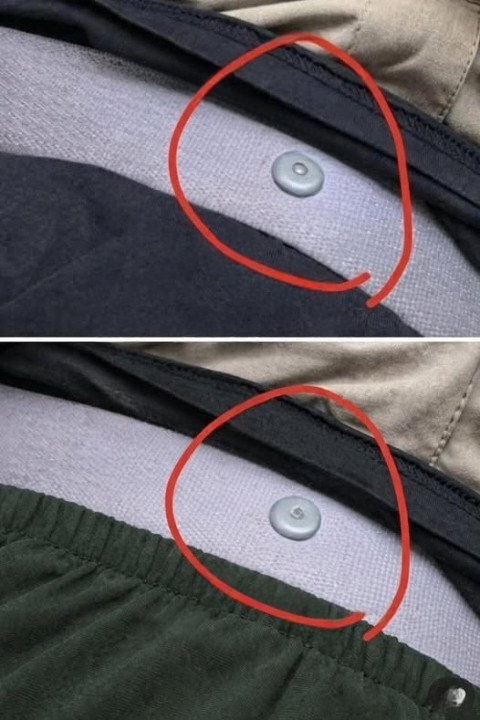
Every time you get into a car, you perform the same automatic motion without thinking. You open the door, sit down, pull the seat belt across your body, and hear that familiar click. It is one of the most routine safety actions in modern life. We rarely question it, rarely analyze it, and almost never consider the engineering hidden within it.
Yet, right there on the seat belt strap, there is a tiny detail most people overlook completely—a small round plastic button.
At first glance, it looks meaningless. It is not part of the buckle, it does not move, and it does not appear to serve any obvious function. Many people assume it is decorative or simply part of how the belt was manufactured. But in reality, this small component plays a surprisingly important role in how your seat belt works every single time you use it.
To understand why, we need to look at what the seat belt is actually designed to do.
A seat belt is not just a strap to “hold you in place.” It is a carefully engineered restraint system designed to manage extreme physical forces during a collision. When a vehicle stops suddenly, your body continues moving forward due to inertia. Without restraint, that motion can cause serious injury as the body impacts the interior of the car. The seat belt’s job is to distribute those forces across the strongest parts of your body—mainly the chest and pelvis—while reducing movement enough to prevent impact injuries.
For this system to work properly, positioning is critical. The belt must sit correctly on your shoulder and chest. If it slips too low or rides too high, it can become less effective or even dangerous in a crash. That is where the small round button comes into play.
This tiny piece is known as a seat belt stopper button. Its purpose is simple but essential: it keeps the metal latch plate (the part you insert into the buckle) in the correct position on the belt when it is not in use.
Without this button, the latch plate would slide freely down the length of the belt every time you unbuckled it. That might not sound like a major issue, but in practice, it would make the seat belt much harder to use. You would have to search for the latch plate, pull it back up, and adjust the belt every time you entered the car. Over time, many drivers would find this inconvenience frustrating—and inconvenience often leads to unsafe habits, like wearing the belt incorrectly or even skipping it entirely.
So, in a very real sense, this small button helps encourage consistent seat belt use simply by making the system easier and faster to operate.
But its role goes beyond convenience.
The stopper button also helps maintain the proper geometry of the seat belt system. Modern seat belts are designed as part of a larger safety network that includes retractors, pretensioners, and load limiters. These systems work together during a collision to tighten the belt instantly, reduce slack, and manage the force applied to the occupant’s body.
For these systems to function optimally, the seat belt must already be in a predictable position before a crash occurs. If the latch plate were constantly sliding and twisting the belt into different positions, it could affect how smoothly the belt engages during sudden force. The stopper button helps keep everything aligned and ready, ensuring the belt behaves consistently every time.
There is also a subtle but important human factor involved: comfort.
Seat belts are designed to be strong enough to withstand enormous force, yet comfortable enough to be worn for long periods. If a belt feels uncomfortable—if it digs into the neck or presses awkwardly against the body—drivers are more likely to adjust it incorrectly. The stopper button helps keep the belt in a stable resting position, reducing unnecessary twisting or shifting that could make it uncomfortable.
In this way, the button indirectly contributes to safety by improving user experience. The more comfortable and intuitive a seat belt is, the more likely people are to use it properly every time.
Interestingly, this small component is rarely mentioned in discussions about car safety, even though it plays a quiet but consistent role in daily driving. It is not something that requires maintenance or adjustment under normal circumstances, and most drivers will never need to think about it. But like many parts of modern engineering, its importance becomes clear only when it is missing or damaged.
If the stopper button breaks or falls off, the difference is immediately noticeable. The latch plate slides freely, often disappearing toward the floor of the car seat. This forces the driver to reach, pull, and adjust the belt every time they enter the vehicle. Over time, this small inconvenience can lead to bad habits, such as wearing the belt incorrectly positioned or partially unfastened for short trips.
While it may be tempting to ignore a missing button, it is not recommended to replace it with makeshift solutions like glue, pins, or clips. Seat belts are safety-critical components, and any modification can interfere with their performance during a crash. The proper solution is always to have the belt inspected or replaced according to manufacturer guidelines.
What makes the stopper button especially fascinating is how it reflects a broader principle of engineering: the most important innovations are often the ones you do not notice.
We tend to focus on advanced features—airbags, sensors, cameras, and automated braking systems. But safety often depends just as much on small, simple components that quietly ensure everything works as intended. The stopper button is one of those details. It does not activate during a crash. It does not emit signals or respond to electronics. Instead, it performs a constant, silent job every time you enter and exit your car.
It ensures readiness.
It ensures consistency.
It ensures that the seat belt is exactly where it needs to be when it matters most.
So the next time you buckle up, take a moment to notice that small round button on the strap. It may look insignificant, but it is part of a carefully designed system built to protect you in one of the most unpredictable moments of driving.
And like many of the best engineering solutions, its success lies in how easily it can be overlooked—until you realize just how important it truly is.