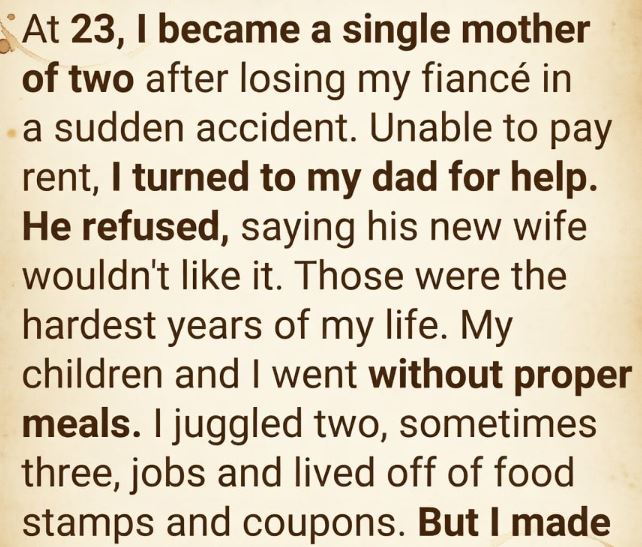
At twenty-three, I learned that love doesn’t always guarantee safety.
When I think back to that time, it feels like a lifetime ago, yet it’s still so clear in my mind—the days when I thought I had it all figured out. I had a partner, a small family, and the kind of hope that comes from believing you’ve finally found the place where you belong. But life, as it often does, had other plans. Losing my partner shattered the illusion of security I’d been clinging to, and my father’s rejection—the one person I thought would always be there for me—sealed the fracture in my world.
I remember standing outside his house that night, two babies in my arms, the cold air biting through my thin coat. There I was, with nowhere to go, wondering how things had gone so wrong. I had always counted on my family to be the ones who would carry me when I couldn’t walk on my own. But that night, the truth hit me like a brick: sometimes, the people you rely on most are the ones who decide you’re too heavy to carry. I had always been the one who helped, who loved unconditionally, but when I needed it in return, it wasn’t there.
It was a moment of profound clarity—one of those moments when everything you thought you knew about love, about family, and about safety falls away. I stopped waiting for someone to come save me after that night. The world had shown me that no one was coming—not in the way I had imagined, anyway. So, I made the choice to become the person who would save me. I became my own rescue.
The Transformation: From Dependence to Strength
Those early years were hard—like scraping by on sheer willpower and determination. There was no grand moment of epiphany or sudden enlightenment. It wasn’t some dramatic leap from despair to triumph. It was simply surviving, day after day, choosing to get up even when it felt impossible. I learned that survival wasn’t about waiting for a knight in shining armor; it was about learning how to fend for myself, how to be strong even when I didn’t feel like it.
I built a life, one small decision at a time. I worked hard to create a home my children could trust, a place where the lights stayed on because I willed them to, even if there was barely enough to get by. I found ways to make ends meet, learned how to fix things that seemed broken beyond repair, and most importantly, I became the kind of mother my children could rely on. I was determined that they would never feel the kind of uncertainty I had felt in my own childhood.
I built this life from the ground up—not with grand plans or dreams of fame, but with the simple, fierce desire to create stability. My world wasn’t perfect, but it was mine. And I had fought hard for it.
But life, it seems, isn’t done with you just because you’ve rebuilt yourself. It has a way of knocking on your door when you least expect it.
The Knock on the Door
It had been years since I’d seen my father. Years since he had turned his back on me at my lowest. When I think about the pain of that rejection, it’s hard to describe. It wasn’t just about the absence of his support—it was the weight of being told, in his silence and in his actions, that I wasn’t worth saving. I had to learn to accept that some doors close, sometimes forever, and no matter how hard you knock, some people will never open them for you.
But then, one day, I was standing at my own door, my life as steady as it had ever been, when I saw a familiar figure in the driveway. My father. Older, his hair grayer, his shoulders a little more hunched. He stood there, looking at me through the screen door, as if waiting for me to make the first move. The years melted away for a moment, and I saw the same man who had once been my world—the same man who had abandoned me when I needed him most.
I don’t know why he came back. Maybe he had been carrying his own regrets, his own burdens, for all these years. Or maybe it was just a realization that time was slipping away, and there were things left unsaid. Either way, there he was, standing at my door, holding the words I had waited so long to hear: an apology. A recognition of the past, of the hurt he had caused.
But even as I listened to his words, I could hear the echo of my own pleading from years before—the desperate, childlike voice that had begged for help, for love, for safety. I could hear it in my head, ringing through the years, asking, “Why didn’t you choose me?” The truth is, I wasn’t sure what I was supposed to do with the apology. The part of me that had craved it for so long, that had waited for the day when he would admit his mistakes, wanted to rush into his arms and let everything go. But the person I had become—the person who had spent years fighting for a life of my own—knew that accepting his apology would be more complicated than that.
The Hardest Decision: Choosing My Own Peace
In that moment, standing in the doorway, I had to make the hardest choice of all: to protect the life I had worked so hard to build. That meant accepting the reality that my father wasn’t the person I needed him to be—and maybe, he never would be. It meant acknowledging that my own journey, the one I had forged with grit and resilience, had to come first. I could hear his apology, but I could also hear the voice of my younger self—the one that had begged for something he wasn’t capable of giving.
I thought about my children, the home I had built for them, the stability I had fought for. I thought about the years of quiet strength it had taken to turn my life around. And I knew, deep down, that I couldn’t risk letting someone in who had once been the source of so much pain. Even if he was remorseful, even if he wished he could go back and change things, the truth was that I couldn’t undo the years of hurt.
So, I made the decision to close the door—not to shut him out completely, but to protect the life I had created. I told him that I appreciated his apology, but that I couldn’t invite him back into my life in the way he might have hoped. The hardest part wasn’t the rejection itself—it was the realization that this was the only thing I could offer him. My peace.
The Question That Stayed Open
As my father turned away, his back hunched with age and regret, I couldn’t help but wonder if I had made the right choice. Was I too harsh? Was there room for healing? Could I ever truly move forward without accepting his apology, without reconciling with the past?
The question that stayed open was the one that had always haunted me: What does it mean to forgive when you’ve already had to save yourself?
The answer, I think, lies in the space between those two things—the love we need and the strength we find within ourselves to keep going, even when we’re told we’re too heavy to carry. In the end, my story wasn’t about waiting for a rescue. It was about becoming the person who could rescue herself. And sometimes, the hardest part of healing is realizing that we don’t have to carry the weight of someone else’s mistakes.