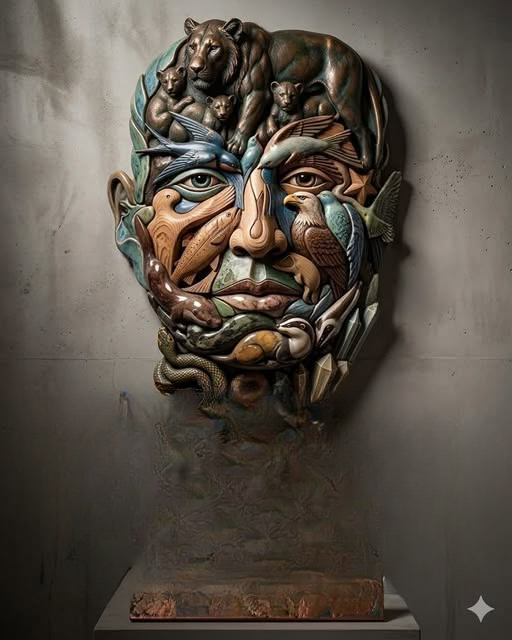
There’s a reason these “first animal you see” images are everywhere right now. They don’t just invite you to look—they demand that you react. Instantly. Without thinking. And in that brief moment between seeing and understanding, something fascinating happens: your brain fills in meaning before your conscious mind has time to intervene.
That’s the entire premise behind the viral “animal perception” test. One image, often layered with overlapping shapes, shadows, and hidden forms, can contain multiple creatures at once. A lion in the branches. A bird in the negative space. A snake in the curves of the design. The claim is simple: whatever you see first isn’t random—it reflects something about how your mind is wired.
It’s not magic. It’s perception.
And perception is far more personal than most people realize.
Why Your Brain Sees What It Sees First
Your brain is not a camera. It doesn’t passively record reality—it interprets it.
When you look at a complex image, your visual system doesn’t analyze everything equally. Instead, it prioritizes patterns it can recognize quickly based on experience, memory, and emotional sensitivity. This is called pattern recognition, and it’s one of the brain’s most powerful survival tools.
In ambiguous images, your mind does something even more interesting: it guesses.
It asks, What is this most likely to be? and then fills in the blanks using your internal “library” of learned associations.
That’s why two people can look at the same illusion and see completely different animals first. One person locks onto a dominant shape immediately, while another notices subtle outlines hidden in the background. Neither is “wrong.” They’re just using different mental shortcuts.
The Psychology Behind the “First Thing You See” Effect
These viral tests are often linked to a mix of real psychological principles and internet-friendly interpretation. One of the key concepts is the primacy effect—the idea that the first thing your brain identifies in a stimulus tends to leave a stronger impression than what follows.
Another is the Gestalt principle, which explains how humans naturally organize visual chaos into complete forms. Your mind hates unfinished patterns. It will aggressively “complete” shapes even when they’re partially hidden or abstract.
Then there’s the Barnum Effect, which plays a major role in why these tests feel so accurate. This is the tendency for people to accept vague, general statements as personally meaningful. If a result says you are “independent but sometimes emotionally guarded,” most people will find at least some truth in it—because nearly everyone experiences those traits at some point.
Put together, these effects create something powerful: a sense that a simple image has revealed something deeply personal.
What the Animals Are “Supposed” to Mean
In most viral versions of this test, each animal is assigned symbolic traits. These interpretations aren’t clinical psychology, but they are based on long-standing cultural symbolism.
If you see a lion first, it’s often interpreted as confidence, leadership, or pride—but also a possible struggle with control or ego.
A rabbit is associated with sensitivity, awareness, and caution, but also anxiety or overthinking in stressful situations.
A bird tends to symbolize independence and a desire for freedom, sometimes at the cost of emotional consistency or commitment.
A snake is often linked to intuition, secrecy, or mistrust—sometimes suggesting someone who observes more than they reveal.
An elephant, meanwhile, represents memory, loyalty, and emotional depth, but can also point toward difficulty letting go of the past.
Again, these are not diagnoses. They are symbolic mirrors—open to interpretation depending on your own experiences.
Why These Tests Feel Weirdly Accurate
The real reason people keep sharing these tests isn’t because they’re scientifically precise—it’s because they feel personal.
When you read a result that vaguely matches something you’ve experienced, your brain does something important: it connects it to memory. That connection creates emotional weight. Suddenly, an abstract image becomes a reflection.
And because the test forces a quick, instinctive choice, it bypasses overthinking. You don’t “study” the image—you react to it. That reaction feels honest, which makes the interpretation feel more credible.
In reality, it’s not revealing a hidden truth. It’s revealing a pattern of attention—what your brain prioritizes in a split second.
That alone can be surprisingly insightful.
What It Doesn’t Mean
It’s important not to mistake these viral tests for psychological evaluation. Real personality assessment involves structured questionnaires, controlled environments, and validated scoring systems developed over years of research.
These images don’t measure personality in a clinical sense. They don’t diagnose traits or uncover hidden flaws. They are not windows into your subconscious in any literal or scientific way.
But dismissing them entirely misses the point as well.
Because what they do measure—attention, perception, instinctive focus—is still a meaningful part of how you move through the world.
The Real Value: Self-Reflection, Not Labels
The most useful way to engage with these tests isn’t to ask, “What does this say about me?” but rather, “Why did I notice that first?”
Was it the boldest shape that caught your eye because you focus on clarity and structure? Or was it a subtle outline hidden in detail because you tend to notice what others miss?
Even if the interpretation isn’t “true,” the reflection it sparks can still be useful.
In that sense, the test becomes less about revealing who you are—and more about noticing how you notice.
The Bigger Reason We Keep Taking Them
These illusions thrive online because they offer something rare: a moment of pause.
In a world where everything scrolls, flashes, and disappears in seconds, they force you to stop. To look. To interpret. To compare your perception with someone else’s.
And in that shared uncertainty—“I saw a bird, what did you see?”—people find connection.
Not because the test is accurate, but because it’s interactive. It turns introspection into a social experience.
Final Thought
So what does the first animal you see really mean?
Not that you have a hidden flaw waiting to be exposed.
Not that your personality is secretly defined by a lion, snake, or bird.
But that your brain is constantly making rapid, invisible decisions about what matters most in a chaotic world—and those decisions shape how you see everything that follows.
In the end, these images don’t reveal a hidden creature in your mind.
They reveal something simpler—and arguably more interesting:
How uniquely your mind builds reality from the same pieces everyone else is looking at.