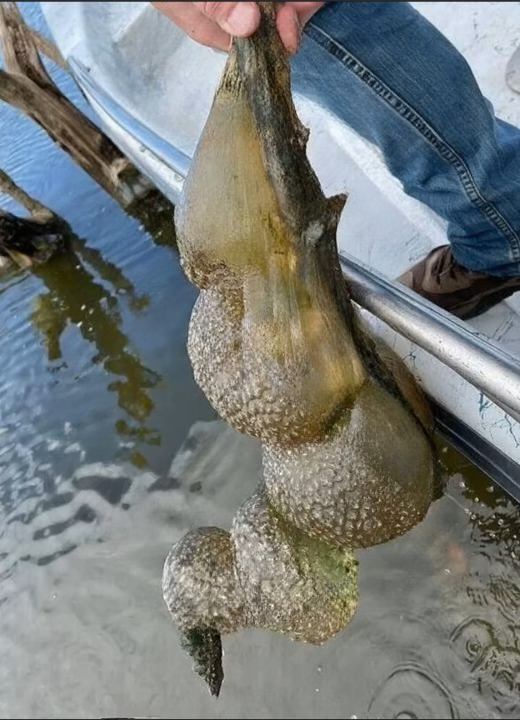
In March 2024, boaters on McGee Creek Reservoir in Atoka County, Oklahoma, reported encountering unusual formations suspended beneath the water’s surface that immediately drew attention. Hanging from submerged branches were translucent, jelly-like clusters that appeared almost otherworldly in the clear freshwater environment.
At first glance, the formations caused confusion and concern among visitors. Their irregular, blob-like shapes and gelatinous texture led some to speculate they might be insect eggs, invasive species, or even an unknown organism. As images of the clusters circulated online, public curiosity intensified, with many attempting to identify the strange underwater phenomenon.
As interest grew, scientists and wildlife officials eventually provided a clear explanation, resolving the mystery.
Scientists Identify the Organisms
According to the Oklahoma Department of Wildlife Conservation, the formations were not harmful or invasive. Instead, they were colonies of bryozoans—microscopic aquatic animals that inhabit freshwater systems across North America and many other regions of the world.
Bryozoans are not single organisms but rather colonies composed of hundreds to thousands of individual zooids. Although they appear as a single gelatinous mass, each colony is made up of tiny, genetically identical organisms working together in a highly coordinated structure.
Each zooid plays a specific role in the colony’s survival, primarily as a filter feeder. Using specialized structures known as lophophores—ring-like arrangements of microscopic tentacles—they draw in water and capture particles such as bacteria, algae, and organic matter. This feeding process sustains the colony while also contributing to the clarity and balance of the surrounding aquatic environment.
Why They Look Like Jelly
The unusual, jelly-like appearance that initially alarmed observers is due to the protective outer layer surrounding the colony. This gelatinous coating helps shield the delicate zooids while they remain embedded within the structure.
When submerged, bryozoan colonies are soft, slippery, and translucent. However, once removed from water and exposed to air, they quickly lose moisture, becoming brittle and less recognizable. Their coloration can vary from clear white to light brown depending on age, environmental conditions, and available nutrients.
In McGee Creek Reservoir, submerged tree branches provided an ideal surface for bryozoans to attach and grow. Calm waters and consistent nutrient flow allowed colonies to expand over time, eventually forming the large, noticeable structures that caught the attention of boaters.
Harmless but Ecologically Important
Despite their strange appearance, bryozoans pose no threat to humans. They do not bite, sting, or produce toxins. Swimmers, anglers, and boaters who encounter them are not at risk.
In fact, scientists often view their presence as a positive ecological indicator. Bryozoans typically thrive in stable freshwater environments with balanced nutrient levels, meaning their presence can suggest relatively healthy water conditions.
Beyond their filtering function, bryozoans also contribute to aquatic food webs. Small fish and invertebrates may feed on them, while other organisms use the colonies as shelter, hiding within their folds and structures. In this way, bryozoans support biodiversity on a microscopic scale.
Ancient Survivors of the Natural World
One of the most remarkable aspects of bryozoans is their evolutionary history. Fossil evidence shows that their ancestors date back hundreds of millions of years, with origins reaching the Ordovician period approximately 470 million years ago.
Over time, bryozoans have adapted to both marine and freshwater environments, diversifying into thousands of species worldwide. The freshwater varieties found in Oklahoma represent only a small portion of this ancient and highly adaptable group.
Their long evolutionary history highlights their resilience. Despite dramatic changes in climate and ecosystems over geological time, bryozoans have continued to survive using highly efficient reproductive and survival strategies.
Reproduction and Survival Strategies
Bryozoans reproduce using specialized structures known as statoblasts—tiny, durable capsules capable of surviving harsh conditions such as freezing temperatures or drought. These structures allow colonies to regenerate when favorable conditions return.
Statoblasts can also be transported between bodies of water by animals, wind, or water currents, helping bryozoans spread and establish new colonies. This adaptability has played a key role in their long-term survival and widespread distribution.
Misunderstood but Essential Organisms
Because bryozoans live underwater and are often small or unnoticed, most people are unfamiliar with them. As a result, encounters with large colonies frequently lead to confusion or concern.
However, scientific research consistently confirms that bryozoans are harmless and beneficial components of freshwater ecosystems. Their presence often indicates a functioning and balanced aquatic environment.
Researchers also use bryozoans as bioindicators, meaning their growth patterns and health can provide insight into water quality and environmental conditions. Changes in their populations may signal shifts in nutrient levels or ecosystem stability.
A Window Into Freshwater Ecosystems
At McGee Creek Reservoir, the appearance of bryozoan colonies suggests favorable environmental conditions that support a diverse range of aquatic life. Clean water, suitable temperatures, and available nutrients created an ideal environment for colony growth.
For scientists, organisms like bryozoans offer valuable insight into ecosystem dynamics. Their feeding behavior helps regulate microscopic organisms in the water, while their structures create miniature habitats for other species.
For the public, the discovery serves as a reminder that freshwater systems are far more complex than they may appear. Beneath the surface, countless organisms interact in intricate ways that sustain ecological balance.
Public Reaction and Scientific Clarification
When the images first circulated online, reactions ranged from curiosity to concern. Without context, the jelly-like formations appeared unusual and unfamiliar, prompting widespread speculation.
However, once experts identified the colonies, public concern quickly shifted to fascination. Many were surprised to learn that such ancient and complex life forms were present in local waters and playing an important ecological role.
Officials encouraged the public to rely on verified scientific information when encountering unfamiliar natural phenomena, emphasizing that many seemingly strange discoveries have simple and harmless explanations.
Conclusion
The jelly-like clusters discovered in McGee Creek Reservoir ultimately proved to be nothing more than ancient colonies of bryozoans—organisms that have existed for hundreds of millions of years and continue to play an important role in freshwater ecosystems today.
What initially appeared mysterious and potentially alarming was, in reality, a natural and beneficial part of the aquatic environment. The discovery highlights how easily unfamiliar forms of life can be misunderstood, and how much complexity exists beneath the surface of even the most familiar landscapes.
In the end, the Oklahoma “jelly blobs” serve as a reminder that nature is often more intricate—and far more fascinating—than it first appears.