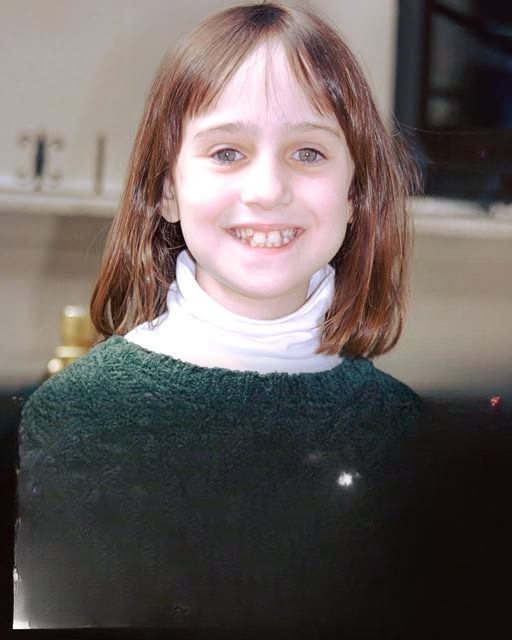
Mara Wilson became one of the most recognizable child actors of the 1990s, a face synonymous with heartfelt family films that defined an entire generation. Born on July 24, 1987, in California, she did not come from a traditional entertainment background. Her early entry into acting happened almost by chance, beginning with television commercials that quickly revealed her natural comfort in front of the camera. Casting directors noticed something rare in her performances: an ease and emotional honesty that didn’t feel manufactured, even at a very young age.
Her first major film role came in 1993 with Mrs. Doubtfire, the Robin Williams-led comedy that became one of the most successful films of its decade. Wilson played Natalie Hillard, one of the children navigating the emotional turbulence of her parents’ divorce. Even among a cast filled with seasoned actors, her performance stood out for its sincerity. She didn’t rely on exaggerated emotion or overacting; instead, she delivered a grounded portrayal that made her character feel real and relatable. That role introduced her to global audiences and positioned her as one of Hollywood’s most promising young talents.
The following year, she starred in Miracle on 34th Street (1994), a remake of the classic holiday film. As Susan Walker, a skeptical young girl slowly learning to believe in Santa Claus, Wilson once again demonstrated a rare emotional balance. She portrayed intelligence and innocence in equal measure, giving the character depth beyond the script’s surface charm. Critics often praised her ability to anchor emotional moments without overshadowing the story, a skill many adult actors struggle to master.
By this point, Wilson’s life was moving at a pace most children never experience. While she was gaining international recognition, her family worked hard to maintain normalcy outside the studio lights. Her parents encouraged her to separate her identity from her career, reminding her that acting was something she did—not who she was. That grounding would later become essential as the pressures of early fame intensified.
In 1996, Wilson landed the role that would define her legacy: Matilda, directed by Danny DeVito and based on the beloved novel by Roald Dahl. As Matilda Wormwood, she portrayed a brilliant, kind-hearted girl with telekinetic abilities who overcomes neglectful parents and a harsh school environment. The film became a cultural landmark, earning enduring popularity and eventually achieving cult-classic status. Wilson’s performance was central to its success. She brought intelligence, vulnerability, and quiet strength to the character, making Matilda feel both magical and deeply human.
However, 1996 also brought a devastating personal loss. Her mother, Suzie Wilson, passed away after battling breast cancer. The tragedy marked a profound turning point in her life. Wilson has described this period as a dividing line—“before and after”—shaping how she understood both childhood and fame. While she continued working, the emotional weight of loss combined with the demands of Hollywood created a complicated internal landscape for someone still growing up.
As she entered her teenage years, Wilson encountered a common but difficult transition experienced by many child actors: the industry’s limited ability to evolve alongside them. The roles she was once perfect for began to disappear, replaced by fewer opportunities that often didn’t align with her identity or interests. Hollywood, known for its rigid casting expectations, struggled to see her beyond the image of her younger self. This disconnect made the path forward increasingly unclear.
Her final major film role came in 2000 with Thomas and the Magic Railroad. After that, Wilson gradually stepped away from acting. Her departure wasn’t a single dramatic decision but a slow, reflective process shaped by both personal choice and industry limitations. Rather than forcing herself into roles that didn’t feel right, she chose to step back entirely. In doing so, she resisted the narrative that former child stars must remain in entertainment to validate their early success.
Life after Hollywood allowed Wilson to redefine her identity outside of performance. She turned to writing as a way to process her experiences and reclaim her voice on her own terms. In 2016, she published her memoir Where Am I Now? True Stories of Girlhood and Accidental Fame, a candid reflection on childhood stardom, emotional growth, and the long-term effects of growing up in the public eye. The book did not rely on nostalgia alone; instead, it examined the complexities of identity, mental health, and self-perception after fame.
She later released Good Girls Don’t, continuing her exploration of expectation, performance, and the pressures placed on young performers—especially girls. Through her writing, Wilson became an articulate commentator on the entertainment industry, offering insight into how child actors are often shaped by external forces before they have the chance to define themselves independently.
Today, Mara Wilson lives a quieter life away from Hollywood, focusing on writing, advocacy, and creative expression. While she remains closely associated with her iconic roles in Matilda, Mrs. Doubtfire, and Miracle on 34th Street, she has built a new identity grounded not in performance but in reflection and authorship.
Her journey highlights a reality often overlooked in discussions about fame: early success does not always lead to lifelong visibility. Sometimes, stepping away is not a retreat but a form of self-preservation and growth. Mara Wilson’s story is ultimately not just about leaving Hollywood—it is about choosing a life defined on her own terms, beyond the characters that once made her famous.