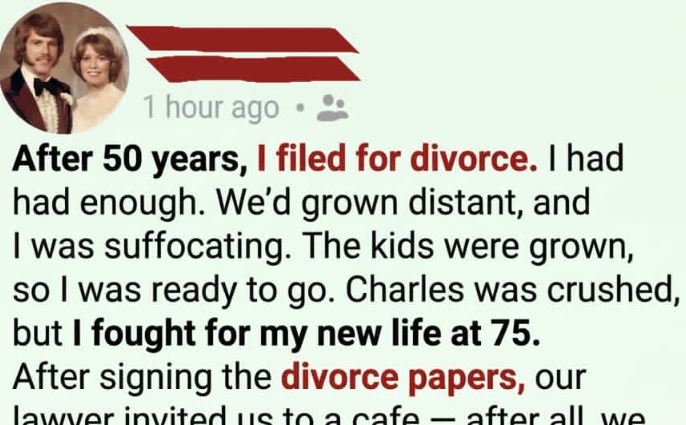
For most of her life, she didn’t recognize what she was giving up—because it rarely arrived all at once.
It came in small adjustments. A decision deferred because it was easier not to argue. A preference set aside because someone else’s mood felt more urgent than her own comfort. A quiet habit of stepping back so the household would feel smoother, calmer, less complicated.
Over time, those small concessions stopped feeling like choices. They started feeling like identity.
By the time she reached seventy-five, she could look back and see the pattern clearly, though it had never felt so defined while she was living inside it. What she once called compromise now looked more like gradual disappearance. Not dramatic, not loud—just steady erosion.
Filing for divorce at that age wasn’t a sudden burst of rebellion. It wasn’t fueled by anger or a desire to rewrite history. It was something quieter than that.
It was recognition.
Recognition that she had spent decades adapting to a life that always seemed to require less of her voice and more of her patience. Recognition that love, at least the version she had been living, had slowly become indistinguishable from obligation. And recognition that continuing the same pattern simply because time had passed did not make it any less painful.
Leaving didn’t feel triumphant.
It felt necessary.
And still, even after the separation, the emotional ties didn’t simply vanish. They rarely do after a lifetime of shared routines and history. So when his stroke came, it arrived like an echo of everything she thought she had stepped away from. The old role tried to return instantly—caretaker, stabilizer, the one who absorbs difficulty so others don’t have to.
For a moment, she felt the familiar pull of guilt. The idea that distance meant cruelty. That choosing herself meant abandoning someone else in a vulnerable state.
But then something unexpected happened.
A letter arrived.
It wasn’t long. It wasn’t dramatic. It didn’t try to rebuild what had been lost or demand forgiveness as a condition for peace. It simply acknowledged what had existed between them in a way neither of them had ever managed while living under the same roof.
It named the imbalance without disguising it as fate. It recognized the patterns without assigning blame as a weapon. And most importantly, it didn’t ask her to fix anything.
There was no instruction hidden inside it. No expectation that she return, repair, or resume the role she had just stepped out of.
It was, in its own fragile way, an apology that didn’t try to reclaim control of the narrative.
And in that absence of demand, something softened in her.
Not the past. Not the consequences. But the pressure she had carried for decades—the belief that her presence was valuable only when it was useful to someone else.
After that, their relationship did not return to what it had been, nor did it transform into something entirely new and idealized. It became something more ordinary, and in many ways, more honest.
She visited him sometimes.
Not out of obligation, but out of choice. And when she did, the visits were different from the life they had shared before. There was no unspoken contract of endurance. No silent expectation that she adjust herself around someone else’s needs.
They spoke more plainly than they ever had before. About small things, about memories, and sometimes about the weight of time itself. There were moments of discomfort, and moments of unexpected clarity.
But when she left, she returned to her own space.
Her apartment was small, filled with light in the late afternoon. There were books she chose for herself, meals she cooked the way she liked them, and paint stains on her fingers from hobbies she had once abandoned because there was never enough time—or permission—to keep them.
Regret still visited her sometimes. It didn’t disappear just because understanding arrived. But it no longer stood alone.
Freedom was there too.
Not the dramatic kind people imagine when they think of starting over, but something quieter and steadier. The freedom to make small decisions without asking permission. The freedom to exist without constantly measuring her worth against usefulness. The freedom to take up space without apology.
Looking back, she no longer framed her life in simple terms of wasted years or lost time. That version felt too incomplete, too harsh on a past she could no longer change.
Instead, she saw it as something more complex.
A long learning curve toward understanding that love, to be real, cannot require disappearance.
And that choosing herself—though it came late, and after much had already been lived—was not an act of betrayal toward anyone else.
It was, finally, an act of beginning toward herself.