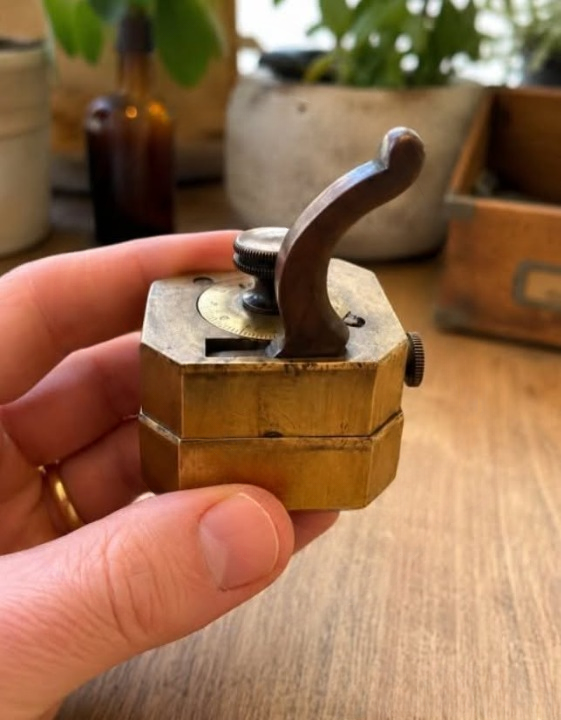
Flea markets are full of forgotten treasures, and part of the excitement is never knowing what you might discover. During a recent visit to a local market, one unusual object immediately caught my attention. It was a small metal device with an intricate design, sturdy construction, and a mechanism unlike anything I had seen before. The seller wasn’t entirely sure what it was, describing it only as an old medical instrument. Intrigued by its craftsmanship and the mystery surrounding it, I decided to bring it home. What I later learned revealed a fascinating chapter of medical history and reminded me how dramatically healthcare has evolved over the centuries.
At first glance, the object looked more like a precision tool than a medical instrument. It featured a compact metal body with a spring-loaded mechanism hidden inside. Although it showed signs of age, it was remarkably well preserved, and its careful engineering suggested it had once served an important purpose. Curious to uncover its story, I began researching antique medical devices and comparing photographs from museum collections.
After some investigation, I identified the object as a scarificator, a historical medical instrument used during the practice of bloodletting. While the name may sound unfamiliar today, scarificators were once common tools in medical care throughout Europe and North America.
A Look Back at an Earlier Era of Medicine
For hundreds of years, physicians believed that many illnesses were caused by an imbalance of the body’s natural fluids, often referred to as the “humors.” Based on the medical knowledge available at the time, doctors thought that carefully removing small amounts of blood could help restore balance and improve a patient’s condition.
Although modern medical science has shown that bloodletting is rarely appropriate outside of a few specific medical conditions, it was once considered a standard treatment for a wide variety of illnesses, including fevers, headaches, infections, and inflammatory conditions.
The scarificator was developed to make the procedure faster and more consistent than using a handheld blade alone.
How the Instrument Worked
Inside the small metal case is a carefully designed spring mechanism connected to several tiny blades.
When the device was activated, the blades briefly extended through small openings before instantly retracting. This created a series of shallow, controlled incisions on the skin.
The design allowed physicians to perform the procedure with greater consistency than making individual cuts by hand.
For an instrument created long before modern manufacturing technology, the engineering is surprisingly sophisticated. Every moving part demonstrates the precision and craftsmanship of skilled metalworkers from the period.
Today, collectors and historians often admire these instruments not for their medical use, but for their mechanical ingenuity and historical significance.
Why Bloodletting Was Once So Common
It’s easy to wonder why such treatments were widely accepted for so long.
The answer lies in the limited scientific knowledge available centuries ago.
Before the development of modern microbiology, advanced diagnostic tools, and evidence-based medicine, physicians relied on the best theories and observations they had. Many treatments were based on long-standing traditions passed from one generation to another.
As scientific understanding improved during the 18th and 19th centuries, researchers gradually learned more about how the human body actually functions. New discoveries about anatomy, infection, circulation, and disease eventually transformed medical practice.
These advances led to safer, more effective treatments and significantly improved patient care.
A Fascinating Piece of History
Holding the scarificator in my hands felt like holding a small piece of history.
Its worn metal surface hinted at decades—perhaps even centuries—of use.
It likely passed through the hands of physicians who genuinely believed they were helping their patients using the best medical knowledge available at the time.
While many historical medical practices now seem unusual, they represent important steps in humanity’s ongoing search for better healthcare.
Each generation builds upon previous discoveries, correcting misconceptions and expanding scientific understanding.
Why People Collect Antique Medical Instruments
Objects like scarificators have become popular among collectors, museums, and history enthusiasts for several reasons.
They offer insight into:
- The evolution of medical science.
- Historical craftsmanship and engineering.
- The development of surgical instruments.
- How healthcare practices have changed over time.
- The importance of scientific research in improving patient care.
Rather than viewing these tools as symbols of outdated medicine, many people appreciate them as educational artifacts that illustrate how knowledge evolves.
Appreciating History Through Everyday Finds
One of the most rewarding aspects of visiting flea markets, estate sales, and antique shops is discovering objects with unexpected stories.
Many items that appear ordinary at first glance have fascinating backgrounds connected to everyday life, technology, science, or culture.
Researching an unfamiliar object can become an enjoyable learning experience, transforming a simple purchase into an opportunity to explore history from a new perspective.
A Reminder of How Far Medicine Has Come
Modern healthcare benefits from centuries of scientific research, clinical studies, improved technology, and a deeper understanding of the human body.
Historical instruments like the scarificator remind us that medical knowledge has continually evolved through observation, experimentation, and discovery.
While treatments once considered standard are now largely obsolete, they played a role in the long journey toward today’s evidence-based medicine.
Finding this unusual antique turned out to be far more rewarding than I expected. What began as an interesting flea market purchase became a fascinating lesson in medical history, craftsmanship, and scientific progress. Sometimes the most memorable discoveries aren’t the most valuable antiques—they’re the ones that inspire curiosity and reveal just how much the world has changed over time.