Flea markets are full of mysteries.
One table might hold forgotten family photographs, another might display antique clocks, vintage toys, or unusual tools whose original purpose has long been forgotten. Part of the excitement comes from discovering objects that spark curiosity and invite questions.
That was exactly what happened when I came across a small metal device at a flea market.
The seller had no idea what it was.
Neither did I.
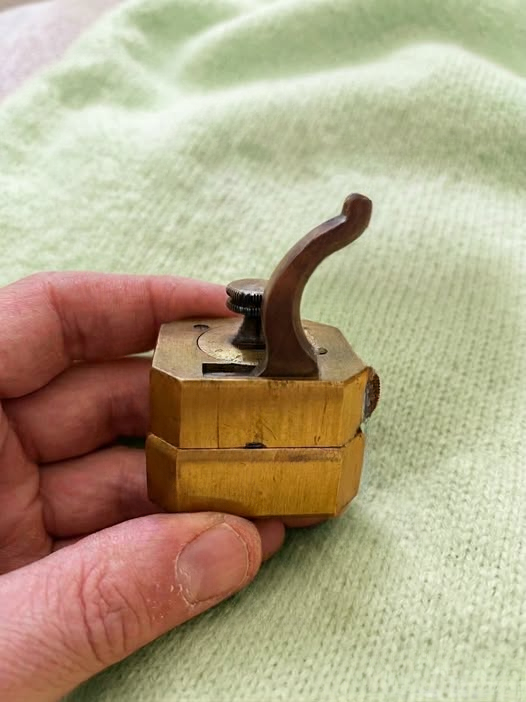
At first glance, it looked like some kind of mechanical tool. It was compact, surprisingly heavy for its size, and featured an intricate design that suggested it had been carefully engineered. The metal showed signs of age, but the mechanism still seemed functional.
Something about it fascinated me.
I bought it for a few dollars, thinking it would make an interesting conversation piece.
What I didn’t expect was that it would lead me down a fascinating journey into the history of medicine.
A Mystery Worth Solving
Once I got home, I began examining the object more closely.
It had a smooth metal casing and a spring-loaded mechanism hidden inside. There were no obvious markings that explained its purpose. It wasn’t immediately recognizable as a household tool, and it certainly didn’t resemble anything commonly used today.
Curiosity got the better of me.
I searched online, compared photographs, and eventually found images of nearly identical devices.
The answer surprised me.
The object was an antique scarificator—a medical instrument once used during the practice of bloodletting.
What Is a Scarificator?
A scarificator was designed to make multiple shallow cuts in the skin quickly and uniformly.
Inside the device were several tiny blades connected to a spring-loaded mechanism. When activated, the blades briefly emerged and then retracted almost instantly, creating a series of small, controlled incisions.
The instrument was often used alongside bloodletting cups or other techniques intended to remove blood from the body.
Today, the idea may sound unsettling, but for centuries bloodletting was one of the most widely accepted medical treatments in the world.
Physicians genuinely believed it could help cure illness.
The Medical Theory Behind Bloodletting
For much of human history, medical knowledge was based on theories that seem unusual by modern standards.
One of the most influential ideas was the concept of the “four humors,” an ancient belief that the body contained four essential fluids:
- Blood
- Phlegm
- Yellow bile
- Black bile
According to this theory, good health depended on keeping these fluids in balance.
When someone became ill, many doctors believed the problem resulted from an excess or imbalance of one of these substances.
Bloodletting was intended to restore equilibrium.
As a result, patients suffering from a wide range of conditions—including fevers, headaches, infections, inflammation, and numerous other ailments—were often treated by having blood removed.
At the time, it was considered legitimate medical practice.
A Tool Used Around the World
Scarificators became especially popular during the 18th and 19th centuries.
Many were beautifully crafted instruments, often stored in wooden cases and made from brass, steel, or other durable materials.
Some physicians carried them as essential parts of their medical kits.
The spring-loaded design allowed doctors to perform the procedure more quickly and consistently than using individual blades by hand.
To modern eyes, the device may seem alarming.
But to people living at the time, it represented advanced medical technology.
Patients often viewed it as a symbol of professional care and expertise.
A Reminder of How Medicine Evolves
Holding the antique scarificator in my hand, I couldn’t help thinking about how dramatically medical understanding has changed.
The doctors who used these devices were not trying to cause harm.
They were working with the best knowledge available to them.
Many genuinely believed they were helping their patients recover.
History is filled with examples of treatments once considered cutting-edge that were later abandoned as science advanced.
Medical progress often involves questioning long-held assumptions, testing new ideas, and learning from mistakes.
The scarificator serves as a powerful reminder of that process.
What once represented trusted medical wisdom is now viewed as a historical curiosity.
More Than Just an Antique
What struck me most wasn’t the device itself.
It was what the object represented.
This small metal instrument had likely witnessed countless moments of hope, fear, and trust.
Patients sat before doctors believing the treatment would help them heal.
Families placed faith in medical professionals who were doing their best with limited knowledge.
The scarificator became a silent participant in those stories.
Looking at it today, it’s easy to focus on how outdated the practice seems.
But it also highlights something timeless: humanity’s constant search for better ways to understand and treat illness.
The Unexpected Value of Forgotten Objects
When I purchased the strange metal device at the flea market, I thought I was buying an unusual collectible.
Instead, I discovered a tangible connection to medical history.
What appeared to be an odd, forgotten tool turned out to be a fascinating artifact from an era when medicine was very different from what we know today.
It’s a reminder that everyday objects can carry remarkable stories.
Sometimes the most intriguing discoveries aren’t the most valuable items at a flea market.
They’re the ones that reveal how people lived, what they believed, and how far society has come.
And thanks to one mysterious little device, I’ll never look at antique tools—or the history behind them—in quite the same way again.