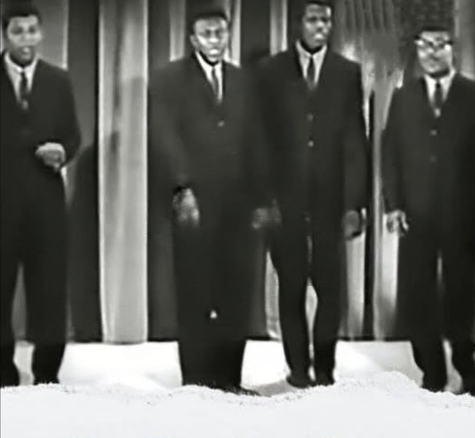
In the landscape of American music, few songs have managed to preserve the raw emotional sincerity of their origin story quite like “In the Still of the Night” by The Five Satins. Recorded in 1956 in the most unassuming of places—a church basement with limited equipment and no expectation of greatness—the song became one of the defining romantic ballads of the doo-wop era. What began as a personal expression of young love transformed into a timeless anthem that still resonates across generations.
At its heart, the song is not just a piece of music history—it is a portrait of teenage emotion captured at its most vulnerable and honest moment.
A Love That Became a Melody
The story begins with Fred Parris, a 19-year-old soldier stationed in Philadelphia during the mid-1950s. Like many young men of his generation, his life was shaped by service, distance, and longing. During a weekend leave, he spent time with his girlfriend Marla, an experience that left a lasting emotional imprint.
When he returned to duty, the contrast between connection and separation became overwhelming. That feeling—sweet, painful, and unresolved—followed him into quiet moments of reflection. As Parris later explained, there is always something singular about first love, a kind of emotional clarity that never quite returns in the same way again.
It was during one of those reflective moments, while stationed and standing watch, that the foundation of “In the Still of the Night” began to form. He wasn’t trying to write a hit song. He was simply trying to hold onto a feeling that was slipping away.
Writing Through Longing
Back at camp, Parris sat at a piano in the day room and began shaping the chords and melody that would eventually define the track. The result was not polished or calculated—it was instinctive. He built the song around emotional memory rather than technical structure.
The lyrics emerged from a place of yearning, capturing the quiet intensity of missing someone deeply. The opening lines and signature vocal phrasing were designed not to impress, but to echo the way memory itself feels: repetitive, soft, and slightly haunting.
What made the composition stand out even in its earliest form was its honesty. It didn’t rely on metaphor-heavy storytelling or complex arrangement. Instead, it leaned into simplicity, allowing emotion to carry the weight of the music.
A Church Basement Recording That Changed Everything
Later in 1956, The Five Satins gathered to record the song in a place few would associate with musical history: the basement of St. Bernadette’s Church in New Haven, Connecticut.
There was no professional studio atmosphere. The equipment was minimal—just basic tape recorders and the natural acoustics of a cold, echoing space beneath the church. But what the setting lacked in sophistication, it compensated for in atmosphere.
The room itself played a role in shaping the final sound. The reverb of the basement, the distance between voices, and the rawness of the recording created something that felt almost otherworldly. It wasn’t engineered perfection—it was accidental emotion captured on tape.
Fred Parris’ lead vocals carried a fragile intensity, while the group’s harmonies layered behind him like echoes of memory. The now-iconic “sho-doo-shoo-be-doo” intro was not just a stylistic choice—it became a defining sonic signature that immediately pulled listeners into the emotional world of the song.
Parris himself later reflected on the experience, suggesting that the environment felt almost sacred, as if the space itself had preserved something special within the recording.
A Song That Didn’t Need Instant Fame
When “In the Still of the Night” was released, it reached a respectable position on the Billboard charts, peaking at number 24. While that was a solid achievement, it did not immediately signal the cultural permanence the song would eventually achieve.
And yet, something unusual happened over time: the song refused to fade.
Unlike many hits of the era that rose and fell with changing musical trends, this track continued to resurface—on radio stations, at dances, in films, and across generations of listeners who discovered it long after its release.
Ironically, the personal relationship that inspired the song did not share the same longevity. Marla, the girl at the center of Parris’ inspiration, eventually moved away, and their story ended quietly. But the emotional essence of that connection remained preserved in the music.
The Rise of a Cultural Standard
As decades passed, “In the Still of the Night” became one of the most frequently covered doo-wop songs in history. Artists such as The Beach Boys, Debbie Gibson, and Boyz II Men each reinterpreted it, adding their own stylistic layers while preserving its emotional core.
Its presence in popular films like Dirty Dancing and The Irishman further reinforced its place in cultural memory. Each appearance introduced the song to new audiences who had never lived through the 1950s but still recognized the emotional language of longing and romance embedded within it.
This cross-generational appeal is part of what makes the song so enduring. It does not rely on nostalgia alone—it speaks to something universally human.
The Emotional Architecture of Doo-Wop
To understand why “In the Still of the Night” remains powerful, it helps to understand doo-wop itself. The genre thrives on harmony, repetition, and emotional directness. It is music built not around complexity, but around feeling.
The Five Satins exemplified this approach perfectly. Their arrangement allowed each vocal layer to contribute to a collective emotional experience rather than compete for attention. The result is a sound that feels intimate even when performed by a group.
The song’s structure mirrors memory itself—softly repetitive, emotionally circular, and deeply personal.
Why It Still Resonates Today
Modern listeners continue to connect with the song not because they share the exact context of 1950s teenage romance, but because they recognize its emotional truth.
Everyone understands:
- The intensity of first love
- The pain of separation
- The quiet moments of reflection that follow emotional change
- The way memories return unexpectedly through sound
These experiences transcend time, making the song feel perpetually relevant.
Even in an era defined by digital production and rapidly shifting musical trends, “In the Still of the Night” stands apart because it feels untouched by time. It does not try to modernize itself. Instead, it remains exactly what it was at its creation: a captured moment of emotional honesty.
A Legacy Preserved in Harmony
Fred Parris, who passed away in 2022, often reflected on how unexpected the song’s journey had been. What began as a private emotional expression became a global standard for romantic music.
The Five Satins never set out to define a genre or influence decades of musicians. They simply recorded a feeling. But in doing so, they created something that outlasted its origin, its era, and even its creators.
Today, “In the Still of the Night” remains more than a doo-wop classic. It is a reminder of what music can do when it is rooted in sincerity rather than intention.
A church basement, a teenage love, and a few simple harmonies were enough to create something that time has never been able to erase.
And perhaps that is the real legacy of the song: proof that the most enduring art is often born not from perfection, but from emotion too honest to ignore.