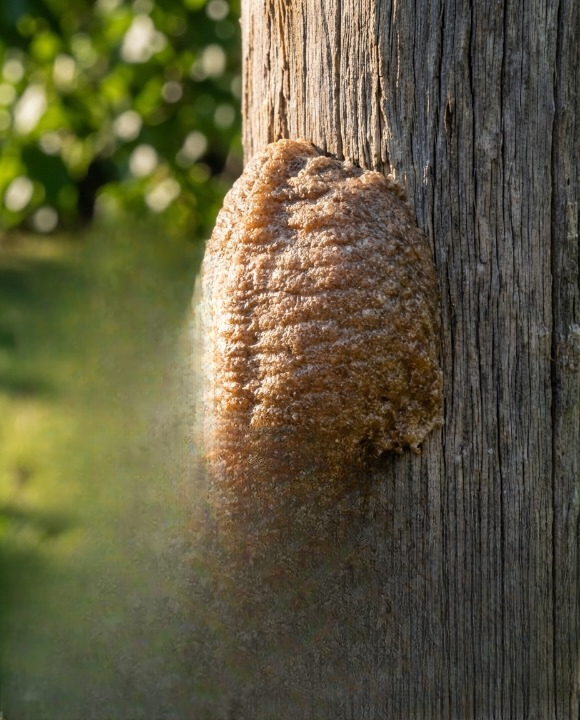
While tidying up your backyard or inspecting your fence line, you might stumble upon something unusual — a hardened, tan-to-brown clump firmly attached to wood, brick, or plant stems. It may look like dried expanding foam, textured mud, or even a strange fungus. Its ridged, papery surface can appear both delicate and surprisingly sturdy at the same time.
At first glance, many homeowners assume it’s debris, insect damage, or an unwanted growth that needs to be removed. However, this curious structure is often something remarkable and beneficial to your garden ecosystem.
In many cases, that foam-like brown mass is an ootheca, the protective egg case of a Praying mantis.
Before scraping it away, it’s worth understanding what it is, how it forms, and why it can actually be a positive sign for your outdoor space.
What Exactly Is an Ootheca?
An ootheca (pronounced oh-uh-THEE-kuh) is a specialized egg case created by certain insects, including mantises. It serves as a protective chamber for dozens — sometimes hundreds — of developing eggs.
Rather than laying individual exposed eggs, the female mantis produces a frothy secretion that quickly hardens into a durable, insulated casing. Inside this structure, her offspring remain safe throughout winter until conditions are right for hatching.
If you’ve found one attached to:
-
A wooden fence
-
A shrub branch
-
A tree trunk
-
A garden stake
-
The underside of a deck rail
There’s a good chance it’s a mantis ootheca.
How the Egg Case Is Created
The process begins in late summer or early autumn. After mating, a female mantis searches for a stable, sheltered surface where she can anchor her eggs.
Once she selects a location, she begins laying eggs while simultaneously secreting a foam-like substance from specialized glands in her abdomen. As this secretion is exposed to air, it rapidly expands and hardens.
This hardened foam becomes the ootheca — a lightweight yet protective shell designed to:
-
Insulate against cold temperatures
-
Shield from rain and snow
-
Protect against predators
-
Prevent dehydration
The structure may appear modest, but biologically, it’s an impressive example of natural engineering.
What Does It Look Like?
While appearance varies slightly by species, most mantis egg cases share common features:
-
Light brown to dark tan coloring
-
An elongated oval or rounded shape
-
A ridged or ribbed surface
-
Firm, foam-like texture
-
Size typically between 1–2 inches long
It may resemble dried spray insulation or a small hardened sponge glued to a surface.
Importantly, it is not mold, fungus, or a wasp nest.
What’s Inside the Ootheca?
Inside the egg case are carefully arranged rows of mantis eggs. Depending on the species, a single ootheca can contain anywhere from 50 to 300 eggs.
Common species in North America include:
-
Carolina mantis
-
Chinese mantis
The Carolina mantis is native to the southeastern United States, while the Chinese mantis was introduced in the late 19th century and has since become widespread.
The eggs remain dormant throughout winter in a state called diapause — a natural pause in development triggered by environmental conditions.
This ensures the young do not hatch during temporary warm spells.
Winter: A Waiting Period
Throughout the colder months, the ootheca remains firmly attached to its surface. The hardened casing acts as insulation, helping to regulate internal temperature despite fluctuating outdoor conditions.
Snow, rain, frost, and wind may affect the outside, but the eggs inside are protected.
During this time, the developing mantises are essentially waiting for spring’s arrival.
Spring: The Hatch
When temperatures consistently rise and daylight increases, the eggs inside begin to develop rapidly.
At the right moment, dozens — sometimes hundreds — of tiny mantis nymphs emerge through small openings in the case.
The sight can be surprising: miniature mantises, complete with tiny front legs adapted for grasping prey, begin to disperse almost immediately.
Each nymph:
-
Looks like a tiny adult mantis
-
Is fully capable of hunting
-
Receives no parental care
-
Begins life independently
Within hours, they harden and start feeding on small insects.
Why Mantises Are Beneficial
Finding a mantis egg case on your property is often a positive sign. Mantises are considered beneficial insects because they are natural predators.
They feed on:
-
Aphids
-
Flies
-
Grasshoppers
-
Moths
-
Beetles
-
Leafhoppers
-
Various garden pests
Because they consume many insects that damage plants, mantises act as natural pest control agents.
Rather than relying heavily on chemical pesticides, encouraging natural predators can help maintain ecological balance.
Do Mantises Harm Beneficial Insects?
Mantises are generalist predators. This means they do not exclusively target harmful insects. They may also eat:
-
Butterflies
-
Bees
-
Other beneficial insects
However, their overall impact is generally considered helpful in garden ecosystems, especially when balanced with other wildlife.
Should You Remove the Egg Case?
In most cases, it’s best to leave the ootheca undisturbed.
However, you may need to relocate it if:
-
You’re painting the fence
-
The branch will be pruned
-
It’s located in a high-traffic area
-
It risks being crushed
Relocation is possible with care.
How to Safely Relocate an Ootheca
If necessary, follow these steps:
-
Use a thin blade or pruners to gently remove the portion of the branch or surface holding the egg case.
-
Avoid puncturing or crushing the center.
-
Reattach it to a similar height and orientation using:
-
Non-toxic glue
-
Twine
-
Garden wire
-
-
Position it off the ground to prevent moisture damage and ant predation.
-
Ensure the ridge or exit area faces outward.
Relocation should be done before spring hatching begins.
What Not to Do
Avoid:
-
Spraying it with insecticide
-
Crushing it unnecessarily
-
Submerging it in water
-
Leaving it on the ground
These actions may prevent successful hatching.
Signs the Ootheca Has Already Hatched
After hatching, you may notice:
-
Small slits or openings
-
A lighter, empty appearance
-
No visible activity
An empty case poses no harm and can be removed if desired.
Why They Choose Fences and Branches
Female mantises prefer:
-
Elevated locations
-
Stable surfaces
-
Areas with moderate shelter
Wood fences and shrubs provide ideal anchor points.
The placement increases survival odds by:
-
Avoiding ground predators
-
Reducing flooding risk
-
Providing nearby food sources for hatchlings
A Sign of a Healthy Yard
The presence of mantis egg cases often indicates:
-
A thriving insect population
-
Low pesticide use
-
Balanced outdoor ecosystems
It suggests your yard supports biodiversity.
Common Misidentifications
People sometimes confuse mantis oothecae with:
-
Mud dauber nests
-
Fungus growth
-
Tree galls
-
Expanding insulation foam
Mud dauber nests, for example, are typically tubular and made of mud, not foam-like material.
Understanding the difference helps prevent accidental removal.
Ecological Importance
Mantises play a role in the food web. They:
-
Help control insect populations
-
Serve as prey for birds and reptiles
-
Contribute to ecological balance
While not the sole solution to pest control, they are part of a larger system.
Observing the Hatch
If you suspect your ootheca will hatch soon:
-
Monitor during warm spring mornings
-
Avoid disturbing the area
-
Watch from a distance
The emergence process may last several hours.
Managing Expectations
Not all hatchlings survive. Natural selection ensures only a portion reach adulthood.
Factors affecting survival include:
-
Predation
-
Weather
-
Food availability
Even so, allowing the process to occur supports biodiversity.
When to Consult a Professional
If you’re unsure whether the structure is a mantis egg case or something potentially harmful, consider contacting:
-
A local extension office
-
A licensed pest control professional
-
A wildlife educator
Accurate identification is important before taking action.
Embracing Natural Balance
Modern landscaping often emphasizes control and uniformity. Yet nature operates through complexity and balance.
Allowing beneficial insects to thrive can:
-
Reduce chemical dependency
-
Promote pollinator health
-
Support soil vitality
-
Strengthen plant resilience
The small brown structure on your fence may be part of that larger system.
Final Thoughts
If you discover a hardened, foam-like brown clump attached to your fence or garden structure, it is likely the egg case of a praying mantis.
Rather than removing it immediately, consider its ecological value. Inside that modest casing may be dozens of future garden predators ready to help maintain balance in your outdoor space.
Sometimes what looks like clutter is actually nature at work.
By observing before acting, you allow your garden to function as an interconnected ecosystem — one that often manages itself more effectively than we realize.