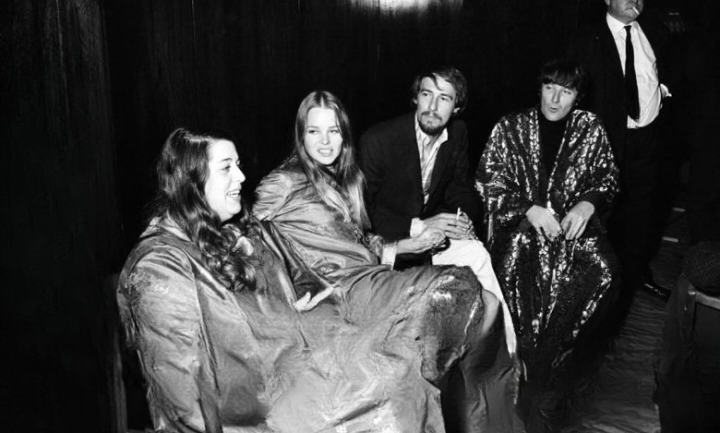
In the early 1960s, New York City stood as a restless crossroads of art, ambition, and cultural transformation. Musicians, poets, and dreamers crowded its cafés and apartments, each chasing a version of success that felt just within reach. Among them were John and Michelle Phillips, a young couple navigating both their personal relationship and the shifting landscape of American folk music. Michelle, originally from California, found herself increasingly affected by the stark contrast between her sunlit home state and the gray, biting winters of the East Coast. That sense of displacement—quiet but persistent—would become the emotional foundation for one of the most iconic songs of the decade: California Dreamin’.
The song’s origins are rooted in a deeply personal moment. As the story goes, John Phillips began writing the opening lines after noticing Michelle’s homesickness during a particularly cold New York winter. The couple, then performing as part of the folk group The New Journeymen, were still searching for a distinct musical identity. What emerged from that domestic observation was something far larger than a private expression of longing—it was a universal articulation of restlessness and desire for escape. Soon after, John and Michelle joined Denny Doherty and Cass Elliot to form The Mamas & The Papas, whose rich harmonies and pop-folk fusion would define their place in 1960s music.
California Dreamin’ captured something both intimate and expansive. Its opening line—“All the leaves are brown, and the sky is gray”—immediately grounds the listener in a mood of quiet dissatisfaction. Yet beneath that melancholy lies an undercurrent of hope. The song does not merely describe longing; it transforms it into motion, into a mental journey toward warmth, light, and possibility. In doing so, it resonated far beyond Michelle Phillips’ personal experience. It became a reflection of a generation navigating social change, geographic mobility, and shifting cultural ideals about freedom and identity.
Interestingly, the song’s first recorded version was not by The Mamas & The Papas themselves but by Barry McGuire. The group contributed background vocals to that early rendition, but it was clear the song carried more potential than a supporting role could contain. When they recorded their own version, with Denny Doherty on lead vocals and Cass Elliot, John Phillips, and Michelle Phillips providing harmonies, the result was strikingly cohesive. Their voices intertwined with a balance of softness and clarity that gave the track its signature emotional texture.
The recording process itself reflected the experimental spirit of the era. Jazz musician Bud Shank contributed an improvised alto flute solo that added a haunting, almost dreamlike quality to the arrangement. Guitarist P.F. Sloan’s understated introduction helped establish the song’s melancholic tone, grounding its emotional weight in a simple but effective musical motif. These contributions, though seemingly small, played a crucial role in shaping the song’s identity as something both polished and organic.
Upon its release in late 1965, California Dreamin’ did not immediately dominate the national charts. Its rise was gradual, fueled in part by radio play on a Boston station that recognized its appeal and began giving it consistent airtime. As it spread, listeners connected deeply with its emotional duality—its ability to be both wistful and uplifting. By March 1966, the song had reached number four on the Billboard Hot 100, cementing its place in the cultural landscape of the decade.
The song’s enduring power lies in its universality. While born from a specific personal experience, it speaks to a broader human impulse: the desire to move toward something better. Whether that “California” represents a physical place, a state of mind, or a symbolic escape from hardship, the sentiment remains recognizable across time and geography. This adaptability has allowed the song to remain relevant long after the cultural moment that produced it.
Over the decades, California Dreamin’ has been covered by countless artists across genres, each interpretation revealing new dimensions of its emotional core. From jazz reinterpretations to rock adaptations, the song has proven remarkably flexible, capable of absorbing new styles while retaining its essential identity. Its frequent use in film and television has further embedded it into popular consciousness, often serving as shorthand for nostalgia, longing, or transition.
The legacy of The Mamas & The Papas is inseparable from the song itself. Their brief but influential career demonstrated the power of vocal harmony and collaborative creativity in shaping the sound of 1960s folk-pop. While they produced several notable hits, none achieved the cultural reach or emotional longevity of California Dreamin’. It remains their defining work, a piece that continues to introduce new listeners to their artistry decades after its release.
Ultimately, the song endures because it captures a feeling that never truly fades: the tension between where we are and where we wish to be. That emotional space—somewhere between dissatisfaction and hope—is timeless. It is what gives California Dreamin’ its quiet power, allowing it to resonate with each new generation that encounters it.
More than half a century later, the song still feels alive. It persists not as a relic of the 1960s, but as a living expression of longing and imagination. In its simplicity lies its strength, and in its melancholy lies its optimism. California Dreamin’ reminds us that even the most ordinary moments of discomfort can become the seeds of something enduring—something that continues to echo across time, place, and memory.