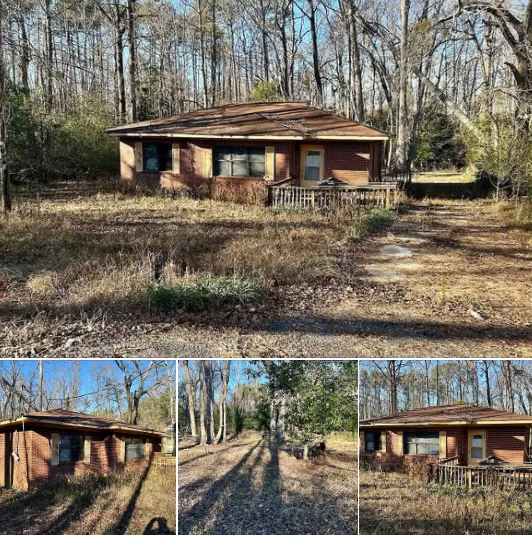
At first glance, the listing looks almost unbelievable.
A residential brick home offered through an online auction with an opening bid of just $100. In a housing market where even modest properties can reach tens or hundreds of thousands of dollars, the number feels like a mistake—or a loophole.
But as the details unfold, the reality becomes clearer. This is not a traditional home sale. It is an auction-driven, tax-deed property transfer wrapped in layers of legal caution, uncertainty, and potential opportunity.
And that contrast—between the extremely low entry price and the high level of risk—is exactly what defines this kind of real estate.
The property in question is one of eleven being sold through an online-only auction platform. All bidding takes place digitally, with no traditional negotiation, no direct seller interaction, and no fixed asking price. Instead, the final value will be determined entirely by competitive bidding among registered participants.
On the surface, this structure appears simple. Register, review the terms, place a bid, and wait for the auction to close. But beneath that simplicity is a system designed for experienced participants who understand how complex distressed real estate transactions can be.
One of the most important details is the ownership history. The seller acquired the property through a delinquent tax sale deed. That alone immediately places the home into a different category than standard residential listings.
Unlike conventional real estate transactions, this property will be transferred via Quitclaim Deed only. That means the seller is not guaranteeing clear ownership, free title, or the absence of liens. Instead, they are transferring whatever interest they may or may not legally hold—without warranties.
In practical terms, that shifts nearly all responsibility onto the buyer.
There has been no title search conducted by the seller, the auctioneer, or the closing attorney. No title insurance will be provided. That single fact dramatically changes the risk profile of the purchase. It means the buyer is entering the transaction without the safety net typically associated with real estate closings.
For this reason, due diligence is not optional—it is essential.
Potential bidders are expected to investigate ownership history, unpaid taxes, liens, zoning restrictions, code violations, and any other legal or financial issues tied to the property. In many cases, this requires reviewing county records, consulting legal professionals, and even physically inspecting the site when possible.
The listing strongly emphasizes that buyers should assume the property is being sold “as-is, where-is, with all faults,” which is standard language in distressed property auctions but carries significant meaning. It signals that no repairs will be made, no conditions guaranteed, and no guarantees exist regarding the state of the structure.
Even basic assumptions—such as whether utilities function or whether the property is occupied—must be independently verified.
What is known, however, is that the structure itself is a residential brick home. Brick construction is often associated with durability, lower maintenance, and long-term structural stability. These characteristics make such homes attractive to investors, particularly those looking at renovation or rental strategies.
But without interior details or verified condition reports, the home remains a question mark.
The investment potential is what draws attention to listings like this. In theory, a distressed brick home acquired at a low entry price can be renovated and resold for significant profit. Alternatively, it can be converted into a rental property or held long-term as part of a real estate portfolio.
However, that potential is always balanced by uncertainty.
Unknown structural issues, hidden liens, legal complications, or even access restrictions can quickly transform what looks like a bargain into a costly, time-consuming project. In some cases, the expense of resolving title issues or performing necessary renovations can exceed the value of the property itself.
This is why auction properties like this tend to attract a very specific type of buyer.
Experienced investors, cash buyers, contractors, and individuals familiar with tax-sale acquisitions are typically the ones who participate. These buyers understand that the $100 opening bid is not a reflection of value—it is simply a starting point designed to generate competitive bidding activity.
The real price will be determined in the final moments of the auction, often influenced by demand, perceived risk, and the level of research each bidder has completed beforehand.
The listing also highlights an important psychological element of auction-based real estate: perception versus reality. A low opening bid can create the impression of a bargain, but in practice, it is often a signal that the property comes with significant uncertainty attached.
In this case, the absence of title insurance and the reliance on a quitclaim transfer are the clearest indicators of that uncertainty.
Still, auctions like this continue to attract attention because they represent possibility. For buyers willing to do the work—legal research, inspections, financial planning—the reward can be access to properties at prices below traditional market value.
But that reward always comes with responsibility.
Unlike conventional purchases, there is no seller warranty, no guaranteed financing structure, and no safety net if issues arise after the sale. Once the bid is placed and the auction closes, the buyer assumes full responsibility for the property’s condition and legal standing.
In that sense, this type of transaction is less about buying a home and more about assuming a position—part investor, part investigator, part risk manager.
The listing ultimately makes one thing very clear: success in this environment is not determined by luck, but by preparation.
Understanding title law, evaluating risk, calculating renovation costs, and setting disciplined bidding limits are all essential steps. Without them, even the most attractive listing can become a financial burden.
In conclusion, this residential brick home represents more than just a property—it represents a type of real estate ecosystem built around uncertainty and opportunity existing side by side.
For some, the $100 opening bid may appear like a door into affordable homeownership or investment potential.
For others, it is a reminder that in real estate auctions, the lowest price is rarely the full story.
Because what you see in the listing is only the beginning of what you need to understand before you ever place a bid.