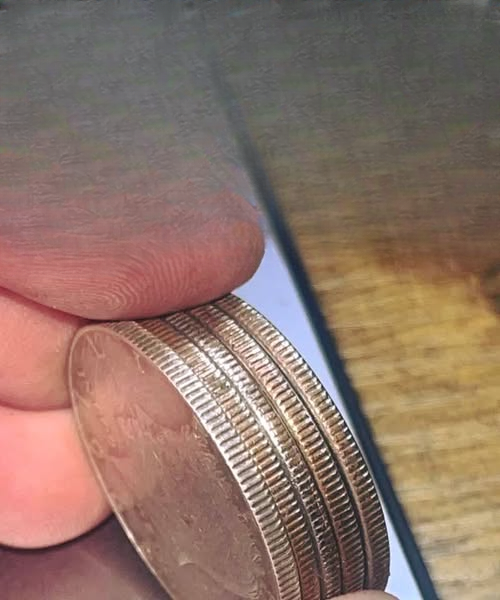
Introduction: The Small Detail Most People Never Notice
Most people handle coins without ever thinking about their design.
A coin is received as change, placed in a pocket, and quickly forgotten. Yet, despite their ordinary role in daily transactions, coins carry a long and surprisingly complex history. Even the smallest design features—such as the ridged or patterned edges found on many coins—exist for reasons rooted in centuries of economic struggle, innovation, and trust.
What looks like a simple texture is actually the result of historical problems that once threatened entire monetary systems.
When Coins Were Made of Precious Metal
Before modern currency systems, coins were not just symbolic representations of value—they were made from valuable materials themselves.
Gold and silver coins had worth because of the metal they contained. Their value was intrinsic, meaning that the physical substance of the coin determined its purchasing power.
This system worked effectively only as long as people could trust that:
- Each coin contained the correct amount of precious metal
- No one had tampered with or reduced its content
- The coin in circulation matched its intended weight and purity
As long as that trust remained intact, coins functioned reliably as currency.
However, that trust also created opportunity for exploitation.
The Problem of “Coin Clipping”
A major issue emerged in early monetary systems known as coin clipping.
Instead of counterfeiting entire coins—which was difficult and risky—some individuals discovered a more subtle method of theft. They would carefully shave or scrape small amounts of metal from the edges of genuine coins.
This process had several advantages for criminals:
- It was slow and difficult to detect
- Each individual coin still appeared valid at first glance
- Small amounts could be taken from many coins over time
- The stolen metal could be collected and sold separately
While each act of clipping removed only a tiny fraction of metal, the cumulative effect across many coins became significant.
Over time, large quantities of gold and silver were quietly extracted from circulation without immediate notice.
The Economic Consequences of Widespread Clipping
As clipped coins became more common, the effects on the economy grew increasingly serious.
Because coins no longer reliably contained their full value, people began to lose confidence in everyday transactions. This led to several problems:
- Merchants started weighing coins instead of accepting them at face value
- Disputes increased over whether coins were genuine or altered
- People became more cautious and suspicious during trade
- Trust in the currency system began to weaken
The impact extended beyond individual transactions. As uncertainty spread, the entire monetary system became less stable.
When trust in currency declines, economic activity slows. People hesitate to spend, accept, or store money they no longer believe is reliable.
In this way, a small and seemingly harmless act—shaving metal from coins—contributed to widespread financial instability.
A Simple but Brilliant Solution: Changing the Edge
To address the problem, governments and mints introduced a surprisingly effective solution: they redesigned the edges of coins.
Instead of leaving coin edges smooth, they began adding:
- Fine ridges
- Grooved patterns
- In some cases, engraved lettering
These modifications served a critical purpose.
Once ridges were introduced, any attempt to remove metal became immediately visible. Even a small amount of clipping would disrupt the uniform pattern along the edge, making tampering easy to detect.
This simple change transformed the edge of a coin into a built-in security feature.
Isaac Newton and the Reform of Currency
One of the most notable historical figures associated with coin reform was Isaac Newton.
Although widely known for his contributions to physics and mathematics, Newton also served in an important administrative role at the Royal Mint in England.
During his time overseeing currency production, the country faced serious issues with:
- Counterfeiting
- Coin clipping
- General loss of public trust in money
Under his leadership, efforts were made to improve the reliability and security of coins. This included strengthening minting processes and introducing more consistent coin edge designs.
These reforms helped restore confidence in the currency system and reduce fraudulent practices.
Why Coin Ridges Still Exist Today
In modern times, most coins are no longer made from precious metals like gold or silver. Their material value is far lower than their face value, meaning that clipping coins would no longer be profitable.
Despite this, ridged edges remain a standard feature on many coins around the world.
This is because they still serve useful functions, including:
Anti-Counterfeiting Support
Coin edge patterns make it harder to produce convincing fake coins.
Machine Recognition
Vending machines, coin counters, and automated systems use edge patterns to help identify coins accurately.
Accessibility
People with visual impairments can often distinguish between coins more easily by touch due to differing edge textures.
Even though the original problem of coin clipping has largely disappeared, the solution continues to provide practical benefits.
A Design That Outlived Its Original Purpose
What makes coin ridges especially interesting is that they are a surviving solution to a historical problem that no longer exists in the same form.
Today, they are no longer essential for preventing precious metal theft, yet they remain embedded in currency systems worldwide because they continue to offer practical advantages.
In this sense, coin ridges are an example of “legacy design”—features created for one purpose that continue to be useful long after their original context has changed.
Conclusion: Small Details With a Long History
Coin ridges may seem like a minor design choice, but they reflect a much larger story about economics, trust, and human ingenuity.
They were created in response to a real threat: the gradual erosion of currency value through small, repeated acts of theft. In solving that problem, governments introduced a design change that improved security and restored confidence in money systems.
Even today, those ridges remain a quiet reminder that:
- Small actions can have large economic consequences
- Simple design solutions can solve complex problems
- Many everyday objects carry hidden historical meaning
The next time you hold a coin, its edge tells a story—not just of money, but of innovation, adaptation, and the constant effort to protect trust in something as essential as currency itself.