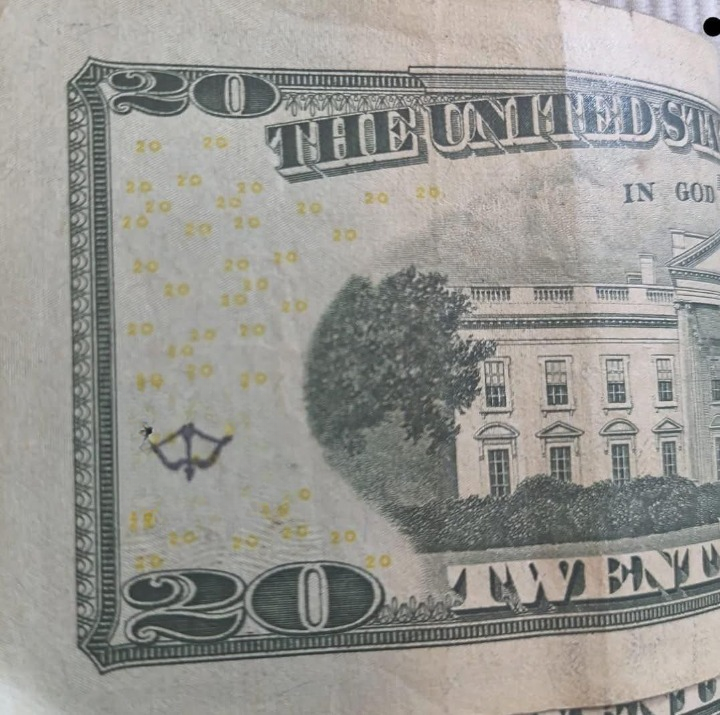
If you have ever taken a closer look at a U.S. dollar bill, you may have noticed something unusual—perhaps a small stamp, a set of initials, a geometric symbol, or even what appears to be a tiny bow and arrow. At first glance, it might seem like random ink or accidental damage. However, these markings often tell a much larger story about global commerce, financial trust, and the remarkable journey of American currency across borders.
These mysterious symbols are known as chop marks, and while they are not widely discussed in everyday conversations, they represent an intriguing chapter in the history of money circulation. From bustling markets in Southeast Asia to informal exchange networks in parts of Africa and Latin America, chop marks have quietly played a role in verifying authenticity and building trust in regions where financial systems vary widely.
In this in-depth exploration, we will examine what chop marks are, where they originated, why they appear on some U.S. bills, whether they are legal, and what they reveal about the global influence of the U.S. dollar.
What Are Chop Marks?
Chop marks are small stamps or ink symbols placed on paper currency by money changers, merchants, or currency handlers. These markings typically appear in blue, black, or red ink and are intentionally kept small so they do not obscure important security features.
Although they may look unofficial, chop marks serve a practical purpose: they indicate that a bill has been examined and verified as authentic by someone handling currency in circulation.
These marks are most commonly found on U.S. bills that have traveled internationally, particularly in regions where:
-
Counterfeit currency is a persistent concern
-
Formal banking infrastructure may be limited
-
Informal markets play a major economic role
-
The U.S. dollar is widely used alongside local currency
In these contexts, trust is everything. A simple stamp can make the difference between accepting or rejecting a bill.
The Global Journey of the U.S. Dollar
To understand chop marks, it’s important to first understand how widely the U.S. dollar circulates beyond American borders.
The dollar is widely regarded as the world’s leading reserve currency. Countries hold it in national reserves, businesses use it for international trade, and individuals in many parts of the world prefer to save in dollars during times of economic uncertainty.
In some regions, U.S. currency is used daily for:
-
Cross-border trade
-
Large purchases
-
Savings and personal transactions
-
Informal market exchanges
Because of this global reach, a single $20 bill printed in the United States might pass through many hands across multiple continents before eventually returning home—if it ever does.
Along the way, it may receive one or more chop marks as evidence of verification.
The Historical Roots of Chop Marks
The word “chop” traces back to historical practices in China. Centuries ago, merchants dealing in precious metals would stamp silver coins with their own unique marks. These stamps confirmed the weight and authenticity of the metal. In competitive markets, such verification was critical.
Over time, as trade expanded and paper currency became more common, the practice of stamping to verify authenticity extended beyond coins. When foreign currencies—particularly U.S. dollars—became widely accepted in certain regions, local money changers adopted similar verification methods.
Today’s chop marks on paper bills are a continuation of that centuries-old tradition of building trust through visible authentication.
Why Money Changers Use Chop Marks
1. Confirming Authenticity
Despite advanced security features such as watermarks, microprinting, color-shifting ink, and embedded security threads, counterfeit currency remains a concern in various parts of the world.
When a money changer carefully inspects a bill and determines it is genuine, they may stamp it with a chop mark. That stamp signals to the next handler that the note has already been examined.
It acts as a layer of reassurance in busy markets where transactions happen quickly.
2. Reducing Repeated Inspections
In high-volume trade environments, repeatedly checking every bill in detail slows business. A recognizable chop mark can speed up transactions because it indicates prior verification.
Over time, certain marks may become familiar within a region, creating informal networks of trust.
3. Supporting Informal Economies
In areas where centralized banking systems may not be easily accessible, trust is often established person-to-person. Chop marks can serve as a simple but effective trust mechanism in these informal financial networks.
What Do Chop Marks Look Like?
Chop marks vary widely in appearance. Some are simple geometric shapes; others are stylized symbols. Common examples include:
-
Stars
-
Arrows
-
Circles or triangles
-
Letters or initials
-
Birds or abstract designs
-
The occasionally noted bow and arrow symbol
These stamps are usually small and placed in areas that do not interfere with essential design elements or anti-counterfeiting features.
While they may appear random to someone unfamiliar with them, in the context of certain markets, they can carry meaning and recognition.
Are Chop Marks Legal?
Under U.S. law, currency should not be mutilated or altered in a way that renders it unfit for circulation. However, small ink stamps that do not obscure key features or affect usability generally do not invalidate a bill.
That said, excessive markings or heavy defacement could cause a bank or automated machine to reject a note. If the bill’s condition deteriorates too much, it may be removed from circulation during routine processing by financial institutions.
In most cases, a small chop mark does not prevent the bill from being used.
A Silent Record of Travel
One of the most fascinating aspects of chop marks is what they imply about a bill’s journey.
Imagine holding a $20 bill with a small arrow symbol stamped in blue ink. That bill may have:
-
Been withdrawn from a bank in the United States
-
Carried abroad by a traveler
-
Exchanged in a currency market overseas
-
Passed through merchants, traders, and customers
-
Returned to the U.S. through international banking channels
The chop mark is a subtle reminder that money does not stay confined within borders. It circulates globally, reflecting trade routes, migration patterns, tourism, and commerce.
Each small stamp represents a chapter in that story.
Chop Marks and the Power of the Dollar
The continued presence of chop marks highlights an important reality: the U.S. dollar is trusted around the world.
In many regions experiencing currency instability, individuals prefer to hold savings in dollars. Businesses often settle large transactions in dollars. International contracts are frequently priced in dollars.
Because of this global trust, ensuring authenticity becomes crucial. Chop marks, though small and informal, contribute to maintaining that trust at the grassroots level.
They are a practical response to a universal challenge: how to verify money quickly and reliably.
Why You Don’t See Them Everywhere
Not every U.S. bill carries chop marks. In fact, most do not. They are more likely to appear on:
-
Lower denominations commonly used in trade
-
Bills circulating in regions with active informal exchange markets
-
Notes that have traveled internationally for extended periods
As financial technology improves and counterfeit detection tools become more widespread, the use of chop marks may decline in some areas. However, in certain markets, the tradition continues.
The Cultural Dimension of Currency
Currency is often seen purely as a financial tool, but it also carries cultural meaning. Chop marks reflect:
-
Merchant traditions
-
Regional trade practices
-
Informal verification systems
-
Community-based trust networks
In that sense, a marked bill is not just money—it is a small artifact of economic history.
What Should You Do If You Find One?
If you come across a bill with a chop mark:
-
Check that it is still intact and readable
-
Ensure major security features are visible
-
Confirm it is not excessively damaged
In most cases, the bill remains perfectly usable. If you have concerns, you can exchange it at a bank.
There is no need to panic or assume fraud simply because of a small stamp.
A Bigger Picture of Global Trade
The existence of chop marks reminds us that the world’s economies are deeply interconnected. A single banknote can:
-
Cross oceans
-
Pass through countless transactions
-
Support businesses in multiple countries
-
Eventually return home
The small bow and arrow mark—or any other symbol—represents a piece of that journey.
It shows that money is not static. It moves, adapts, and reflects the flow of commerce worldwide.
Conclusion
At first glance, a small stamp on a U.S. bill might seem insignificant. Yet chop marks reveal a fascinating layer of global economic activity.
They trace their roots back centuries to merchant stamping practices. They serve as informal authentication tools in regions where trust is vital. And they quietly document the worldwide reach of the U.S. dollar.
The next time you examine your wallet, take a closer look. If you spot a tiny symbol—an arrow, a star, or even a bow and arrow—you may be holding more than just currency.
You may be holding a traveler.
A silent witness to international markets.
A reminder that even the smallest marks can carry a story that spans the globe.