At some point in your driving life, you’ve likely approached an intersection almost automatically expecting the same familiar sight: a red, octagonal stop sign with bold white letters.
It’s one of the most universally recognized traffic symbols in the world. Even children who can’t yet read know what it means. Red octagon. White “STOP.” Bring the vehicle to a complete halt.
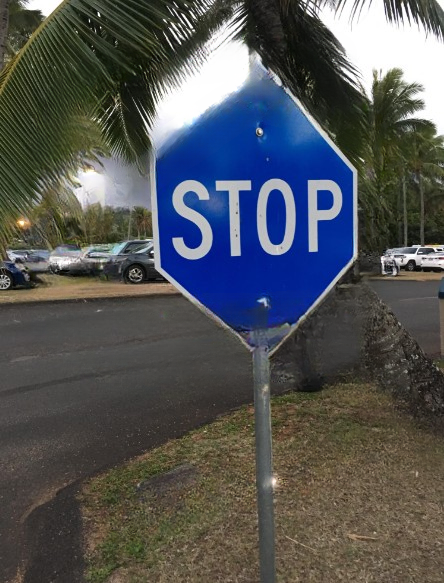
So imagine driving through a quiet neighborhood, a parking lot, or a campus road—and instead of red, you see a blue stop sign.
Same shape.
Same lettering.
Different color.
It’s enough to make you hesitate. Is this official? Is it decorative? Is it enforceable? Should you stop?
The short answer: yes, you should stop.
The longer answer involves traffic regulations, design standards, color psychology, private property rules, and even a little bit of history.
Let’s explore what a blue stop sign really means, where you might see one, and why the traditional red stop sign became the global standard in the first place.
The Familiar Red Stop Sign: Why We Recognize It Instantly
Before we talk about blue stop signs, it’s important to understand why red stop signs are so consistent and recognizable.
In the United States, traffic control devices are governed by the Federal Highway Administration under standards outlined in the Manual on Uniform Traffic Control Devices (MUTCD).
The MUTCD establishes detailed guidelines for:
-
Shape
-
Color
-
Reflectivity
-
Placement
-
Size
-
Lettering
According to these standards, official stop signs must be:
-
Red background
-
White border
-
White uppercase lettering
-
Octagonal in shape
This uniformity is not accidental. It ensures that drivers immediately recognize the sign—regardless of the state they’re driving in.
The octagon shape itself is exclusive to stop signs in the U.S., meaning drivers can identify it even from behind or in poor weather conditions.
So where does blue fit into this?
What Is a Blue Stop Sign?
A blue stop sign typically mirrors the traditional design:
-
Octagonal shape
-
White “STOP” text
-
Reflective surface
The only major difference?
The background is blue instead of red.
Here’s the key point:
Blue stop signs are not officially recognized for public roadway traffic control in the United States under federal standards.
That means you won’t find them regulating intersections on government-maintained roads.
Instead, they are typically installed in:
-
Private communities
-
Gated neighborhoods
-
Parking lots
-
University campuses
-
Industrial complexes
-
Business parks
They function similarly—but they are not federally standardized traffic control devices.
Why Blue Stop Signs Exist
If red is required for public roads, why would anyone use blue?
There are several practical reasons.
1. Private Property Flexibility
On private property, traffic control devices do not always have to strictly follow federal highway standards.
Property owners may choose custom signage for:
-
Aesthetic consistency
-
Branding
-
Differentiation from public streets
-
Internal traffic management
For example, a gated community might prefer blue signage to match its design theme.
A corporate campus might use customized signs to create a cohesive visual identity.
As long as the sign’s intent is clear—and drivers understand it indicates stopping—the color variation may be permitted on private grounds.
2. Visual Distinction from Public Roads
Using blue instead of red can subtly signal:
“This is private property.”
It distinguishes internal traffic control from public street regulations.
This can help clarify:
-
Jurisdiction
-
Enforcement authority
-
Liability considerations
However, despite the color difference, drivers are still expected to comply for safety reasons.
3. Aesthetic and Design Considerations
In master-planned communities or educational campuses, visual uniformity often matters.
Blue signage may complement:
-
Architectural themes
-
Institutional colors
-
Landscape design
For example, a university whose official color is blue might integrate blue signage across campus roads.
It becomes part of the overall visual identity.
The Psychology of Traffic Sign Colors
Traffic sign colors are not random. They are carefully chosen based on how humans perceive color and respond to it.
Here’s a breakdown of common traffic sign color meanings:
Red
-
Stop
-
Prohibition
-
Immediate attention
-
Danger
Yellow
-
Warning
-
Hazards
-
Caution
Green
-
Direction
-
Permitted movement
-
Guidance
White
-
Regulatory information
-
Speed limits
-
Rules
Blue
-
Information
-
Services
-
Amenities
In standard traffic systems, blue typically signals:
-
Rest areas
-
Hospitals
-
Gas stations
-
Information points
That’s why seeing blue used for “STOP” feels unusual. It conflicts with our trained visual associations.
A Brief History of Stop Sign Colors
Believe it or not, stop signs were not always red.
When stop signs were first introduced in the early 1900s, they were actually yellow with black lettering.
Why yellow?
At the time, reflective materials were limited. Yellow was one of the most visible colors both during daylight and at night under headlights.
It wasn’t until the 1950s that improved reflective technology allowed red to become the standard.
In 1954, the U.S. formally adopted the red stop sign with white lettering.
Red was chosen because:
-
It signals urgency.
-
It has strong cultural associations with danger and stopping.
-
It captures attention quickly.
Since then, the red stop sign has become nearly universal.
Where You’re Most Likely to See a Blue Stop Sign
Because blue stop signs are not federally regulated for public roads, they typically appear in private or controlled-access spaces.
Private Residential Communities
Gated neighborhoods often install their own signage.
Blue stop signs may be used to:
-
Control internal intersections
-
Slow traffic
-
Maintain visual branding
These signs are enforceable through community rules rather than state traffic law.
Parking Lots
Large parking lots may use non-standard signage.
Blue stop signs in these areas help:
-
Reduce collisions
-
Manage flow
-
Clarify right-of-way
Even though they’re not government-issued, ignoring them can still cause accidents.
University and College Campuses
Some campuses customize signage to reflect school colors.
A blue stop sign might align with institutional branding.
However, the expectation remains the same: drivers should stop.
Industrial and Commercial Facilities
Warehouses, factories, and distribution centers often use internal traffic systems.
Blue stop signs in these settings help regulate:
-
Forklift traffic
-
Delivery trucks
-
Employee vehicles
Safety, not aesthetics, is usually the priority in these environments.
Are Blue Stop Signs Legally Enforceable?
On public roads: No, they are not recognized under federal traffic law.
On private property: It depends.
Enforcement may fall under:
-
Property management policies
-
Security enforcement
-
Contractual agreements
-
Local ordinances
Even if a ticket isn’t issued, ignoring a posted stop sign in a parking lot can still result in:
-
Liability in accidents
-
Insurance complications
-
Civil consequences
From a safety standpoint, compliance is always the smart choice.
Other Unusual Stop Sign Variations
Blue stop signs aren’t the only non-standard variations out there.
Here are a few others that have appeared in specific contexts.
Fluorescent Enhanced Stop Signs
Some intersections use high-visibility reflective coatings to increase nighttime clarity.
These are still red—but brighter.
Flashing LED Stop Signs
In high-risk areas, LED lights may flash around the sign’s border to increase attention.
These are common near:
-
School zones
-
Dangerous intersections
-
Rural crossings
Bilingual Stop Signs
In regions with multilingual populations, signs may include multiple languages.
For example, in Quebec, stop signs display “Arrêt” instead of “Stop.”
Black-and-White Decorative Signs
Some private communities use minimalist black-and-white signage for aesthetic purposes.
Again, these are typically on private property.
What Should You Do If You See a Blue Stop Sign?
The safest and most practical answer:
Treat it like any other stop sign.
Come to a complete stop.
Look both ways.
Proceed when safe.
Even if it’s on private property, it was installed to regulate traffic and prevent accidents.
Ignoring it increases risk—not just of legal issues, but of collisions.
Safety should always override confusion about color.
Why Uniform Traffic Standards Matter
Traffic systems rely heavily on consistency.
Uniform colors and shapes allow drivers to:
-
Process information quickly
-
React without hesitation
-
Navigate unfamiliar areas safely
If every community used different colors and designs on public roads, confusion would increase dramatically.
That’s why federal guidelines exist.
Blue stop signs remain rare precisely because standardization improves safety.
The Takeaway: Blue Doesn’t Mean “Ignore”
While a blue stop sign may feel unusual, it still communicates a familiar message.
The shape is intentional.
The wording is clear.
The expectation remains: stop.
In private environments, these signs serve important safety functions.
They may not carry the same legal authority as federally regulated red signs—but they exist to reduce risk and manage traffic flow.
Final Thoughts: The Meaning Behind a Blue Stop Sign
Seeing a blue stop sign can feel surprising because it disrupts our expectations.
We’re conditioned to associate red with stopping.
But when you encounter a blue version, it doesn’t signal a new rule or secret system.
It usually signals:
-
Private property
-
Customized signage
-
Internal traffic management
The safest response is always the same: stop fully and proceed cautiously.
In the end, the goal of any stop sign—red, blue, or otherwise—is not simply compliance with regulations.
It’s preventing collisions.
It’s protecting pedestrians.
It’s ensuring orderly traffic flow.
Color may vary in certain settings, but safety remains the constant priority.
And when in doubt?
Pause.
Look around.
Proceed carefully.
That’s good driving—regardless of the shade of the sign.