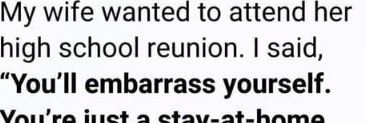
He didn’t notice the shift at first. Not because it was subtle in the moment, but because he wasn’t paying attention to what mattered. In his mind, he had been having an ordinary conversation at the kitchen table—half listening, half thinking about emails and deadlines—when Anna mentioned her high school reunion.
He barely looked up.
“Oh, that sounds nice,” he said, in the same tone someone might use for a neighbor’s renovation project or a weather update. Then, almost without thinking, he added, “Just your old friends catching up, right?”
It was a small sentence. A careless one. The kind of phrase that doesn’t feel significant when it leaves your mouth.
But it landed somewhere heavier than he intended.
Anna didn’t respond right away. She just nodded slightly, as if accepting something she had already learned not to argue with. The conversation moved on—dinner plans, school schedules, bills—but something about her presence changed. Not dramatically. Not visibly. Just enough that, over the following days, he began to notice a quiet withdrawal he couldn’t explain.
Fewer shared comments in passing. Less laughter at small things. A growing distance that filled the spaces between words instead of replacing them.
He told himself it was nothing.
The Version of Success He Believed In
If asked, he would have said he valued hard work. Stability. Providing for his family. These were the things he believed defined responsibility, and in his mind, he had fulfilled them well.
But somewhere along the way, “providing” had become the only metric he measured.
And in that measurement, everything else became background noise.
Anna’s work inside the home, the invisible structure she maintained every single day—the coordination, the emotional labor, the constant anticipating of needs before they became problems—had slowly disappeared from his definition of contribution.
Not because he didn’t see it at all.
But because he had stopped recognizing it as something that counted.
The Change He Didn’t Expect
The distance between them widened gradually, like a door that isn’t fully closed but never fully open either.
He noticed it most in small moments. The way she stopped asking for his opinion on things she used to include him in. The way she no longer explained her day in detail. The way she stopped trying to make him see what she was carrying.
At first, he interpreted it as independence. Even maturity. He assumed she was simply “doing her own thing.”
It didn’t occur to him that she might be stepping back from something that no longer felt seen.
Then came the box.
The Box on the Table
It arrived without explanation. A simple cardboard container placed carefully on the kitchen table, as if it carried more weight than its appearance suggested.
Anna didn’t say anything when he opened it.
Inside was a framed high school photograph. The kind taken before people fully understand what their lives will become. Smiling faces, awkward poses, names scribbled in fading ink along the margins.
At first, he didn’t understand why she had kept it.
Then he saw the signatures.
Not just classmates. Teachers. Professionals. People who had gone on to become doctors, engineers, executives—names that carried quiet weight in conversations like the ones he used to value.
And then, a note folded neatly along the side.
It wasn’t addressed to him.
It was from her closest friend.
He read it once.
Then again.
The words were simple, but they stayed with him longer than expected:
Being a mother is harder than any title we have.
There was no exaggeration in it. No attempt to compare achievements or diminish anyone else’s work. Just recognition—plain, honest acknowledgment of something that had been overlooked for too long.
What He Had Been Missing
For the first time, he didn’t see the box as sentimental.
He saw it as evidence.
Not of what Anna had done in the past, but of what she had been carrying in the present—without recognition, without applause, without the external validation he had unconsciously assumed mattered more than anything else.
He thought about sleepless nights she never mentioned as sacrifices. The way she managed illness, schedules, emotions, routines—all the things that kept their home functioning without entering the category of “achievement” in his mind.
He realized something uncomfortable.
He hadn’t just overlooked her effort.
He had been editing it out entirely.
The Conversation They Finally Had
That night, he tried to explain himself. Not defensively, but clumsily, as people often do when they realize too late that they have been speaking a different language than the person beside them.
He said things like “I didn’t mean it that way” and “you know I appreciate everything you do.”
But for the first time, he understood that appreciation spoken after years of invisibility doesn’t erase the experience of being unseen.
Anna listened. Not with anger. Not with tears. Just with the quiet stillness of someone who had already had this conversation many times inside her own mind.
When she finally spoke, her words were simple.
“I don’t need the world to recognize me,” she said. “I needed you to.”
And that sentence stayed in the room longer than anything else.
The Reunion That Wasn’t About the Reunion
When the next reunion came around, Anna didn’t ask for permission or reassurance.
She simply told him she was going.
There was no confrontation. No argument. No emotional escalation. Just a calm decision that didn’t require approval anymore.
He offered to come with her, but she shook her head gently.
“I need to go as myself,” she said.
He didn’t argue.
For once, he understood that this wasn’t about the event. It wasn’t about classmates or old memories or social comparison.
It was about something quieter.
Reclaiming a version of herself that had been reduced for too long.
What He Understood Too Late
As she left that evening, dressed simply but confidently, he stood at the doorway and watched her walk away.
There was no dramatic moment of realization. No sudden emotional collapse. Just a steady awareness forming in him—slow, uncomfortable, unavoidable.
He had spent years measuring worth in visible outcomes.
She had spent those same years building a life that couldn’t be measured that way at all.
And in doing so, she had carried more than he had ever taken the time to understand.
A Different Kind of Respect
When she returned later that night, nothing about their home had changed.
But something between them had.
Not fixed. Not resolved. Not magically repaired.
Just seen.
And for the first time, he understood that respect wasn’t something you offered in words after the fact.
It was something you lived in the way you noticed someone while they were still right beside you.
Not after they stepped away.
Not after they stopped asking to be seen.