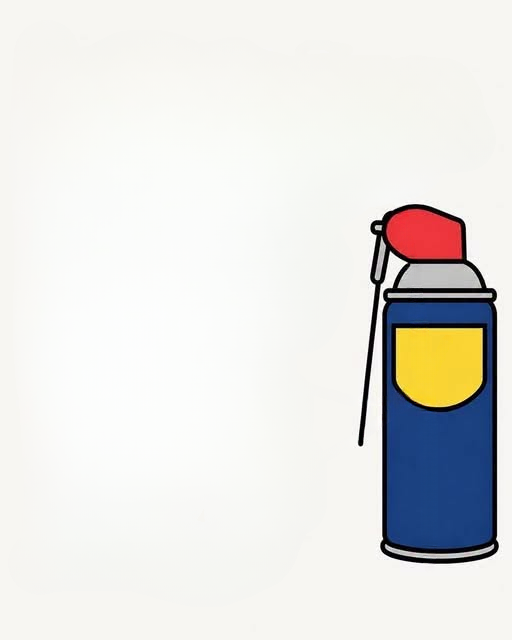
Walk into almost any garage, workshop, or utility room, and there’s a good chance you’ll spot a familiar blue-and-yellow can sitting on a shelf. For decades, WD-40 has been the go-to solution for loosening rusty bolts, silencing squeaky hinges, protecting tools, and tackling countless maintenance jobs around the home.
Despite its popularity, many people have never stopped to ask a simple question: What does “WD-40” actually mean?
The answer isn’t a clever marketing slogan or a random product name. Instead, it tells the story of persistence, innovation, and dozens of failed attempts that eventually led to one of the world’s most recognizable maintenance products.
A Product Born from an Engineering Challenge
The story of WD-40 begins in the early 1950s during a time of rapid technological development.
Engineers were searching for a reliable way to protect metal equipment from moisture and corrosion. Water is one of metal’s greatest enemies, encouraging rust that can weaken machinery, damage equipment, and shorten the lifespan of valuable components.
The challenge was finding a chemical formula that could effectively push moisture away from metal surfaces while leaving behind a protective barrier.
It sounded simple.
In reality, it proved remarkably difficult.
The Long Road to Success
Rather than giving up after a few unsuccessful experiments, engineer Norm Larsen and his team continued refining their formula.
Each attempt taught them something new.
Some mixtures failed to repel water effectively.
Others didn’t provide lasting protection.
Many simply didn’t perform as expected.
Instead of seeing those unsuccessful experiments as failures, the team treated them as valuable lessons that moved them one step closer to success.
That persistence eventually paid off.
Why It’s Called WD-40
The product’s famous name is surprisingly literal.
“WD” stands for “Water Displacement.”
The number “40” refers to the fact that the successful formula was achieved on the team’s 40th attempt.
After thirty-nine unsuccessful experiments, the fortieth formula finally delivered the results the engineers had been searching for.
Rather than inventing a flashy brand name, they simply kept the laboratory designation.
That simple name would eventually become known around the world.
An Industrial Solution Finds Everyday Uses
WD-40 wasn’t originally designed for household repairs.
Its first purpose was industrial, helping protect metal parts from corrosion and moisture in demanding environments.
However, workers quickly discovered the product could do much more than its original job.
People began using it to:
- Loosen rusted nuts and bolts
- Silence squeaky hinges
- Protect tools from rust
- Remove grease and grime
- Clean certain sticky residues
- Help free jammed mechanical parts
Word spread quickly.
Before long, homeowners, mechanics, farmers, and hobbyists were all finding new ways to use the versatile spray.
Its reputation grew naturally through practical experience rather than advertising alone.
A Household Name Around the World
As demand increased, WD-40 expanded far beyond its industrial origins.
Today, it can be found in homes, workshops, factories, farms, automotive garages, and maintenance departments across the globe.
Its instantly recognizable blue-and-yellow can has become one of the most familiar products in the world of home maintenance.
For many people, owning a can of WD-40 is simply part of having a toolbox.
Whether fixing a squeaky door, maintaining garden equipment, or protecting bicycle parts from moisture, countless users rely on it for everyday maintenance tasks.
More Than Just a Lubricant
One common misconception is that WD-40 is primarily a lubricant.
While it can temporarily reduce friction and loosen stuck parts, its original design focused on displacing water and protecting metal surfaces from corrosion.
Over time, its cleaning and penetrating properties made it useful for many additional applications.
Its versatility has become one of its greatest strengths, allowing one simple product to solve a wide variety of maintenance problems.
A Lesson in Persistence
Perhaps the most interesting part of WD-40’s story isn’t the product itself.
It’s the process behind it.
The engineers didn’t succeed immediately.
They didn’t find the perfect formula after five or ten attempts.
It took forty carefully tested experiments before they achieved the desired result.
That history serves as a reminder that innovation often comes through patience, careful observation, and a willingness to keep improving after setbacks.
Many successful inventions share a similar path.
What appears simple today often represents years of testing, adjustments, and determination behind the scenes.
Why the Story Still Matters
More than seventy years after its creation, WD-40 remains one of the world’s best-known maintenance products.
While countless new products have entered the market over the decades, the original spray continues to earn the trust of professionals and homeowners alike.
Its lasting popularity isn’t just about what it does.
It’s also about the story behind it.
A simple laboratory label became an international brand because one team refused to stop experimenting until they found a solution that worked.
Every time someone picks up a can to loosen a stubborn bolt or protect a favorite tool from rust, they’re using a product born from persistence rather than luck.
The Next Time You Reach for WD-40…
The next time you see that familiar can sitting on a shelf, you’ll know there’s more behind the name than a random combination of letters and numbers.
WD stands for Water Displacement.
40 marks the 40th formula—the one that finally succeeded after dozens of unsuccessful attempts.
It’s a small piece of engineering history hidden in plain sight and a reminder that many everyday products have fascinating stories behind them.
Sometimes, the most ordinary items around the house carry extraordinary histories, proving that persistence, problem-solving, and a little patience can leave a lasting mark on the world.