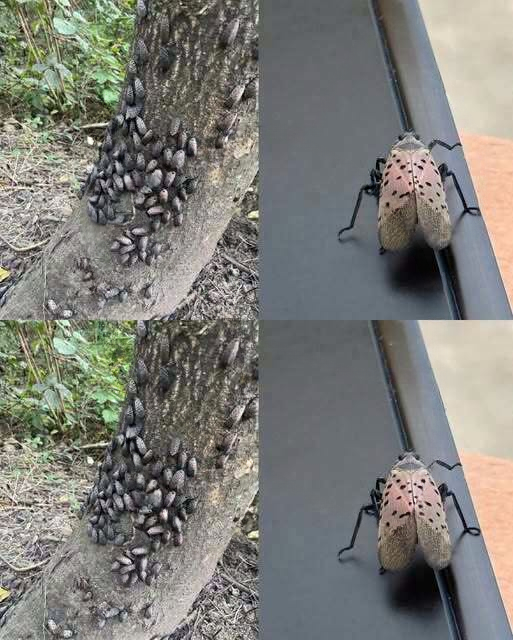
You may notice something unusual happening in your backyard long before you ever actually see the insect responsible.
A strange sticky film appears on your car after it’s been parked under a tree. Your patio furniture feels coated in a sugary residue. Leaves begin to darken with a soot-like film that spreads across branches and shrubs. At first glance, these changes seem unrelated, almost like random environmental quirks. But together, they often point to a single cause: the spotted lanternfly, an invasive insect that is rapidly spreading across parts of the United States and raising growing concern among farmers, ecologists, and homeowners alike.
Originally native to parts of Asia, the spotted lanternfly is not just another backyard bug. It is a highly adaptable plant hopper that feeds on the sap of trees and plants by piercing their bark and stems with specialized mouthparts. While a single insect does little noticeable harm, large infestations can drain significant amounts of nutrients from plants, weakening them over time and making them vulnerable to disease, environmental stress, and even death in severe cases.
What makes the spotted lanternfly especially dangerous is its wide appetite. It has been documented feeding on more than 70 plant species, including economically important crops such as grapevines, apples, peaches, and walnuts, as well as common ornamental trees like maples and birches. For vineyards and orchards, heavy infestations can lead to reduced yields, lower-quality fruit, and significant financial losses.
One of the earliest and most noticeable warning signs of an infestation is not the insect itself, but what it leaves behind. As spotted lanternflies feed, they excrete a sugary waste product known as honeydew. This sticky substance coats leaves, branches, outdoor furniture, vehicles, and anything else located beneath infested trees. While it may seem like a minor nuisance at first, honeydew creates ideal conditions for the growth of sooty mold, a black fungus that spreads across surfaces and blocks sunlight from reaching plant leaves.
Although sooty mold does not directly infect or kill plants, it interferes with photosynthesis by preventing leaves from absorbing sunlight efficiently. Over time, this additional stress can significantly weaken already compromised vegetation, compounding the damage caused by the insects themselves.
The spotted lanternfly also goes through several distinct life stages, each with its own appearance, which makes identification important for early detection. In its early nymph stages, the insect is small, black, and covered in bright white spots, giving it a speckled appearance that makes it surprisingly noticeable against green leaves. As it matures, it develops red coloration along with black and white markings, becoming more visually striking and easier to identify.
Adult spotted lanternflies are roughly one inch long. At rest, they appear relatively harmless, with gray forewings covered in black spots that allow them to blend into tree bark and outdoor surfaces. However, when they take flight, they reveal vivid red hindwings bordered with black and white, a sudden burst of color that makes them one of the more visually distinctive invasive insects in North America.
Another critical sign of infestation comes in the form of egg masses. Female spotted lanternflies lay their eggs in clusters of 30–60, covering them with a gray, mud-like protective coating that allows them to blend into tree bark, rocks, outdoor furniture, and even vehicles. These egg masses are often mistaken for dried mud or paint splatters, making them easy to overlook.
Because egg masses can survive winter conditions and are frequently transported unintentionally on firewood, vehicles, trailers, and outdoor equipment, they play a major role in the insect’s rapid spread. This is why experts strongly encourage people to inspect outdoor items before moving them from one location to another, particularly if traveling from known infested regions.
If egg masses are found, experts recommend scraping them off surfaces into a sealed container filled with rubbing alcohol or hand sanitizer. This effectively destroys the eggs before they have a chance to hatch and continue the infestation cycle.
Beyond individual control efforts, awareness is one of the most important tools in managing the spread of the spotted lanternfly. Many infestations begin unnoticed in residential neighborhoods before expanding into agricultural land and forested areas. Early detection allows for faster intervention and reduces the long-term impact on both ecosystems and local economies.
Homeowners are encouraged to regularly inspect trees, fences, decks, and outdoor furniture during warmer months when the insects are most active. Paying attention to sticky residues, mold growth, and unusual clusters of insects can help identify problems early before populations grow out of control.
Agricultural agencies in affected regions often provide updated guidance on monitoring and reporting sightings. Following these recommendations is essential, as coordinated efforts between residents, farmers, and environmental officials are the most effective way to slow the spread of invasive species like the spotted lanternfly.
While the insect itself may be visually striking—with its gray wings and sudden flashes of red—it represents a serious ecological and agricultural threat. Its ability to reproduce quickly, feed on a wide variety of plants, and travel unnoticed in egg form makes it especially difficult to contain once established in a region.
The key to managing this invasive pest is vigilance. Recognizing the signs of infestation early, removing egg masses when found, and reporting sightings to local authorities can all make a meaningful difference.
The spotted lanternfly may look like just another colorful insect resting on a tree trunk, but its impact is far more destructive than its appearance suggests. By staying informed and taking action when needed, homeowners can play an important role in protecting gardens, orchards, forests, and the broader ecosystem from one of the most concerning invasive species of recent years.