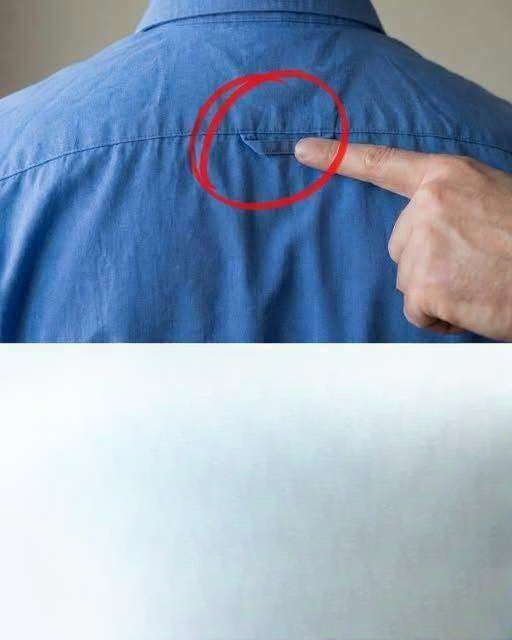
You’ve probably seen it a thousand times without ever giving it much thought—the small fabric loop stitched beneath the back collar of a button-down shirt. It sits quietly, almost invisibly, as if it were an afterthought rather than a deliberate piece of design. Most people assume it is decorative or simply a leftover from manufacturing. Yet this tiny detail carries a surprisingly layered history that moves through practical campus life, mid-century fashion innovation, and even a set of social myths about status and romance.
What looks like nothing more than a stray piece of fabric was once known as the “locker loop,” introduced and popularized in the early 1960s by the American clothing brand GANT. It was designed for a very specific problem faced by university students living in cramped dormitories and crowded athletic facilities. Without reliable closet space or enough hangers, shirts often ended up crumpled inside metal lockers, losing their crisp appearance before morning classes. The solution was simple but effective: a small reinforced loop sewn beneath the collar that allowed garments to be hung neatly on a hook, keeping them clean, organized, and wrinkle-free.
But like many practical inventions, it did not remain purely functional for long. As Ivy League style gained cultural momentum in the United States during the mid-20th century, the locker loop began to take on symbolic meaning beyond its original purpose. It became subtly associated with the polished, preppy aesthetic of elite university life—rowing teams, library study sessions, and the carefully curated appearance of effortless sophistication. In this context, the loop evolved from a utilitarian feature into a quiet marker of identity and belonging, signaling participation in a specific cultural world shaped by tradition and privilege.
Over time, students themselves began to assign additional meanings to the locker loop. On some campuses, a popular but unofficial belief emerged that the presence of an intact loop indicated romantic availability, suggesting the wearer was unattached and open to attention. Conversely, a loop that had been cut or removed was said to signal the opposite condition: that the wearer was in a relationship and no longer on the “market.” Whether universally practiced or not, this idea contributed to a layer of informal social code that transformed clothing into a medium of silent communication among students.
As decades passed, the original functional necessity of the locker loop gradually diminished. Improvements in clothing storage, standardized hangers, and modern laundry practices rendered the feature largely obsolete. However, it did not disappear; instead, it persisted as a stylistic remnant embedded in the design language of the button-down shirt. Today, designers reinterpret the loop in varied ways, sometimes preserving it as a nod to heritage, and other times exaggerating or recoloring it as a decorative accent.
Beyond its aesthetic and historical associations, the locker loop also offers a fascinating example of how industrial design features can outlive their original purpose by decades or even centuries in some form. Designers and historians alike often point to such details as evidence that clothing is not merely functional but also deeply embedded in social and cultural systems. In this sense, a simple loop of fabric becomes a point of entry into broader conversations about class, identity, and the evolution of everyday objects.
Even in today’s fast-moving fashion industry, where trends shift rapidly, such enduring micro-details continue to shape how we understand clothing as both utility and expression. Ultimately, the persistence of the locker loop reminds us that no detail in design is ever truly insignificant.
What makes the locker loop especially interesting is how it reflects the broader human tendency to repurpose functional design into cultural storytelling over time. In doing so, it transforms from a simple garment feature into a subtle archive of lived experience, collective memory, and evolving style. The quiet endurance of such details encourages us to look more closely at the objects we wear and to recognize the histories stitched into them.
So while most people continue to overlook the small loop beneath the collar, it quietly carries a story that bridges practicality, identity, and the subtle language of fashion. In that sense, even the most overlooked stitch can become a window into the hidden narratives of everyday life. Ultimately, what appears as a trivial detail reveals how design carries meaning far beyond its original intent. The locker loop, in all its simplicity, continues to remind us that history often lives in the smallest stitches of what we wear.