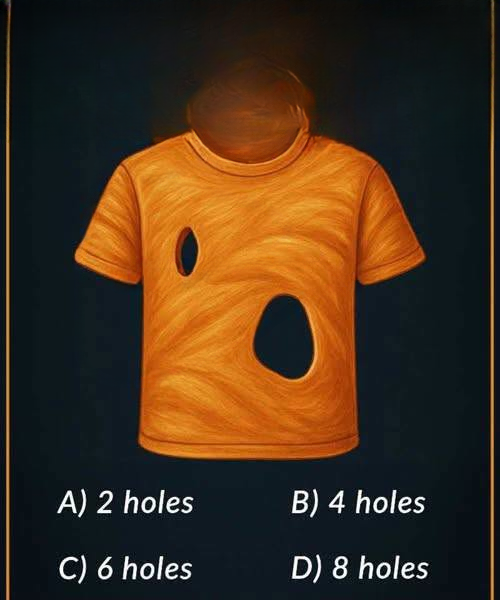
At first glance, it looks like one of those simple brain teasers you’d expect to solve in seconds. A picture of a T-shirt with a few visible tears appears on the screen, followed by a straightforward question:
“How many holes are in the shirt?”
Most people answer almost instantly.
Some confidently say 2, pointing to the two obvious tears in the middle of the fabric.
Others insist the answer is 4, believing they’ve spotted hidden openings.
Then someone says 6, and suddenly the debate begins.
What seemed like a children’s puzzle quickly becomes a fascinating lesson in perception, observation, and the assumptions our brains make without us even realizing it.
Why This Simple Puzzle Tricks So Many People
Our brains are designed to recognize patterns as quickly as possible. Instead of carefully analyzing every detail, we often rely on shortcuts to reach an answer.
When we see a T-shirt, we automatically recognize it as a familiar object. We focus on what appears unusual—the ripped fabric—while ignoring the parts we’ve come to accept without thinking.
That’s exactly why this riddle is so effective.
It isn’t testing your intelligence.
It’s testing how thoroughly you observe.
The First Answer: Two Holes
Many people immediately count only the two tears visible in the center of the shirt.
From this perspective, the question seems simple.
There are two damaged areas.
Therefore, there are two holes.
It’s the answer most people give within seconds.
But is it really complete?
Looking More Carefully
A T-shirt already has several openings before it’s ever worn.
Think about it.
There is:
- One opening for the neck
- Two openings for the sleeves
- One opening at the bottom
Those are all holes.
If you include the two tears shown in the picture, the total becomes:
- Neck: 1
- Left sleeve: 1
- Right sleeve: 1
- Bottom opening: 1
- Two tears: 2
Total: 6 holes.
Suddenly, what looked like a simple puzzle has a completely different answer.
But Wait—Could There Be Even More?
Some versions of the illustration show daylight through the tears.
If the shirt is ripped completely through both the front and back layers of fabric, each tear creates an opening on both sides.
That leads some people to argue for an even higher number.
This is where the discussion becomes interesting.
The puzzle isn’t really about finding one universally correct answer.
It’s about recognizing the assumptions you’re making before you answer.
Why Our Brains Miss the Obvious
Psychologists often describe perception as an active process rather than a passive one.
Your brain doesn’t simply record everything your eyes see.
Instead, it filters information based on experience and expectation.
When you look at a shirt, you don’t consciously count the neck opening or sleeve openings because your mind already categorizes them as “normal.”
The torn sections grab your attention because they break that expectation.
The riddle works because it challenges that automatic filtering process.
Observation Versus Assumption
This tiny puzzle teaches a surprisingly important lesson.
Many mistakes in everyday life don’t happen because people lack intelligence.
They happen because people stop observing and start assuming.
We often believe we’ve seen the whole picture when we’ve actually noticed only the parts that stand out.
Whether we’re reading an email, interpreting a conversation, or solving a puzzle, our minds naturally fill in missing information.
Sometimes that helps us.
Sometimes it causes us to overlook what’s been in front of us all along.
Why These Puzzles Go Viral
Visual riddles like this spread quickly because they create instant discussion.
Friends compare answers.
Families debate their reasoning.
Social media fills with comments arguing for different solutions.
Everyone feels certain—until someone explains another perspective.
That “aha!” moment is incredibly satisfying because it reminds us that seeing isn’t always the same as observing.
Is There Really One Correct Answer?
The answer depends on how the question is interpreted.
If you’re counting only the visible tears in the fabric, the answer is 2.
If you’re counting every opening that exists in the T-shirt—including the neck, sleeves, and bottom hem—the answer is 6.
And if the tears pass completely through both the front and back of the shirt, some people argue the total could be even higher.
The beauty of the riddle is that it encourages careful thinking rather than rewarding quick guesses.
The Bigger Lesson
In the end, this puzzle isn’t really about a T-shirt.
It’s about perspective.
It reminds us that our first impression isn’t always the complete picture, and that slowing down to examine something carefully can completely change our understanding.
The next time you encounter a tricky question—or even an everyday problem—it may be worth pausing for a second look.
Sometimes the answer isn’t hidden.
It’s been there all along, waiting for you to notice it.