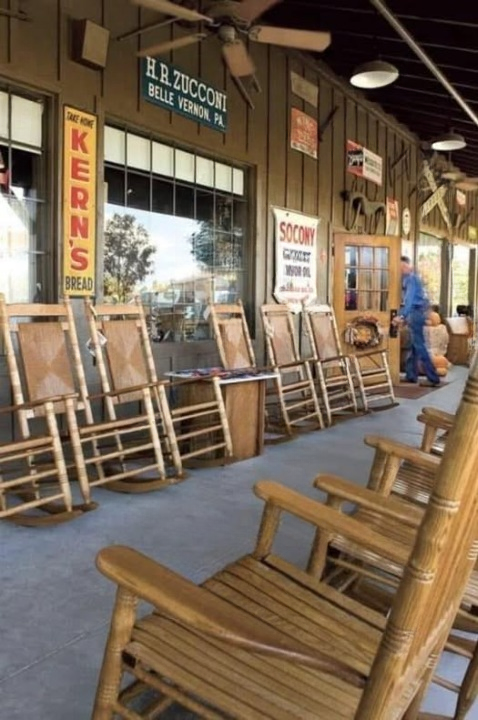
If you’ve ever eaten at Cracker Barrel Old Country Store, you already know the experience feels like stepping into another era. From the rocking chairs lined up on the front porch to the country store filled with nostalgic candy, wooden toys, and home goods, the chain has built its identity on comfort, tradition, and a carefully preserved sense of Americana.
No matter which location you visit—whether it’s along a quiet highway in Tennessee or near a busy interstate in Florida—the experience feels strangely identical. The biscuits taste the same, the lighting feels warm and familiar, and the décor wraps around you like something inherited rather than newly built. But what most people don’t realize, even after hundreds of visits, is how deliberately every detail of that atmosphere has been engineered.
The charm of Cracker Barrel isn’t accidental. It is designed. Every restaurant is built to evoke a nostalgic version of rural American life, blending the feeling of a general store with the comfort of a family kitchen. The wooden walls, soft lighting, and checkerboard tables are not random aesthetic choices—they are part of a unified design language meant to trigger familiarity and emotional comfort the moment you walk in.
One of the most overlooked secrets is the décor itself. At first glance, the walls look like a cozy collection of antiques gathered over decades. Old farming tools, faded advertisements, framed photographs, and cast-iron cookware seem casually arranged, as if they were simply inherited from a long-lost general store. But in reality, each location is carefully curated. A dedicated design team selects every item, sourcing antiques from across the United States and assembling them into themed displays.
There is even a centralized system behind it. Items are cataloged, shipped, and rotated so that every restaurant maintains a consistent “old country store” identity. Before a new location opens, designers spend weeks arranging artifacts to make them look naturally accumulated over generations. The result is an illusion of history—one that feels authentic, even though it is carefully constructed.
Beyond the walls, another hidden detail is waiting in plain sight: the peg game on every table. That small triangular wooden puzzle with colorful pegs is more than just a waiting-time distraction. It is part of the brand’s philosophy. In a world dominated by screens and fast entertainment, the game encourages something slower and more tactile—an old-fashioned way of passing time. Many customers fiddle with it without realizing it has become a signature piece of the restaurant’s identity.
Then there are the rocking chairs on the front porch, one of the most iconic elements of the entire experience. What many visitors don’t know is that those chairs are not just decoration—they are actually for sale. Guests can purchase the same chairs they sit in while waiting for a table. This small detail reinforces the idea that the experience of Cracker Barrel is meant to extend beyond the restaurant itself and into people’s homes.
Food consistency is another hidden layer of engineering. Whether you order chicken and dumplings in one state or meatloaf in another, the experience is intentionally standardized. Recipes are carefully measured and prepared under strict guidelines so that every plate tastes nearly identical across all locations. This uniformity is not just about efficiency—it is about trust. Travelers can walk into any Cracker Barrel anywhere in the country and know exactly what comfort will taste like.
What makes all of this more interesting is how intentional the “small-town” feeling truly is. Every detail, from the warm lighting to the antique clutter, is designed to create the illusion of stepping into a simpler, slower version of America. It is not meant to replicate one specific town or time period—it is meant to evoke a feeling of collective nostalgia, even for places or moments you may never have personally experienced.
Even the country store portion of the restaurant plays a role in this storytelling. The shelves are filled with old-fashioned candy, board games, cast-iron cookware, and seasonal decorations that reinforce the sense of stepping into a general store from decades past. Customers often browse while waiting for a table, extending the experience beyond just dining and into memory-triggering exploration.
Part of why people return again and again is not just the food, but the emotional consistency. In a world that constantly changes, Cracker Barrel Old Country Store offers something rare: predictability wrapped in nostalgia. You know what you’re going to get, and that familiarity becomes comforting in itself.
But once you start noticing the design choices, the experience shifts. The antiques are no longer just decorations—they become curated storytelling tools. The peg game is no longer just a toy—it becomes a symbol of intentional simplicity. The rocking chairs are no longer just seating—they are part of a broader brand identity that extends into memory and emotion.
Even the pacing of the restaurant contributes to the effect. Service is not rushed. Lighting is warm rather than bright. Noise levels are softened by wood and texture rather than echoing metal or glass. Everything works together to slow you down, whether you realize it or not.
At its core, Cracker Barrel is not just a restaurant chain. It is a carefully constructed experience built around nostalgia, comfort, and familiarity. Every object inside—from the antiques on the walls to the games on the table—has been chosen or designed to reinforce a single idea: that you are stepping into something timeless.
So the next time you find yourself sitting in a rocking chair on that familiar porch, take a moment to look around. Notice the objects you’ve walked past a hundred times. Pick up the peg game. Study the walls. You may realize that what feels like a simple country restaurant is actually a quiet piece of storytelling—one you’ve been part of without even knowing it.