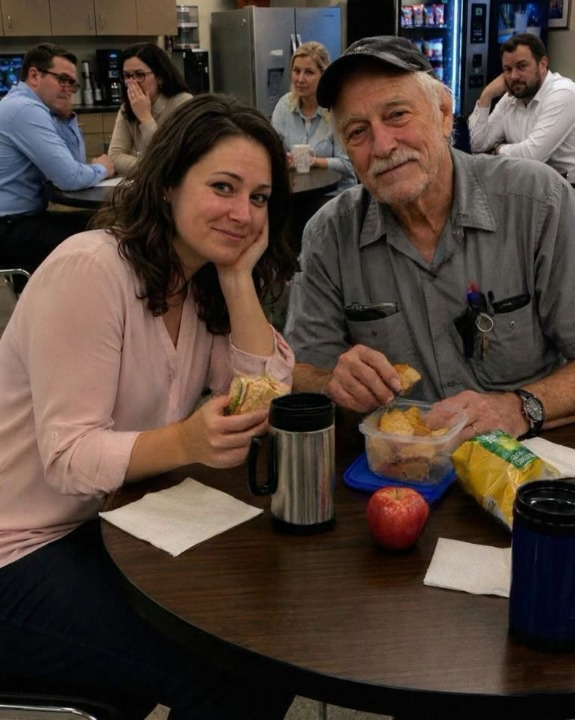
For eleven years, I ate lunch with the janitor.
Not occasionally.
Not when nobody else was available.
Every single workday.
At exactly noon, I carried my lunch to the same small table by the window, where Charles Wilson was usually reading a worn paperback or drinking coffee from the same faded thermos.
And every single day, my coworkers made fun of me for it.
At first, the comments were harmless.
“Got another date with the janitor?”
“Careful, you’ll end up learning how to clean toilets.”
“Does he at least give you insider information about the bathroom schedule?”
People laughed.
I laughed too.
At least in the beginning.
But over time, the jokes became more pointed.
Some coworkers genuinely couldn’t understand why a mid-level manager would spend her lunch breaks with a man they barely acknowledged existed.
To them, Charles was invisible.
The quiet old janitor who emptied trash cans, swept floors, and fixed broken light fixtures.
Nothing more.
To me, he was one of the most interesting people I had ever met.
Our friendship began by accident.
On my first day at the company, I was terrified.
Fresh out of college, desperate to prove myself, and convinced everyone could see how nervous I was.
I carried my lunch into the breakroom and discovered every table was occupied.
Every table except one.
Charles sat alone near the window.
He looked up and smiled.
“Plenty of room here,” he said.
I sat down.
That simple decision changed my life.
At first, our conversations were ordinary.
Weather.
Books.
Office gossip.
Current events.
But gradually, they became something deeper.
Charles asked questions nobody else asked.
Not about sales numbers.
Not about promotions.
Not about office politics.
He asked how I was doing.
Really doing.
When I struggled with self-doubt after receiving criticism from my supervisor, Charles listened without interrupting.
When I got my first promotion, he celebrated like I had won an Olympic medal.
When my engagement ended unexpectedly and I spent weeks pretending I was fine, Charles saw through every forced smile.
He never pushed.
Never judged.
Never offered empty platitudes.
He simply listened.
And somehow, that was enough.
Meanwhile, the office continued to mock our friendship.
People treated it as some strange curiosity.
One coworker once asked me directly why I wasted my lunch breaks with “the cleaning guy.”
I remember Charles overhearing the comment.
He simply smiled and continued eating his sandwich.
Later, I apologized.
He shrugged.
“People see what they’re prepared to see,” he said.
At the time, I didn’t fully understand what he meant.
Years passed.
The company changed.
Managers came and went.
Entire departments disappeared.
But Charles remained.
Every day.
Same table.
Same thermos.
Same warm smile.
Then one Monday morning, he wasn’t there.
At first, nobody noticed.
By lunchtime, someone mentioned that Charles hadn’t been seen all day.
A week later, Human Resources sent a brief email.
Charles Wilson had passed away unexpectedly.
The message was three sentences long.
No company-wide meeting.
No memorial.
No moment of silence.
By the next morning, most people had already moved on.
The man who had spent years quietly taking care of the building had vanished, and hardly anyone seemed to care.
I cared.
I attended his funeral alone.
Or at least, I expected to.
The service was small.
A few distant relatives.
Several former coworkers from jobs he had held decades earlier.
A handful of neighbors.
No one from my office except me.
That hurt more than I expected.
As the service ended and people began leaving, an older man in a dark suit approached me.
“Are you Emily Carter?” he asked.
I nodded.
“My name is Richard Hayes. I’m Charles Wilson’s attorney.”
My stomach tightened.
“Attorney?”
He handed me a small key and a folded document.
“Mr. Wilson instructed me to give these to you personally after the funeral.”
I stared at him.
“There must be some mistake.”
“There isn’t.”
He pointed toward a side room.
“There’s a box waiting for you.”
My hands trembled as I unlocked the door.
Inside sat an ordinary shoebox.
Nothing about it looked remarkable.
Yet something about it made my heart race.
I sat down and carefully lifted the lid.
What I found inside changed everything.
There was no money.
No jewelry.
No hidden fortune.
Instead, there were eleven envelopes.
One for every year we had known each other.
Each envelope was labeled with a year.
Beneath them sat a leather-bound journal.
And underneath that, a stack of photographs.
I picked up the first photo.
It was me.
My first day at work.
Standing nervously in the breakroom.
I looked completely overwhelmed.
I flipped through the stack.
There were dozens.
Hundreds.
Photos of moments I barely remembered.
Me studying reports late at night.
Me laughing after receiving a promotion.
Me sitting alone after difficult meetings.
Me crying quietly in the stairwell after learning my engagement had ended.
I stared at the images in disbelief.
Charles had documented my life.
Not in a creepy or invasive way.
In a careful, compassionate way.
As if he had been preserving evidence that I mattered.
With shaking hands, I opened the journal.
The first entry was dated eleven years earlier.
“Young woman sat at my table today. Terrified. Trying very hard not to show it. Reminds me of myself at that age.”
I turned the page.
Then another.
Then another.
The journal contained observations from every year of our friendship.
Charles remembered everything.
The projects I worried about.
The promotions I doubted I deserved.
The family struggles I rarely discussed.
The dreams I was afraid to pursue.
He recorded our conversations with astonishing care.
Not because he was collecting information.
Because he cared.
Each entry revealed something I had never fully understood.
While I believed Charles was simply listening to me, he had been paying attention in a way nobody else ever had.
He saw me.
Completely.
The final pages contained a letter.
I unfolded it slowly.
“Dear Emily,”
“If you’re reading this, then our lunches have finally come to an end.”
I already felt tears forming.
“There is something I never told you because I never wanted it to matter.”
The next sentence stopped me cold.
“Before becoming a janitor, I spent thirty-two years teaching philosophy at a university.”
I blinked.
Then read it again.
A professor?
Charles had never mentioned that.
Not once.
The letter continued.
After losing his wife and son in a tragic accident decades earlier, he had retired early.
The grief consumed him.
Eventually, he sought a simpler life.
He took custodial jobs because they allowed him to observe people without expectations.
Without titles.
Without status.
Without pretense.
He wanted to understand human nature from a different perspective.
And according to his letter, he learned something surprising.
Most people ignored those they considered unimportant.
Few looked beyond job titles.
Few treated everyone with equal respect.
But one person did.
Me.
I struggled to continue reading through my tears.
“You often believed our lunches benefited me.”
“The truth is that they benefited us both.”
“You never spoke to me differently because of my job.”
“You never treated me as less important than anyone else.”
“That quality is rarer than intelligence, talent, or ambition.”
Then came the final revelation.
Charles had left me his modest savings.
Not a fortune.
But enough to make a meaningful difference.
The letter explained why.
“This is not a gift.”
“It is an investment.”
“You have spent eleven years proving that kindness is not weakness.”
“I believe you will use this opportunity to become exactly the person you are meant to be.”
By the time I reached the final paragraph, I was openly crying.
The last sentence nearly broke me.
“Thank you for seeing me when everyone else looked away.”
I sat alone in that room for nearly an hour.
Thinking.
Remembering.
Understanding.
For years, I believed I had been doing something kind by sharing my lunch table with an elderly janitor.
Now I realized how incomplete that view had been.
Charles wasn’t someone who needed saving.
He wasn’t lonely because nobody wanted to talk to him.
He wasn’t waiting for someone to validate his existence.
He had simply chosen to live quietly.
And in doing so, he taught me lessons no classroom ever could.
When I returned to work the following week, everything looked different.
The building was the same.
The people were the same.
But I noticed things I had overlooked before.
The receptionist nobody greeted.
The security guard people walked past without acknowledgment.
The maintenance staff who kept everything running while receiving almost no recognition.
Charles had spent years showing me that every person carries a story invisible to everyone else.
A title reveals very little.
A position reveals even less.
Character is what matters.
Months later, I used part of Charles’s inheritance to establish a scholarship fund in his name.
Not for academic achievement.
Not for leadership.
For kindness.
For students who consistently treated others with dignity regardless of status.
It felt like something Charles would appreciate.
Today, the table by the window still sits empty.
Sometimes I eat there alone.
Sometimes others join me.
But every time I look at that chair, I remember a man the world dismissed and underestimated.
A man who quietly changed my life.
A man who taught me that the greatest gift one person can give another isn’t money, advice, or opportunity.
It’s attention.
It’s noticing.
It’s seeing someone completely and letting them know they matter.
And thanks to Charles Wilson, I will never underestimate the power of that gift again.