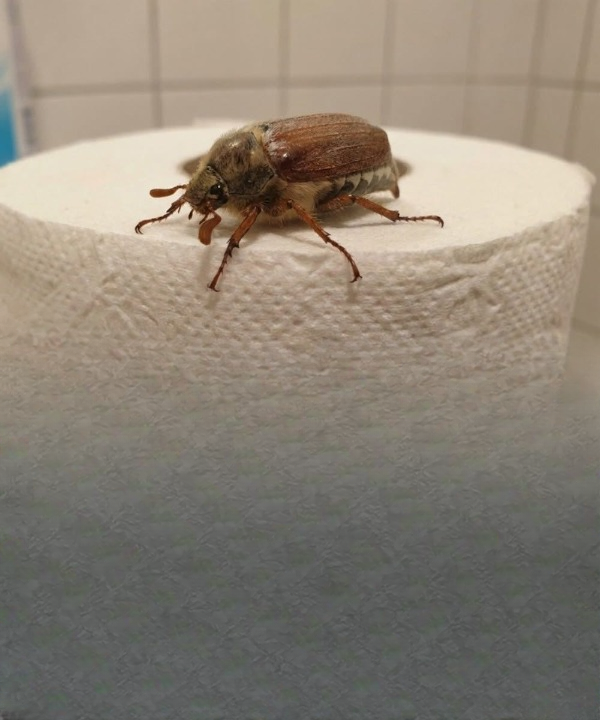
It’s a familiar late-night moment for many people: you enter the bathroom, switch on the light, and suddenly hear a loud “thwack” as something heavy collides with the ceiling, mirror, or tiles. A large insect is circling awkwardly in the light, bumping into surfaces with surprising force. Instinctively, it catches your attention—and maybe even gives you a small shock.
If you’ve experienced this, there’s a high chance you’ve encountered a cockchafer, also known as a May bug (Melolontha melolontha). Despite its intimidating appearance and noisy flight, this insect is completely harmless to humans.
Understanding what it is, why it appears indoors, and how to respond calmly can turn a stressful moment into a simple, manageable situation.
First and Most Important: It Is Not Dangerous
The cockchafer is one of those insects that looks far more alarming than it actually is. At first glance, its large body, winged form, and noticeable movement can make it seem threatening. However, it poses no real risk to people or pets.
To be clear:
- It does not bite humans
- It does not sting
- It is not poisonous or venomous
- It does not spread disease
- It does not infest homes
Those noticeable “jaw-like” structures on its head are not defensive weapons. They are designed for feeding on plant material, not for interacting with humans.
In short, despite its dramatic entrance into your bathroom, it is simply an outdoor insect that has wandered into the wrong place.
Why It Ended Up in Your Bathroom
The appearance of a cockchafer indoors is almost always accidental. These insects are strongly influenced by light, especially bright artificial lighting at night.
Bathrooms, in particular, often create the perfect conditions for confusion:
- Bright white or LED lighting
- Reflective surfaces like tiles and mirrors
- Open windows or ventilation gaps
- Warm, humid air
To a nocturnal insect, this combination can resemble natural cues that normally guide movement outdoors. As a result, the insect becomes disoriented and repeatedly flies toward the light source, mistaking it for an exit or environmental signal.
This behavior is known as phototaxis, meaning movement in response to light. In the case of cockchafers, it is strongly positive—they are drawn toward light rather than away from it.
Seasonal Appearance and Behavior
Cockchafers are not present in homes year-round. They appear seasonally, typically in late spring to early summer, depending on the region. Their adult phase is relatively short, often lasting only a few weeks.
During this time, they become more active at dusk and during the night. Males fly around searching for mates, often in noisy and unpredictable patterns. Because their flight is not particularly controlled or precise, they are more likely to accidentally enter open windows or doors.
This seasonal behavior explains why sightings are usually brief and concentrated within a specific period of the year.
Why the Loud “Crash” Happens
One of the most memorable things about cockchafers is their flight pattern. Unlike many smaller insects that move silently, cockchafers are large, heavy-bodied beetles with relatively clumsy flight mechanics.
When they fly indoors:
- They often misjudge distances
- They repeatedly collide with surfaces
- Their wing beats create a loud buzzing sound
- They are easily disoriented by reflective environments
This combination results in the loud “thump” or “whap” sound that often surprises people when they first notice them.
How to Identify a Cockchafer
Cockchafers are often confused with other large beetles, especially June bugs. However, there are a few distinguishing features that make identification easier:
- They have fan-like antennae that spread outward
- Their body is typically brown with a slightly fuzzy appearance
- They are larger and more robust than many similar beetles
- Their flight is louder and more erratic
- They are most active in late spring evenings
Because several beetles share similar shapes and sizes, misidentification is common, especially when the insect is seen briefly indoors.
What You Should Do If You Find One Indoors
The most important thing to remember is that the insect is not a threat. Your response should focus on calmly guiding it back outside.
1. Stay calm and avoid sudden movements
The insect cannot harm you. Even if it lands on you, it will simply crawl or fly away.
2. Reduce the light source
Turn off the bathroom light if possible. Darkness helps disorienting the insect settle, reducing frantic flight behavior.
3. Open a path to the outside
If there is a window or exit nearby, open it. Cockchafers will naturally move toward open space once they are no longer drawn to artificial light.
4. Use directional lighting if needed
In some cases, placing a light outside the window can help guide the insect out of the room.
5. Gently assist if necessary
If it does not leave on its own, you can carefully guide it using a simple method:
- Place a cup or container over it
- Slide a piece of paper underneath
- Carry it outside and release it onto a plant or tree
This approach avoids harm and safely relocates the insect.
What You Should Avoid Doing
While the situation may feel uncomfortable, certain reactions are unnecessary and should be avoided:
- Do not attempt to squash the insect
- Do not use insect sprays indoors unnecessarily
- Do not flush it down drains or toilets
- Do not panic or chase it aggressively
These actions are either ineffective or unnecessarily harmful, especially since the insect is harmless and only temporarily misplaced.
Will More Cockchafers Enter Your Home?
In most cases, no. A single insect entering a home is usually an isolated incident caused by light attraction and open access points.
However, a few conditions may slightly increase the likelihood of future visits:
- Leaving windows open at night during peak season
- Using bright white lighting near open spaces
- Having no window screens or barriers
Even then, cockchafers do not live or breed indoors. Their life cycle depends on soil, plant roots, and outdoor environments, particularly during their larval stage.
Once the short adult season ends, sightings typically stop completely until the following year.
Simple Prevention Tips
If you want to reduce the chances of future nighttime visitors, a few small adjustments can help:
- Use warm or yellow-toned lighting instead of bright white LEDs near open windows
- Install insect screens on bathroom windows
- Keep windows closed during peak activity months in the evening
- Reduce unnecessary outdoor-facing lighting at night
These steps help minimize light attraction while still allowing ventilation and comfort.
The Ecological Role of Cockchafers
Although they can be startling when they appear indoors, cockchafers play an important role in natural ecosystems.
As adults, they feed on leaves and plant material. As larvae, they live underground, contributing to soil turnover and decomposition processes. This helps maintain healthy soil structure over time.
They are also part of the food chain, serving as a food source for:
- Birds
- Bats
- Small mammals such as hedgehogs
In some regions, their populations declined significantly in the past due to pesticide use. In recent years, there has been ecological interest in their gradual return, as they contribute to biodiversity and ecosystem balance.
So while an indoor encounter may feel inconvenient, it is actually part of a much larger natural cycle taking place outside.
Final Thoughts
A cockchafer appearing in your bathroom can be surprising, especially at night when its loud flight and sudden movements catch you off guard. However, despite its dramatic presence, it is completely harmless and only temporarily disoriented.
The best response is always calm observation, minimal interference, and gentle guidance back outdoors.
These insects are not signs of infestation or danger—they are simply part of the natural environment interacting briefly with human spaces. Once understood, the situation becomes far less stressful and much easier to manage.
In the end, what feels like a startling interruption is really just a small reminder of how closely human environments and nature overlap, even in the most ordinary places like a bathroom at night.