The iron hissed across my shirt collar even though it was already smooth. I kept pressing it down anyway, like if I made the fabric perfect enough, the day itself would behave.
On the dresser, my wife’s photo sat exactly where it had for eighteen years. Same soft smile. Same steady eyes. Same reminder of everything I lost in a single hour when Hailey was born and she was gone.
“I kept my promise,” I said quietly. “She never felt like she was missing anything.”
But standing there that morning, I wasn’t so sure I had ever believed it.
Hailey came down the stairs in her cap and gown, moving slower than usual. There was something folded in her sleeve she kept touching, like a secret she wasn’t ready to let go of.
“You ready?” I asked.
“Almost,” she said.
She hadn’t been herself all week. Quiet phone calls. Long pauses. A distant look I couldn’t quite place. I told myself it was graduation nerves. Every parent does that—fills in the unknown with something harmless.
Still, I noticed things. The attic ladder left down twice. Old boxes shifted. A question she asked out of nowhere about whether her mother had ever hidden things from me before she died.
I ignored the knot forming in my chest.
On the drive, I tried to picture the moment I had waited for since she was born: her name called, her hand looping through my arm, the walk across the field like we had done through every school event since kindergarten.
“Front row,” she said as we parked. She kissed my cheek. “Don’t be late when they call me.”
“Never,” I said. “I’ve never missed a second of you.”
I meant it.
I just didn’t know what that meant anymore.
The stadium was already full when we arrived. Families crowded bleachers, cameras lifted, voices rising and falling in waves of celebration.
The principal stepped forward.
“Each graduate will choose one person who helped them reach this moment,” he announced. “They will cross the field together.”
I exhaled. Simple. Familiar. Safe.
I had rehearsed this moment in my mind for years.
Then I heard it.
“Hailey Marie.”
I stood immediately.
My hand lifted toward her seat without thinking.
But she didn’t take it.
She didn’t even look at me.
Instead, she stood and walked right past me.
At first, I thought she had misheard. That she would turn back.
She didn’t.
She kept walking toward the edge of the field.
Toward the school janitor.
He stood there in a pressed gray suit I had never seen before, cap in his hands, posture tight like he was holding himself together by force.
The crowd shifted.
Whispers started.
“Isn’t that the janitor?”
“Why him?”
“Where’s her father?”
I stayed standing, my hand still half-raised, feeling suddenly ridiculous.
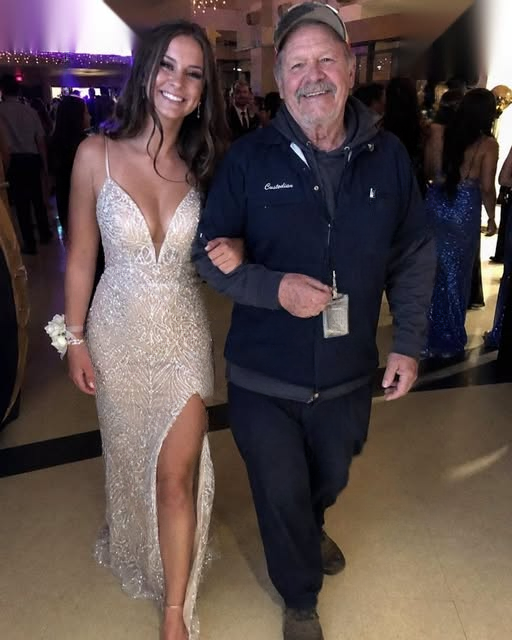
Hailey reached him and gently slipped her arm through his.
“Would you walk with me?” she asked.
His eyes filled instantly. He nodded.
And together, they started across the field.
Each step felt louder than the last.
Each step felt like something I didn’t understand slipping further away from me.
They reached the stage.
The janitor didn’t climb it.
Instead, he turned toward the principal and asked for the microphone.
A hesitation passed through the stadium.
Then it was given to him.
Silence fell.
He reached into his jacket and pulled out a yellowed envelope.
Old. Folded. Carefully preserved like it had been carried through years for this exact moment.
He looked up.
And for the first time, his eyes met mine.
“I was asked to read this today,” he said, voice unsteady. “So the truth is heard. Especially by you.”
My stomach tightened.
He opened the envelope.
“The date on this letter is the day Hailey was born,” he continued.
A murmur moved through the stands.
My mouth went dry.
I didn’t understand why my chest suddenly hurt.
Then he began to read.
“My dearest husband…”
My breath stopped.
That voice didn’t belong in a stadium.
It belonged in memory.
It belonged in grief.
My wife.
Gone eighteen years.
Still somehow here.
The janitor’s voice shook as he continued.
“She said you were already carrying too much,” he read. “That grief should not become a second burden of hidden truth.”
My hands clenched so hard my nails cut into my palms.
What truth?
The world around me felt too large and too small at the same time.
Then he said it.
“The man standing beside your daughter is your brother.”
For a moment, I didn’t process the words.
They passed through me like noise.
Then stopped.
Brother.
I blinked.
Once.
Twice.
Something deep in my memory shifted.
My mother. A kitchen table. A conversation I had never fully understood.
“There was a child before you,” she had said once, years ago. Then she had stopped speaking.
I had never asked again.
Because asking meant opening something I wasn’t ready to face.
I looked at the janitor again.
Really looked.
The shape of his face.
The scar near his chin.
The way he held the paper like it was heavier than anything else in the world.
Recognition didn’t arrive gently.
It hit all at once.
“No,” I whispered.
But even as I said it, I knew.
Hailey was crying now on the stage, holding both of them.
The janitor lowered the letter.
“I never wanted to take anything from you,” he said quietly. “I only wanted to be near you. That’s all.”
Something inside me cracked—not in anger, but in something far more complicated.
Years of absence suddenly had shape.
Years of unknown presence suddenly had meaning.
I walked before I realized I was moving.
Down the steps.
Across the field.
The crowd blurred.
The only thing that stayed sharp was him.
When I reached him, I stopped.
For a long moment, neither of us spoke.
Then I asked, barely above a whisper:
“Is it true?”
He nodded once.
That was enough.
No defense. No elaboration.
Just truth.
And somehow, that was worse—and better—than anything else.
I pulled him into an embrace before I thought about it.
His shoulders shook against mine.
“I didn’t want to take anything,” he said again.
“You didn’t,” I replied quietly. “You just existed where I never knew to look.”
Hailey stepped between us, still crying, still smiling through it.
“Both of you,” she said softly. “Walk me.”
So we did.
The three of us crossed the field together.
Not as strangers anymore.
Not as separate lives colliding by accident.
But as something none of us had names for yet.
That night, the house felt different.
Not fixed.
Not healed.
But no longer hollow.
Hailey sat between us at the kitchen table, laughing through tears at something small and ordinary.
I placed the envelope beside my wife’s photo.
“You planned this,” I said quietly.
Of course she had.
And for the first time in eighteen years, I understood what she had really left behind.
Not just answers.
But a family I was finally ready to see.