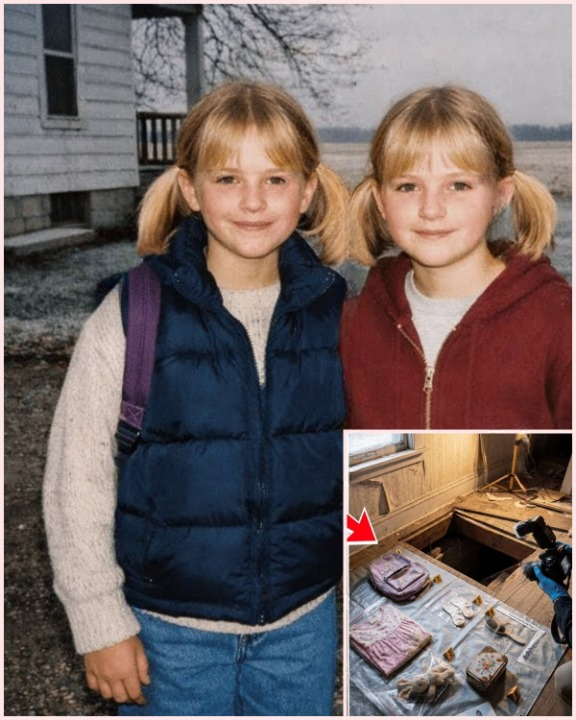
The farmhouse stood alone at the end of the gravel drive like something the land had decided to keep but never forgive.
By January 2026, its white paint had peeled into thin ghostly layers, revealing gray wood beneath—warped, tired, and softened by three decades of weather. The porch sagged under its own memory. Broken windows stared out at fields of Milbrook County, Indiana, flat and endless under a dull winter sky.
Natalie Brennan sat in her rental car for nearly ten minutes before she could bring herself to turn off the engine. Her hands stayed locked around the wheel anyway.
She had not returned here in over twenty years.
Some places don’t remain locations. They become thresholds. This was one of them.
The call from Sheriff Thomas Grayson had come three days earlier.
His voice, once sharp and confident during the 1993 investigation, now carried the weight of age and unfinished business.
“Natalie,” he had said, “we need you to come back. The demolition crew found something in the farmhouse. Something you need to see.”
When she pressed for details, he refused.
“Not over the phone. But… after all this time, we may finally have answers about Vivien.”
Now she stood outside the house where she and her twin sister had once shared a bedroom, and felt the past press against her ribs like a hand that refused to let go.
Vivien Brennan had vanished on a November night in 1993.
Natalie was ten. Vivien was ten. They had gone to sleep in twin beds on opposite sides of a small, dim room. By morning, Vivien’s bed was empty.
No broken windows. No struggle. No footprints in the frost outside. The back door was unlocked, but intact.
And just like that, one of them was gone.
For thirty-three years, there had been nothing.
Natalie stepped out into the cold.
Sheriff Grayson’s patrol car idled near the porch. A demolition crew stood by heavy machinery. Yellow tape cut across the entrance like a warning the house no longer needed to give.
Grayson met her at the base of the steps.
“You shouldn’t have come alone,” he said.
“I’ve been alone in this since I was ten,” she replied. “Just tell me what you found.”
He hesitated. “They were removing floorboards in the upstairs bedrooms. Your old room. They found a crawl space that isn’t on any blueprint we have.”
Natalie’s breath caught.
“And inside,” he continued carefully, “were items belonging to a child. Clothing. Shoes. A backpack.”
The air tightened around her.
They walked inside.
The house felt wrong in motion—like every step stirred something that had been waiting too long to be disturbed. Mold clung to the walls. Wallpaper hung in strips like shed skin. Dust swirled through beams of harsh flashlight and work lamp.
By the time they reached the second floor, Natalie’s chest felt hollow.
Her old bedroom door hung crooked on its hinges.
Inside, the room had been stripped bare. Only the outline of memory remained—two faded rectangles on the floor where beds had once stood. One by the left wall. One by the window.
The investigators had cut open a section between them.
A woman in protective gear crouched beside it, photographing the edges of a hidden cavity beneath the floorboards.
Sheriff Grayson gestured. “Dr. Rachel Torres, lead investigator.”
The woman stood, removing one glove.
“Dr. Brennan,” she said gently. “I’m sorry we’re meeting like this.”
Natalie didn’t respond. Her eyes were fixed on the opening in the floor.
Something had been sealed beneath her childhood bedroom.
Something that had been there while she slept.
Torres lowered her voice. “We recovered several items. We’re still cataloging, but… there’s something else.”
She hesitated, then reached into an evidence box and placed a small, weathered object into Natalie’s hands.
A hair clip.
Faded plastic. Pink, chipped at the edges.
Natalie’s throat tightened instantly.
Vivien had worn it the night she disappeared.
“I recognize that,” she whispered.
Grayson looked away.
Torres continued, “We also found markings on the interior beams of the crawl space. Not scratches—intentional carvings. We believe someone spent time there.”
Natalie stepped closer to the opening. The flashlight beam revealed scorched wood, faint initials etched into the underside of the floorboards.
V.B.
Her knees weakened.
“No,” she said quietly. “No, that’s not possible.”
But the room did not answer.
Grayson spoke carefully. “We’re calling in forensic linguistics and historical reconstruction. If someone was kept here…”
“If?” Natalie snapped, her voice breaking. “You think she was alive under this house?”
No one answered immediately.
Torres finally said, “We don’t know yet. But the evidence suggests prolonged occupancy.”
Natalie backed away from the hole in the floor as if it might open further.
All those years.
All that silence.
All that nothing.
And beneath it—something had been there the entire time.
Her sister had not simply vanished.
She had been hidden.
A sound escaped Natalie’s throat before she could stop it—a fractured breath that felt like it belonged to someone younger.
“I was right here,” she whispered. “I was right in the next bed.”
Grayson’s voice softened. “Natalie—”
“No,” she said sharply. “Don’t.”
She looked down at the hair clip again, her fingers shaking.
The house seemed to tilt around her.
Thirty-three years of funerals she never held properly. Birthdays she stopped marking. A life built around absence that now felt… rearranged.
Torres stepped carefully closer. “We’re going to do everything we can to reconstruct what happened. But we need you to prepare for the possibility that this changes everything you thought you knew.”
Natalie gave a hollow laugh.
“Everything I knew was already gone,” she said. “You just found where it was buried.”
Outside, wind moved through the broken windows, stirring dust into thin spirals.
And for the first time since 1993, the question that had defined her entire life no longer felt like a question.
It felt like the beginning of an answer no one was ready to face.