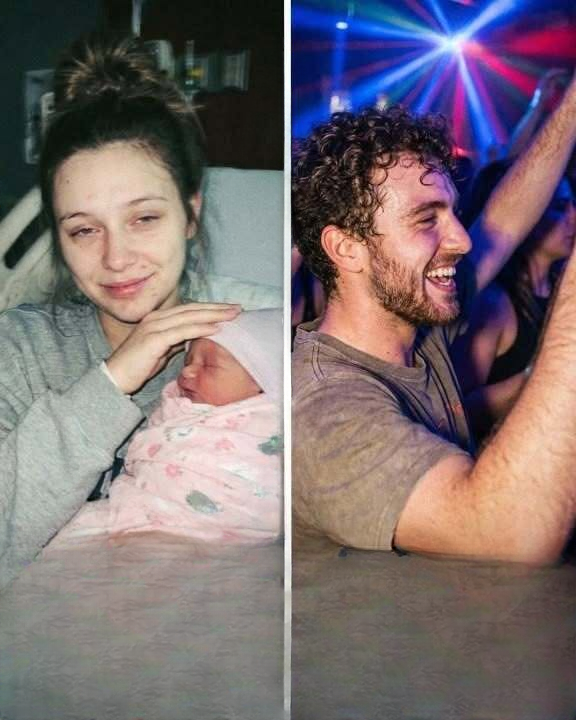
At first, he struggled.
He made mistakes that he never admitted were his responsibility. Burned meals he insisted followed “bad instructions.” Mixed up diaper sizes and blamed the packaging. Panicked every time the baby cried for more than a few minutes, pacing the hallway like noise alone could break him.
And more than once, I found him standing over the crib, frozen, as if he were waiting for someone to step in and tell him what to do next.
But no one did.
Because Rose refused to rescue him.
That was the difference in her approach. Where others softened his discomfort or stepped in to smooth things over, she simply stood back and watched him sit in the consequences of what he had done—and what he had failed to do.
Whenever he tried to hand the baby off and disappear into another room, Rose stopped him with a look sharp enough to end the conversation before it started.
Whenever he complained that he didn’t know what he was doing, she reminded him that no one does at the beginning.
And whenever he tried to avoid the responsibility altogether, she pointed toward the nursery and said the same two words every time:
“Figure it out.”
For the first few weeks, he resisted everything.
He was bitter, defensive, and restless. He hated the fact that the house didn’t feel like his anymore. He hated the restrictions Rose quietly imposed after I gave birth alone—no excuses, no disappearing acts, no escaping responsibility through silence.
Most of all, he hated that no one trusted him to do what a father was supposed to do.
But something strange began to happen over time.
He stopped treating the baby like an interruption to his life and started treating her like part of it.
At first, it was mechanical. Feedings done out of obligation. Diaper changes performed with visible frustration. Sleepless nights endured like punishment.
But slowly, something softened.
It began in small moments that didn’t announce themselves as important. The way he learned her cries without needing to be told what they meant. The way he started lingering a few extra minutes after feeding her, instead of immediately leaving the room. The way his voice changed when he spoke to her, as if he was no longer performing the role of a father but actually becoming one.
One evening, while feeding her, he paused.
She had wrapped her tiny fingers around his thumb and refused to let go.
I watched his face carefully in that moment, expecting the same frustration I had seen so many times before.
Instead, I saw something different.
Confusion, first.
Then stillness.
Then something that looked almost like recognition.
For the first time, he wasn’t thinking about what he had lost or what he resented.
He was thinking about her.
Months passed.
The exhaustion didn’t disappear, but it shifted into something shared. Late-night feedings became routine instead of crisis. Doctor visits became something we navigated together instead of separately. Laundry piles became part of the background noise of a life that was, slowly, stabilizing.
And through all of it, Rose watched quietly.
She never offered praise too quickly. That wasn’t her way. She believed change that wasn’t tested wasn’t real, and responsibility that wasn’t sustained meant nothing.
But one afternoon, I found her sitting on the porch, watching him push the stroller down the sidewalk.
“He finally understands,” she said.
I sat beside her. “Understands what?”
“That being a father isn’t a title,” she replied.
I followed her gaze.
He was making exaggerated faces at the baby, trying to make her laugh. And she was responding—small smiles, soft sounds, the earliest signs of recognition.
“And what is it supposed to be?” I asked quietly.
Rose tapped her cane once against the wooden floor.
“A choice.”
I never forgot that.
Because she was right.
Parenthood isn’t something that happens once and stays fixed. It is a repeated decision. A daily return to responsibility, even when it is inconvenient, exhausting, or undeserved.
And for a long time, he had failed to make that choice.
Until he didn’t.
A year later, Rose’s health began to decline.
It happened gradually at first—slower steps, longer rests, more time spent sitting in silence while life moved around her. But even as her strength faded, her awareness didn’t.
She still noticed everything.
Still asked questions no one else thought to ask.
Still made sure nothing slipped back into old patterns.
One evening, she asked us both to sit with her.
The baby was asleep upstairs. The house was quiet in that heavy, settled way that only comes after a long day.
Rose looked at him first.
“You disappointed me,” she said simply.
He lowered his eyes. “I know.”
The silence that followed wasn’t harsh. It was final.
Then she surprised both of us.
“But I’m proud of the man you’re becoming.”
His reaction broke something open in him. He didn’t respond with words. He couldn’t. He just cried—quietly at first, then fully, as if something he had been holding for years had finally been allowed to collapse.
Rose reached for his hand.
“Don’t waste the second chance you were given.”
Then she turned to me.
“And don’t spend your life punishing him for who he used to be.”
It wasn’t easy to hear.
But it was honest.
And Rose had never been interested in comfort if it came at the expense of truth.
She passed away three months later, peacefully, surrounded by the life she had shaped far more than anyone realized.
At her funeral, the church was full. Not out of obligation, but recognition. People came because she had mattered in ways that weren’t always visible until she was gone.
After the service, he stood holding our daughter while she rested her head against his shoulder.
For a long time, neither of us spoke.
Then he finally said, “If she hadn’t changed the will, I would’ve lost everything.”
I shook my head gently.
“No,” I said.
He looked at me, confused.
“She didn’t take everything from you.”
I looked down at our daughter.
“She made sure you found what mattered.”
And in that moment, there was no argument left between us—only understanding.
The house Rose left behind remains with us now, a quiet reminder of her presence in every corner. But the most important thing she gave us was never written in legal documents or tied to property.
It was the lesson she enforced when no one else would.
That love without responsibility is only sentiment.
And that families are not built by words spoken in easy moments.
They are built by showing up.
Again and again.
Even when it’s hard.
Especially when it’s hard.
And because of Rose, a little girl who entered the world without her father beside her grew up knowing what it means to have one who stayed.