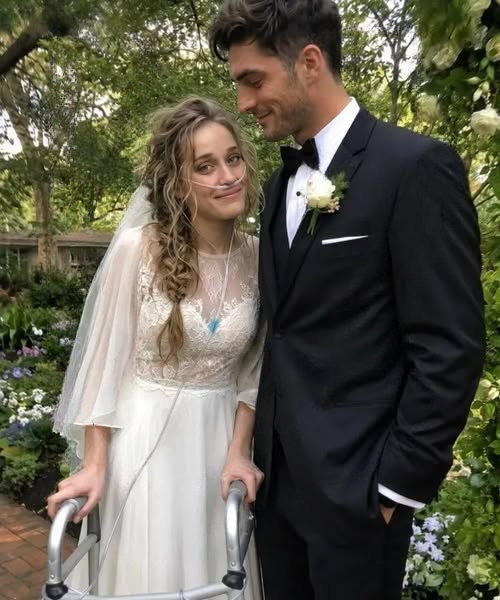
The day I heard the word terminal, the room didn’t spin or go dark like in movies. It just… emptied out. The doctor kept talking, something about timelines and treatment options, but all I could hear was the sudden absence of my future.
I remember gripping my fiancé Daniel’s hand so tightly my knuckles hurt. I was waiting for him to say something—anything that would anchor me to the life we had been planning. The wedding invitations were already half-designed. The venue deposit was paid. My dress was hanging in a garment bag in the spare room like a promise waiting to be fulfilled.
He didn’t say much that day. Just nodded. Held my hand. Promised we’d “figure it out.”
Two days later, he was gone.
No argument. No dramatic confrontation. Just a text saying he wasn’t “strong enough for this” and that he was sorry. Then silence. The kind that doesn’t echo—it erases.
I became, overnight, a woman with a dying body, an untouched wedding dress, and a future collapsing in on itself. Friends didn’t know what to say. My parents spoke in careful voices, as if too much emotion might accelerate time itself.
The wedding venue refused to refund us. The florist still sent reminder emails. Life kept moving forward with an almost cruel indifference.
And I was stuck in it—somewhere between grief and survival.
That was how I ended up searching for something absurd: an acting agency.
At first, it was just desperation disguised as practicality. I told myself I wasn’t looking for a real husband, just someone to stand beside me for a day so I wouldn’t have to explain the cancellation of a life I had already paid for.
Most agencies didn’t respond. One did.
“I’ll do it,” the message said. “But I have one condition.”
His name was Elias.
We met in a quiet café where people didn’t ask too many questions. He didn’t look like someone trying to sell a service. No rehearsed charm, no polished sympathy. Just a calm presence that made me feel, for the first time in weeks, like I could breathe without bracing for impact.
“My condition,” he said gently, “is that I get to know you. Not the patient. Not the diagnosis. You.”
It should have felt strange. It didn’t.
Elias had once worked in hospice care before becoming an actor. He said he understood how easily people became roles in their own tragedies—and how important it was to be seen as more than that.
So we met again. And again.
He learned how I took my coffee. How I hated being called “brave” when I was just exhausted. How I still wanted my wedding to feel like joy, even if joy was temporary.
He didn’t try to fix anything. He just stayed.
When my ex-fiancé Daniel reappeared a week before the ceremony, it felt like a cruel joke. He stood in my doorway with rehearsed regret in his voice, saying he had made a mistake, that he “wasn’t ready before but was ready now.”
But all I saw was timing.
He wasn’t coming back because he loved me more than fear. He was coming back because fear had finally become familiar.
Behind him, Elias stood quietly in the hallway, holding a small box of documents for the ceremony arrangements. He didn’t interrupt. Didn’t posture. He simply waited.
For the first time, I understood the difference between someone who returns when it’s convenient—and someone who never left.
“I already chose,” I told Daniel.
And that was the end of it.
The wedding day itself didn’t feel like a performance. It didn’t feel like pretending.
Elias didn’t try to replace what I had lost. He didn’t act like this was a traditional love story. Instead, he walked beside me through every fragile moment of it—the appointments, the fatigue, the long silences between treatment days where even hope felt heavy.
When I walked down the aisle, it wasn’t toward a future I was guaranteed. It was toward a moment I was still alive to experience.
Elias stood at the altar with steady hands and no illusion that promises could stop what was coming. But he didn’t flinch from it either.
That was what mattered.
Love, I learned, is not always loud or permanent. Sometimes it is simply the decision to remain present in a life that is becoming harder to hold.
I won’t pretend the ending is the one I once imagined. It isn’t.
But I was not abandoned in the middle of it.
I was accompanied.
And in a life where so much had become uncertain, that kind of presence turned out to be its own kind of forever.