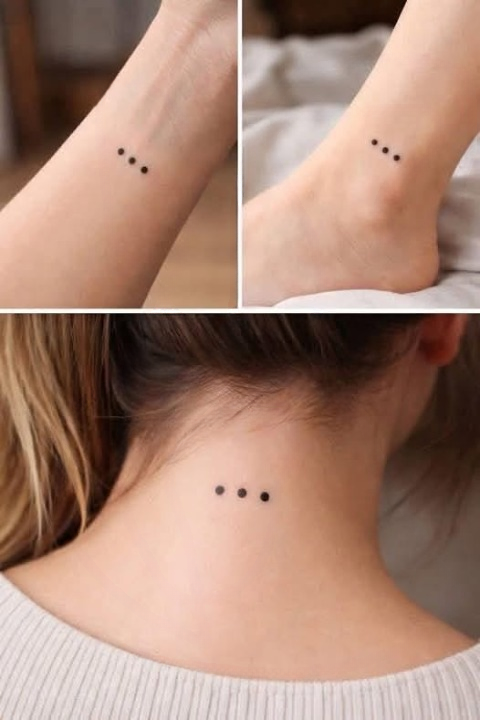
The three dot tattoo is one of the simplest yet most widely misunderstood body markings in modern tattoo culture. At first glance, it appears minimal—just three small dots placed in a triangle formation, often on the hand, wrist, or near the eyes. But despite its simple design, it carries a wide range of meanings depending on cultural context, personal history, and geographic region.
For some people, the three dot tattoo represents a personal philosophy rather than a formal affiliation. For others, it has historical associations with hardship, resilience, or life experiences that are not always openly discussed. Its meaning is not universal, which is part of what makes it so symbolic and, at times, controversial.
Origins and “Mi Vida Loca” Association
One of the most well-known interpretations of the three dot tattoo comes from its connection to the phrase “mi vida loca,” a Spanish expression meaning “my crazy life.” In some communities, the three dots are seen as a visual shorthand for this idea, representing a life shaped by struggle, risk, or unpredictability.
However, it is important to understand that this interpretation is not tied to a single group or organization. Instead, it has been adopted in different ways by different individuals over time. For some, it reflects rebellion or a nonconventional lifestyle. For others, it is simply an aesthetic choice inspired by street culture or personal identity.
Prison Symbolism and Misinterpretations
In certain regions, the three dot tattoo has been associated with prison environments or gang-related symbolism. In these contexts, it has sometimes been interpreted as representing silence, loyalty, or a commitment to a code of conduct. However, the meaning is not consistent across all institutions or groups.
Because of this association, people who display the tattoo may sometimes face social stigma or assumptions about their background, even if their personal meaning has nothing to do with criminal activity. This highlights one of the challenges of symbolic tattoos: meaning can be assigned by observers rather than the wearer.
Experts in cultural studies often emphasize that symbols like the three dots can shift meaning depending on time, place, and social perception. What may be seen as harmless in one setting can be misinterpreted in another.
Personal Meaning and Individual Expression
For many people, the three dot tattoo has nothing to do with gangs or prison symbolism at all. Instead, it serves as a deeply personal mark. Some individuals choose it to represent key life stages, such as past, present, and future. Others interpret it as a reminder of resilience through hardship or survival after difficult experiences.
In this sense, the tattoo becomes less about external meaning and more about internal storytelling. It may symbolize a journey through pain, growth, and recovery. Because it is small and minimalist, it allows the wearer to attach meaning without needing to explain it publicly.
This personal flexibility is one reason the design has remained popular across different cultures and age groups.
Cultural Variations Across Countries
The meaning of the three dot tattoo can vary significantly across different countries and communities. In some places, it is viewed as purely aesthetic body art with no deeper implication. In others, it may be connected to specific subcultures or interpreted through the lens of local social history.
For example, in certain urban environments, minimalist tattoos like three dots are associated with street fashion or identity expression. In other contexts, they may be interpreted more cautiously due to historical associations with correctional institutions or organized groups.
Because of these differences, the same tattoo can be read in multiple ways depending on who is viewing it.
Social Stigma and Misunderstanding
One of the key issues surrounding the three dot tattoo is social perception. People who wear it may sometimes be judged based on assumptions rather than reality. This can lead to misunderstandings in workplaces, social settings, or public spaces.
However, tattoo culture has evolved significantly in recent decades. Minimalist designs are now widely accepted in mainstream fashion and personal expression. As a result, older interpretations tied strictly to stigma are gradually becoming less dominant, although they still exist in some contexts.
This shift reflects a broader change in how society views body art—not as a fixed label, but as a form of personal expression that evolves over time.
Why Simple Designs Carry Deep Meaning
One of the reasons the three dot tattoo remains so compelling is its simplicity. Unlike detailed tattoos that clearly depict specific images, minimalist symbols invite interpretation. This openness allows individuals to project their own experiences onto the design.
A small cluster of dots can represent survival, memory, transformation, or even silence. It can mark a turning point in life that does not need to be explained to others. In this way, the tattoo becomes both private and visible at the same time.
The power of the design lies not in its complexity, but in its ambiguity.
Final Thoughts
The three dot tattoo is a reminder that meaning is not always fixed. It can be cultural, personal, historical, or misunderstood depending on context. While it has been linked in some interpretations to prison symbolism or street culture, it is equally often used as a personal expression of life experience, identity, or resilience.
Ultimately, what the tattoo represents depends on the individual who wears it. And perhaps that is why it continues to endure—it is small enough to be simple, yet open enough to hold a lifetime of meaning.