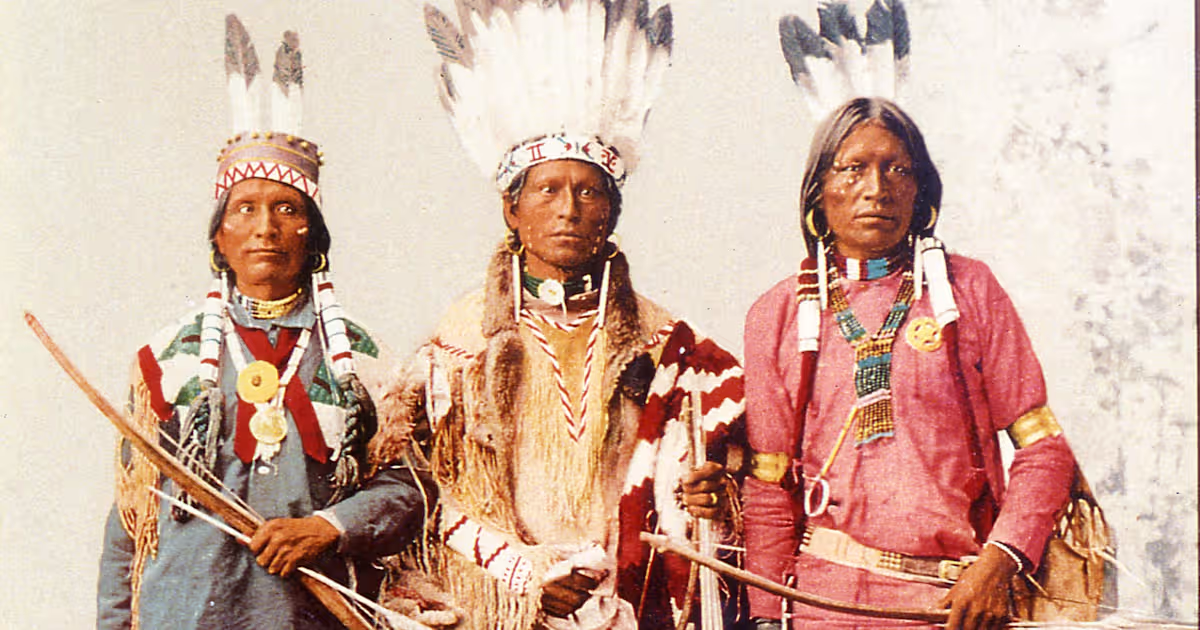
Long before highways divided the land and skyscrapers pierced the sky, before maps were drawn with straight lines and territories were claimed in unfamiliar names, this land carried different footsteps. It breathed in a rhythm shaped by drumbeats, ceremony, wind, and prayer. The story of Native Americans is not just a chapter in history—it is the foundation beneath it. It is a story of nations, not one people. A story of brilliance, resilience, heartbreak, survival, and unbreakable identity.
When people speak about Native America, they often reduce it to a single image: a feathered headdress, a tipi against a sunset, or a warrior on horseback. But the truth is far deeper and more powerful. Across this vast continent existed hundreds of sovereign nations, each with its own language, governance, spirituality, science, and social systems. From the desert Southwest to the Arctic North, from the Eastern woodlands to the Pacific Coast, civilizations thrived long before the word “America” was ever spoken.
In what is now called the Southwest, the ancestors of the Hopi Tribe and the Navajo Nation built complex societies rooted in harmony with the land. They engineered irrigation systems in dry climates and constructed dwellings from earth that blended into the landscape like living architecture. Corn was more than food—it was sacred. Each kernel represented life itself, a connection between earth and spirit.
Far to the east, the Iroquois Confederacy, known as the Haudenosaunee, formed one of the most sophisticated democratic systems in the world. Long before modern democracies claimed innovation, the Great Law of Peace guided nations in unity and collective decision-making. Clan mothers held immense political power, selecting and advising leaders. Governance was built on consensus, responsibility, and balance. Many historians acknowledge that this confederacy influenced early American political thought, though their contribution is rarely given the credit it deserves.
In the Great Plains, the arrival of horses transformed life in powerful ways. Nations like the Lakota adapted quickly, becoming skilled horsemen and buffalo hunters. The buffalo was not just an animal—it was survival. Every part of it was used: meat for nourishment, hides for clothing and shelter, bones for tools, sinew for thread. Nothing was wasted. Life revolved around respect—for nature, for community, for ancestors.
To the northwest, the Tlingit and other coastal peoples mastered the sea. They carved towering totem poles that told stories of lineage and spirit. Their cedar canoes sliced through water with grace and strength. Salmon runs were sacred cycles of abundance, carefully managed through knowledge passed down across generations.
Each nation carried wisdom specific to its environment. In the Arctic, the Inuit developed extraordinary survival skills in freezing climates. Igloos, often misunderstood, were engineering marvels of insulation. Hunting techniques required patience, precision, and deep respect for the animals that sustained life.
Yet despite their diversity, Native nations shared common values: interconnectedness, reciprocity, and a worldview that did not separate humans from the earth. The land was not property—it was relative. Rivers were not resources—they were lifelines. Mountains were not obstacles—they were ancestors watching over the people.
When European ships first appeared on the horizon, the world changed forever.
At first, contact was complex—sometimes cooperative, often cautious. Trade networks formed. Ideas were exchanged. But diseases carried across oceans devastated Indigenous populations at unimaginable scales. Entire villages disappeared before they ever saw the faces of those who brought the sickness. It was not merely tragedy—it was catastrophe.
As colonies expanded, land hunger grew. Treaties were signed and broken repeatedly. Native nations were pushed westward, removed from ancestral homelands that held sacred burial grounds and centuries of history. One of the darkest examples was the forced relocation known as the Trail of Tears. Thousands of Cherokee and other southeastern nations were marched under brutal conditions. Many died from disease, starvation, and exhaustion. Families were torn apart, yet culture endured.
In the Great Plains, resistance rose fiercely. Leaders emerged whose names still echo through history. Sitting Bull stood as a spiritual and political leader of the Lakota, guiding his people during times of immense pressure. Crazy Horse became legendary for his courage and refusal to surrender his identity. Their stand during battles such as Battle of the Little Bighorn symbolized the fight to protect land and life.
But warfare was only one part of the struggle. Perhaps even more damaging were assimilation policies designed to erase Native identity. Children were taken from their families and sent to boarding schools where they were forbidden to speak their languages or practice their traditions. Hair was cut. Names were changed. Spiritual ceremonies were outlawed. The goal was clear: “Kill the Indian, save the man.” Generations grew up disconnected from their roots, carrying trauma that still echoes today.
Yet despite every attempt to erase them, Native nations survived.
Languages once nearly silenced are now being revitalized. Young people are learning ancestral words and songs. Elders share stories that were once whispered in secrecy. Cultural gatherings like powwows celebrate dance, regalia, and drum circles that bring communities together in pride rather than fear.
In the twentieth century, activism reshaped the narrative. Organizations like the American Indian Movement demanded sovereignty, treaty rights, and justice. The occupation of Alcatraz Island in 1969 drew global attention to Indigenous struggles. It was a declaration: Native people were not relics of the past—they were present, political, and powerful.
Today, Native Americans continue to lead in fields ranging from environmental protection to art, law, medicine, and technology. Many tribal nations operate their own governments, courts, and educational systems. Sovereignty remains a central principle. Tribal lands are not simply territories—they are self-governing nations within a nation.
Environmental leadership has become especially significant. Indigenous communities have long practiced sustainable land management rooted in balance. In recent years, Native activists have stood at the forefront of movements to protect water and sacred lands. The defense of water at Standing Rock brought international awareness to the power of Indigenous unity and environmental justice.
Artistic expression continues to thrive. Native filmmakers tell stories from within, reclaiming narratives long distorted by Hollywood. Authors write novels blending tradition and contemporary life. Musicians combine ancestral rhythms with modern soundscapes. The image of Native America is no longer confined to old Western films—it is dynamic, urban, and evolving.
Spiritual traditions, once banned, are practiced openly again. Sweat lodges, sun dances, and seasonal ceremonies reconnect communities to their ancestors. These are not performances for outsiders; they are living faiths, carried with dignity and care.
Perhaps the most powerful truth about Native America is this: survival itself is resistance. To exist after centuries of displacement, disease, forced assimilation, and systemic discrimination is an act of strength beyond measure.
The story does not end in tragedy. It continues in resilience.
Across reservations and cities, Native youth are reclaiming identity with pride. College programs in Indigenous studies are growing. Language immersion schools are helping children speak the words of their grandparents. Digital platforms allow artists and educators to share culture on their own terms.
There are still challenges—poverty, healthcare disparities, underfunded schools, and legal battles over land and water rights. But there is also determination. Tribal courts fight for justice. Cultural leaders protect sacred sites. Families pass down traditions around kitchen tables and ceremonial fires.
When we truly listen to Native America, we hear something profound: a worldview centered not on dominance, but on relationship. A philosophy where future generations matter as much as present gain. A reminder that humanity is strongest when it respects the earth rather than exploits it.
Imagine if more of the world embraced that principle.
The drumbeat that once echoed across plains still sounds today—not as an echo of the past, but as a pulse of the present. It carries memory. It carries grief. It carries joy and pride and defiance.
Before borders, there were nations.
Before cities, there were civilizations.
Before textbooks simplified the story, there were countless voices.
Those voices are still here.
Native America is not history.
It is living.
It is breathing.
It is rising.
And its story—one of endurance, sovereignty, and unbreakable spirit—continues to shape the land we stand on today.