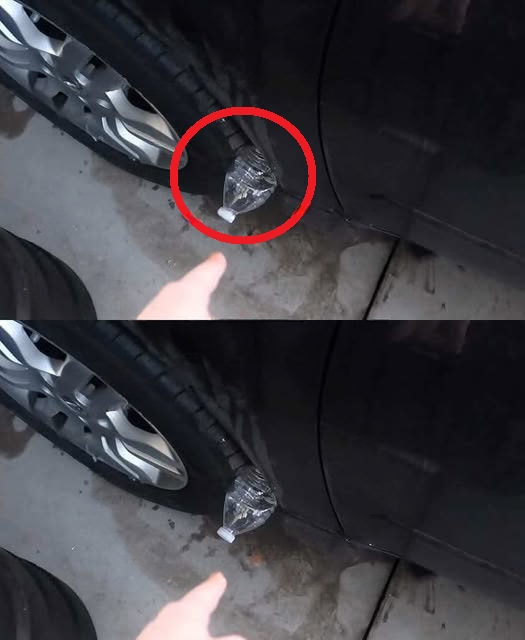
It looks like something harmless at first.
A plastic bottle.
Maybe it rolled out of a shopping bag, maybe a passerby tossed it there without thinking. Most people would barely register it—until they notice where it is.
Wedged against a tire.
That’s when curiosity kicks in. And sometimes, so does fear.
Online, this idea has spread widely: that a plastic bottle placed on a car tire could be a signal used by thieves. The theory sounds dramatic, even cinematic, but it’s rooted in a real concern—how small, unnoticed cues can be used to create moments of distraction and vulnerability.
So what’s actually going on here?
The Theory Behind the “Bottle on Tire” Trick
The most common explanation shared in viral posts is this:
A thief places an empty plastic bottle between a car’s wheel well and tire—usually on the passenger side, where it’s less visible to the driver.
When the driver starts the car and begins moving, the bottle gets crushed. That produces a loud cracking or crunching sound.
Naturally, the driver thinks something is wrong.
A mechanical issue. A piece of debris. A possible tire failure.
So they stop the car.
And that brief pause—especially if the driver exits the vehicle without locking it—is where the perceived risk comes in. The idea is that an opportunist could take advantage of that moment of distraction.
It’s a simple concept: create confusion, then rely on human instinct to investigate.
But How Real Is This Risk?
Here’s where things become less sensational.
There is no widespread evidence from law enforcement agencies that this is a common or established method of car theft. It exists more as an online cautionary tale than a documented, repeatable crime pattern.
That doesn’t mean it’s impossible. It just means it’s not something most police departments list as a standard threat.
In real-world vehicle theft, criminals tend to rely on more predictable methods: unlocked doors, keyless entry relay attacks, stolen keys, or targeting vehicles left running unattended.
The “bottle on tire” scenario is better understood as part of a broader category of advice stories—warnings that spread because they feel plausible, not because they are frequently verified.
And that distinction matters.
Why Stories Like This Spread So Quickly
Even if the exact scenario is rare, the emotional logic behind it is powerful.
It plays on three things:
First, the fear of distraction. People know how easy it is to react quickly without thinking.
Second, the vulnerability of routine. Getting into a car is something most people do on autopilot, often while multitasking or rushing.
Third, the idea of invisible risk. Something small and ordinary—like a plastic bottle—suddenly becomes suspicious.
That combination makes the story memorable. It sticks.
And in the age of social media, anything memorable spreads fast, whether it’s fully verified or not.
What You Should Actually Do If You See Something Unusual
Even if the specific “bottle trick” isn’t a confirmed widespread tactic, the general safety advice still has value—because it encourages awareness.
If you ever notice an unusual object near your tire or under your vehicle, the key is not panic. It’s observation.
Before reacting, take a moment to look around your environment. Are you in a busy area or an isolated one? Do you feel like you’re being watched or rushed? Is anything else out of place?
If something feels off, it’s perfectly reasonable to delay stepping out immediately.
You can also check your surroundings from inside the car first. Many modern situations don’t require immediate physical inspection at all.
And if you do decide to exit, the safest habit is simple: keep your keys with you and your door secured whenever possible.
The Real Safety Lesson Behind the Story
Stripped of the viral framing, this idea isn’t really about plastic bottles.
It’s about situational awareness.
Most opportunistic crimes don’t rely on complex schemes. They rely on distraction, routine behavior, and moments when people assume everything is fine.
That’s why safety advice often focuses less on specific tricks and more on general habits:
Lock your doors.
Stay aware of your surroundings.
Avoid stepping away from your vehicle unnecessarily in uncertain situations.
Trust your instincts if something feels unusual.
These aren’t dramatic precautions—they’re just small, practical habits that reduce risk across many different scenarios.
Separating Fear From Usefulness
The problem with viral warnings like this is not that they’re entirely useless. It’s that they often blur the line between possibility and probability.
Yes, someone could theoretically use a distraction to create a moment of vulnerability.
But that doesn’t mean every unusual object is part of a coordinated threat.
Sometimes a bottle is just a bottle.
Still, the reason these stories resonate is because they push us to notice things we normally ignore. In that sense, they can make people more observant drivers and more cautious in unfamiliar situations.
The challenge is keeping that awareness grounded in reality, not fear.
Final Thought
If you ever see a plastic bottle near your tire, the most likely explanation is simple: it’s trash, or it got caught there accidentally.
But the broader takeaway is still useful.
Not everything unusual is dangerous—but paying attention before reacting is never a bad habit.
Awareness doesn’t mean assuming the worst.
It just means giving yourself an extra second to understand the situation before you respond.
And sometimes, that single second is the difference between panic and clarity.