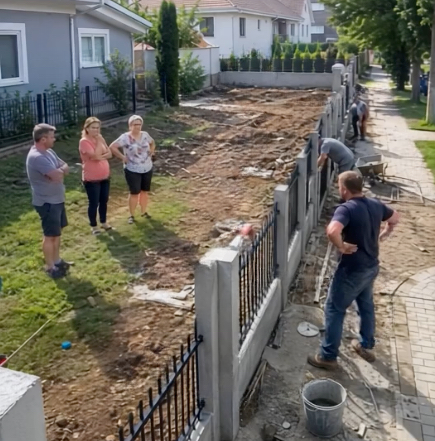
They cut across the corner of my yard in a shallow arc, fresh enough to still darken the grass. The same corner where the Carters had once insisted the “shared space” should begin. The same corner I had already made legally, clearly, and permanently mine.
Daisy stood beside me on the porch, ears perked, watching the yard like she understood something had shifted.
I walked down the steps slowly, following the marks. They didn’t just cross the grass—they ended abruptly at the edge of the new fence line, where the ground had been reinforced during construction. Not decorative reinforcement. Not aesthetic. Structural. The kind of work you don’t notice until you need it to hold.
Someone had tried to drive over it anyway.
That evening, I called the surveyor who had originally staked the property. He came out within the week, walked the perimeter, and confirmed what I already knew: every inch of that fence sat exactly where it was supposed to. The Carters’ “shortcut,” their “access idea,” their entire shared-backyard fantasy—it had never been anything but assumption.
Still, I asked him to document everything again.
Ethan showed up while we were standing there.
He didn’t say hello. He didn’t even pretend this was casual anymore.
“You really brought him back out here?” he asked, arms crossed.
“I didn’t need to,” I said. “You already knew where the line was.”
Mara appeared behind him, quieter this time, her expression tighter than before. She looked at the surveyor, then at the fence, then at me.
“We thought it wouldn’t matter a few feet,” she said.
“That’s how it always starts,” I replied.
The surveyor finished his notes, gave a polite nod, and left us standing in the kind of silence that isn’t peaceful—it’s final.
For a few days after that, nothing happened. No more tire tracks. No footsteps cutting corners. Even the neighborhood seemed to exhale a little, as if waiting to see which version of the story would win: the one where people respected boundaries, or the one where they kept testing them.
Then the city inspector arrived.
He walked the property with a clipboard, stopped at the reinforced section, and knelt to inspect the ground. I stood back and let him work.
“Interesting work here,” he said finally.
“I wanted it secure,” I replied.
He nodded once. “It is. Whoever designed this didn’t want any encroachment.”
That was all he said, but it was enough.
The following afternoon, the Carters got their notice.
I didn’t see the exact contents, but I saw Ethan read it from my porch. Watched the color drain from his face in real time. Mara stood beside him, her hand covering her mouth as she scanned the page.
Ethan looked up at me then, something between disbelief and anger flickering in his eyes.
“You reported us?”
“I didn’t report you,” I said calmly. “I documented what was happening on my property. That’s all.”
He took a step forward, then stopped himself. Like he’d finally realized stepping forward didn’t mean anything anymore.
Mara exhaled sharply. “We didn’t mean for it to go this far.”
“It never does,” I said again.
The inspector returned two days later with a second notice. This one required correction—grading changes on their side of the property where repeated encroachment had caused erosion concerns. Nothing dramatic. Nothing theatrical. Just paperwork turning into reality.
Concrete doesn’t move. Soil does. Rules do. People sometimes don’t until they have to.
By the end of the week, contractors arrived—not on my land this time, but theirs. I watched from my porch as stakes went up on the Carters’ side, marking where their yard would need to be reworked to prevent further runoff toward my fence.
Ethan stood outside during the entire process, hands in his pockets, saying nothing.
For the first time since they moved in, he wasn’t trying to expand anything.
Mara didn’t approach me again, but one evening she left a small wooden planter near the edge of their property line. It sat carefully placed, not crossing over, not testing anything. Just existing where it was allowed to exist.
A quiet acknowledgment without words.
Weeks passed.
The yard settled into itself again—no tension in the grass, no questions in the soil. Daisy stopped watching the fence like it was a battlefield and started treating it like what it had always been: just a boundary.
One morning, Ethan walked over alone.
He stopped at the edge of the fence and didn’t step closer.
“I was wrong,” he said, bluntly.
I didn’t respond immediately. I didn’t need to.
He nodded once, like he understood that too.
“I thought open space meant shared space,” he added. “I didn’t think about what it meant for you.”
“That’s the difference,” I said. “You thought about what you wanted it to be.”
He looked down, then back up. “We’ll stay on our side.”
“I know,” I said.
And this time, it wasn’t a threat or a warning. It was simply true.
When he turned to leave, there was no drama in it. No final confrontation. No victory speech.
Just distance.
That night, I sat on the porch again while the sun dropped behind the trees. The fence cast a long shadow across the yard—sharp, clean, unbroken.
Daisy rested her head on my foot.
For the first time in a long while, nothing in the yard felt like it was waiting to be claimed.