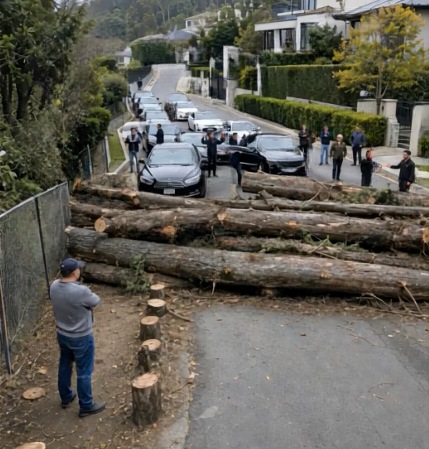
There’s a particular kind of silence that follows destruction—not peaceful silence, but the kind that feels wrong. Heavy. Displaced. I stood in it that morning, staring at the jagged stumps where my sycamores used to be, and felt something in me shift in a way I couldn’t immediately name.
Those trees weren’t decoration. They weren’t landscaping. They were memory.
My father planted the first of them when I was still small enough to believe the world was permanent. Over the years, they grew into a living boundary between my land and everything beyond it—towering, steady, familiar. They marked seasons, weathered storms, and held decades of life within their branches.
Now they were gone.
Just sawdust and silence.
Mara stood beside me, close enough that I could feel her presence without needing to look at her. She didn’t speak at first. She just took in the scene the way I did, as if words would cheapen what had already been done.
Finally, she said, “This wasn’t carelessness. This was deliberate.”
I let out a slow breath. “They wanted a better view.”
She scoffed softly. “They always do.”
The “they” was Cedar Ridge Estates—a gated community that had expanded over the last few years until it pressed right up against my property line. Expensive homes, manicured lawns, and a constant quiet expectation that the world around them should adjust itself for their comfort.
Apparently, my trees had been in the way.
And someone decided that was enough justification.
What made it worse wasn’t just the loss—it was the assumption behind it. That my land, my history, my boundaries were negotiable if someone wanted something badly enough.
I walked slowly between the stumps, my boots crunching against scattered wood chips. Each one felt like a sentence cut short. Each ring in the wood a year I could no longer point to.
Mara followed me. “What are you thinking?” she asked carefully.
I didn’t answer right away.
Because I was already thinking about the road.
It cut through my property in a narrow strip—an access road the original developers had negotiated years ago when the land was divided. It served only Cedar Ridge Estates now. No public utility. No shared necessity. Just convenience.
Convenience built on my land.
They had forgotten that detail. Or assumed I would never act on it.
That was their second mistake.
By the time we reached the house, my decision was already forming into something solid.
“I want the survey maps,” I said.
Mara nodded immediately. She knew that tone.
Within hours, I had everything confirmed: the deed, the easements, the exact boundaries. Every line clear. Every right intact. There was no ambiguity—just assumptions on their side and ownership on mine.
That evening, I made the calls.
Not angry calls. Not emotional ones.
Practical ones.
Fence installation. Heavy gates. Legal notices. Security signage. The kind of infrastructure that doesn’t ask permission—it establishes reality.
By the next morning, work had begun.
And by the end of the week, the only road into Cedar Ridge Estates no longer functioned as an invitation. It functioned as a wall.
The reaction was immediate.
Voicemails first. Then emails. Then a visit from the HOA president himself—arriving in a car too clean for the dirt he was about to step into.
He spoke quickly, sharply, trying to frame it as a misunderstanding. A disruption. An inconvenience.
I listened quietly until he finished.
Then I said, “You cut down my trees.”
He hesitated. “That was… landscaping decisions made by—”
“No,” I interrupted. “Those were not your decisions to make.”
Silence settled between us. Real silence this time.
Not the kind left by destruction.
The kind left by realization.
He tried again, softer now. “We can discuss compensation.”
I shook my head. “You don’t compensate history. And you don’t replace what you didn’t have the right to take.”
That was the end of the conversation.
Not because I raised my voice.
Because I didn’t need to.
In the days that followed, the story spread through nearby communities in the way these things always do—half fact, half rumor, sharpened by repetition. Some called it revenge. Others called it justice. Most simply called it what it was: a line being drawn where one had been ignored.
Eventually, Cedar Ridge came back with lawyers.
This time, I met them on neutral ground.
They came prepared for negotiation.
I came prepared for confirmation.
The easement was real. The ownership was indisputable. The access they depended on existed only at my discretion.
And discretion, I explained calmly, had limits.
The meeting ended without resolution. But something more important had already happened: the certainty that they could not simply undo what they had done with apologies and assumptions.
Weeks passed.
The road remained closed.
The development adjusted—reluctantly, unevenly. Deliveries rerouted. Access reconfigured. Inconvenience absorbed where entitlement once lived comfortably.
And on my land, something quieter began to return.
Not the sycamores.
Those were gone.
But something else.
Boundaries.
Every time I walked the property now, I could feel them—not as fences or signs, but as clarity. A reminder that land is not just space. It is memory. And memory, once violated, demands acknowledgment.
Mara joined me one evening as the sun dropped low behind the remaining trees.
“They’ll talk about this for a long time,” she said.
“Let them,” I replied.
She looked at me. “Do you regret it?”
I thought about the stumps. About my father. About the silence that followed.
“No,” I said. “I regret what they did. I just made sure it had consequences.”
The wind moved through the property differently now. Not less alive—just more honest.
And the road stayed closed.
Not out of spite.
But out of certainty.
Some things, once taken, cannot simply be negotiated back into place.
And some lines, once crossed, redraw everything that follows.