The first time I noticed something was wrong with our elderly neighbor, it was because my six-year-old son refused to stop asking questions.
“Why doesn’t Miss Adele turn her porch light on anymore?”
I barely looked up from the dishes.
“Maybe she forgot, sweetheart.”
But Oliver kept staring through the kitchen window toward the small blue house next door.
“She always turns it on.”
He was right. Every evening around sunset, Adele’s porch glowed warmly like clockwork. She had lived beside us for years, and despite her age, she remained fiercely independent. She baked cookies for neighborhood children, watered flowers even during heatwaves, and somehow remembered every birthday on the block.
But lately, things had changed.
The flowers had wilted.
The curtains stayed closed.
And now the porch light remained dark.
At the time, I convinced myself it was nothing serious. People slow down as they get older. Maybe she was tired. Maybe she simply wanted privacy.
Life was busy, and busy people become experts at explaining away discomfort.
Oliver, however, had not yet learned how to ignore what felt wrong.
That evening, while I packed his school lunch for the next day, he quietly disappeared into his bedroom. A few minutes later, he returned dragging his dinosaur-shaped piggy bank across the floor.
“I want to help Miss Adele,” he announced.
I smiled distractedly. “That’s sweet, honey.”
He shook the bank.
Coins rattled loudly inside.
“She needs it more than me.”
Children say things with a clarity adults spend years losing.
The next afternoon, Oliver marched next door holding every dollar he had saved from birthdays, chores, and loose change collected from couch cushions.
I followed behind him, embarrassed but curious.
Adele answered after a long pause. She looked thinner than usual, wrapped in a faded sweater despite the warm weather.
Oliver held out the piggy bank with both hands.
“You can borrow this,” he said seriously. “You don’t even have to pay me back fast.”
At first, Adele looked confused.
Then her eyes filled with tears.
“Oh, sweetheart…”
That was when I noticed the folded notice sitting on the table behind her.
FINAL DISCONNECT WARNING.
My stomach dropped.
The electricity company logo sat clearly across the top.
Suddenly the dark porch made sense.
So did the unopened blinds.
And the silence.
I apologized repeatedly, embarrassed that my child had walked directly into something so personal. But Adele simply shook her head.
“It’s alright,” she whispered. “I was figuring it out.”
Still, the drive home felt heavy.
That night, Oliver asked if Adele would be okay now.
I told him yes.
But honestly, I wasn’t sure.
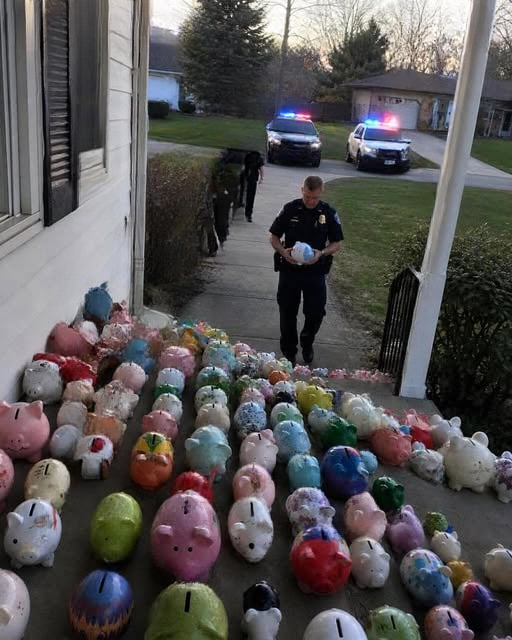
The next morning, I woke up to flashing lights outside our house.
For one terrifying second, I thought something terrible had happened.
Patrol cars lined the street.
Neighbors stood in clusters across the sidewalk.
And scattered all over our front yard were piggy banks.
Dozens of them.
Ceramic pigs.
Glass jars.
Coffee cans filled with coins.
Plastic treasure chests.
Some had notes taped to them.
“For Adele.”
“From the Martinez family.”
“She helped my mom when I was little.”
“Thank you for feeding us after Dad lost his job.”
I stood frozen in the doorway while Oliver pressed his face against the screen.
“Mom… what happened?”
One of the officers approached us gently, smiling.
Apparently, after Oliver visited Adele, she mentioned the encounter to a cashier at the grocery store. The cashier told someone else. By evening, the story had spread across town through text messages, social media posts, and neighborhood groups.
And suddenly everyone remembered Adele.
People remembered free babysitting.
Soup deliveries during illnesses.
Birthday cakes left quietly on porches.
School clothes purchased anonymously for struggling families.
For years, Adele had helped people privately, never asking for recognition.
Now an entire community was realizing how much they owed her.
The patrol cars weren’t there because of danger.
The officers had shown up to help organize traffic after donations overwhelmed the street.
One patrol officer carried grocery bags to Adele’s porch.
Another unloaded blankets and supplies from a pickup truck.
A local electrician volunteered to restore her utilities free of charge.
Someone else paid several months of her bills anonymously.
By midmorning, reporters had started arriving.
But the moment that stayed with me had nothing to do with cameras.
It happened quietly.
I watched Oliver walk over to Adele holding her hand carefully as neighbors continued dropping off donations around them.
“See?” he told her proudly. “I said people would help.”
Adele laughed softly through tears.
“You were the first one who noticed I needed it.”
That sentence hit harder than anything else that day.
Because she was right.
An entire neighborhood had passed her dark house for weeks.
We all saw it.
But seeing is different from noticing.
Adults become skilled at looking away from uncomfortable things. We assume someone else will step in. Someone else will call. Someone else will care.
Meanwhile, a six-year-old boy saw a dark porch and understood immediately that something was wrong.
No complicated reasoning.
No hesitation.
Just compassion.
As more people arrived throughout the day, stories about Adele spread everywhere.
One man revealed she used to secretly buy lunches for children at the elementary school.
Another woman said Adele sat with her mother during chemotherapy appointments years earlier.
A firefighter admitted Adele regularly dropped homemade cookies at the station every Christmas.
The gifts piling across our yard became more than donations.
They became confessions.
Each one seemed to say the same thing:
“You mattered to me, even if I forgot to say it.”
By afternoon, the power company reversed the shut-off completely.
A local restaurant offered Adele free meals for a year.
Teenagers volunteered to maintain her yard.
And somehow, through all of it, Oliver remained confused about why everyone seemed so emotional.
“We just helped our neighbor,” he whispered to me.
Exactly.
That was the whole point.
Children understand community naturally until adults teach them suspicion, distance, and excuses.
That evening, after the crowd finally thinned, I tucked Oliver into bed and asked why helping Adele felt so important to him.
He looked at me like the answer was obvious.
“Because she was alone.”
Simple.
Honest.
Enough.
Lying awake later that night, I realized what unsettled me most about the entire experience.
It wasn’t Adele’s financial struggle.
It wasn’t the overdue bills.
It was how easily all of us had accepted silence as normal.
We had confused independence with invisibility.
But Oliver hadn’t.
A dark porch light bothered him because he still believed neighbors should notice one another.
And maybe that belief saved someone.
By the end of the week, Adele’s porch glowed warmly again every evening.
But something else had changed too.
Neighbors stopped rushing past each other.
People checked in more often.
Meals appeared unexpectedly on doorsteps.
Conversations lasted longer.
Kindness spread faster than gossip ever could.
All because one little boy emptied his piggy bank without stopping to calculate whether it would make a difference.
In the end, Oliver’s savings didn’t solve Adele’s problems alone.
But they reminded an entire town what compassion looks like before fear, pride, and busyness bury it.
And honestly, I think we all needed that reminder.